Virgin PTFE and PFA are chemically clean fluoropolymers, while filled PTFE compounds are composites. Virgin PTFE is a linear homopolymer of tetrafluoroethylene, and PFA is a melt-processible copolymer containing perfluoroalkoxy side groups. Filled PTFE adds materials such as carbon, graphite, glass fiber, or metal oxides and sulfides to improve mechanical or tribological performance, but those additives introduce additional contamination and recycling considerations in high-purity laboratory applications.
For trace-sensitive laboratory work, virgin PTFE or PFA is generally preferred because its composition is controlled and free from intentionally added fillers. Filled PTFE can provide better wear resistance, stiffness, or dimensional stability, but it is not equivalent to an unfilled high-purity grade in either chemical cleanliness or recycling behavior.
How the Material Structures Differ
Virgin PTFE: A Fluorine-Sheathed Homopolymer
PTFE consists of repeating tetrafluoroethylene units in a linear carbon-fluorine backbone. The fluorine sheath gives the polymer exceptional chemical resistance, low surface energy, thermal stability, and low friction.
Standard PTFE has extremely high melt viscosity. It generally cannot be processed like a conventional thermoplastic, so manufacturers typically use compression molding, sintering, ram extrusion, or machining.
Virgin PFA: A Modified, Melt-Processible Fluoropolymer
PFA retains the chemically resistant PTFE-like backbone but incorporates perfluoroalkoxy side groups. These side groups reduce crystallinity and lower the melting range to approximately 305-310 °C, allowing PFA to melt-flow during injection, blow, and other thermoplastic processes.
This structure supports the manufacture of complex, smooth, and translucent laboratory components with fewer machining steps. PFA is commonly selected for high-purity vessels, tubing, fittings, and fluid-handling components where low extractables and low permeation are important.
Filled PTFE: A Polymer Matrix With Secondary Phases
Filled PTFE is not a chemically modified version of pure PTFE alone. It is a composite in which the PTFE matrix contains a dispersed filler or combination of fillers.
Carbon and graphite can improve wear resistance and reduce deformation. Glass fiber can increase stiffness and dimensional stability, while mineral or metal-containing additives can modify hardness, thermal behavior, or tribological performance.
The filler remains a distinct material phase rather than becoming part of the PTFE molecular chain. This distinction explains both the performance benefits and the added purity and recycling risks.
Why Purity Matters in Laboratory Applications
Virgin Status Controls Material History
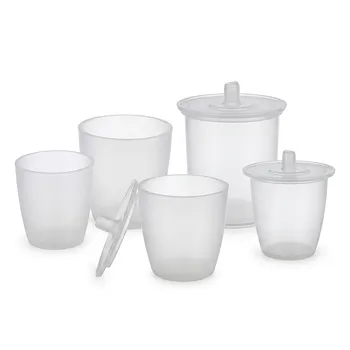
Virgin resin has not previously been preformed, sintered, used, or exposed to processing contaminants. Its controlled starting composition makes it suitable for applications such as trace-analysis vessels, digestion tubes, storage bottles, crucibles, and custom-machined electrochemical cells.
“Virgin” describes the material’s processing history, not a unique molecular structure. A virgin PTFE article and a virgin PFA article therefore differ structurally, but both are manufactured from controlled, unused resin.
Filled Compounds Add Potential Contaminants
Filled PTFE cannot provide the same purity profile as unfilled virgin PTFE or PFA when its additives are unsuitable for the application. Fillers may introduce elements that can leach, shed, or become exposed at a machined or worn surface.
This is especially important when analyzing trace metals, ions, or other species at very low concentrations. Even when the PTFE matrix itself remains chemically inert, the filler phase can compromise sample integrity.
Surface Quality Also Affects Sample Integrity
PFA can be molded into smooth, void-free components with low surface roughness and low extractables. Its non-wetting surface can also reduce sorption and residue retention.
PTFE remains valuable where machining flexibility, high-temperature performance, and flex-fatigue resistance are more important. However, machined PTFE and molded PFA should be evaluated for surface condition, porosity, extractables, and application-specific contamination controls rather than treated as interchangeable materials.
How Recycling Differs
Conventional PTFE Recycling Is Mainly Physical
Traditional PTFE recycling generally involves collecting clean scrap, such as machining turnings or off-specification preforms, and grinding it into powder or micropowder. The material is reused without converting the polymer back into its original monomers.
This route is most practical for unfilled PTFE, where the recovered powder has a relatively consistent composition. Recycled or reprocessed material may be suitable for less demanding mechanical products or fluorinated micropowders, but it should not automatically be treated as equivalent to virgin resin.
Reprocessed PTFE Has Different Properties
Thermal or chemical re-treatment can reduce PTFE molecular weight. Compared with virgin PTFE, reprocessed material may exhibit lower tensile strength, elongation, and impact strength, along with a lower melting point.
Visible signs can include higher specific gravity, off-white discoloration, or uneven surface appearance. Although the material can retain chemical insolubility, non-flammability, and low friction, those properties do not establish high-purity suitability.
Filled PTFE Is Harder to Reprocess Conventionally
Grinding a filled PTFE compound produces a powder that still contains the original filler. It does not restore the material to unfilled PTFE, and the filler may be unevenly distributed after processing.
The recovered compound can also contain mixed or unknown additive levels, wear debris, processing residues, or contamination from the previous application. For critical laboratory components, this uncertainty is a significant disadvantage.
Advanced HTC Can Treat Both Polymer Types
High-Temperature Conversion, or HTC, can pyrolyze both filled and unfilled fluoropolymers and recover fluorinated monomer building blocks such as tetrafluoroethylene (TFE) and hexafluoropropylene (HFP). The primary reference identifies reported yields above 80% under suitable process conditions.
This is fundamentally different from grinding and reusing scrap. HTC is a chemical recycling route that breaks down the fluoropolymer rather than preserving the original article or powder.
The polymer portion can be converted into feedstock for new fluoropolymer production, but inorganic fillers do not become TFE or HFP. They remain as residual solids or require separate downstream handling and separation.
Understanding the Trade-offs
Purity Versus Mechanical Performance
Unfilled virgin PTFE and PFA minimize the risk of elemental contamination and are the appropriate starting points for trace-sensitive work. Filled PTFE can outperform unfilled grades in wear, stiffness, creep resistance, or dimensional stability.
The choice therefore depends on whether analytical cleanliness or mechanical durability is the controlling requirement. In a high-purity fluid path, a mechanically stronger filled grade may still be unacceptable if its additives can affect the sample.
Recyclability Versus Material Consistency
Unfilled scrap is comparatively straightforward to identify, grind, and reuse. Filled scrap requires accurate knowledge of the filler type, concentration, prior service exposure, and contamination history.
Chemical recycling can broaden the range of fluoropolymer waste that is recoverable, but it requires specialized high-temperature equipment and does not eliminate the need to manage non-fluoropolymer fillers.
PTFE Versus PFA Processing
PTFE usually requires compression molding, sintering, or machining, which can create more manufacturing scrap for complex geometries. PFA can be injection molded into intricate shapes and can reduce secondary machining and associated waste.
That process advantage does not mean PFA is always mechanically superior. PTFE generally offers excellent flex-fatigue performance, while PFA is often preferred for smooth, molded, low-extractable components and high-purity fluid distribution.
“Recycled” Does Not Mean “Contaminant-Free”
Recycled PTFE may be physically reused scrap, while reprocessed PTFE has undergone additional thermal or chemical treatment. Neither designation guarantees the controlled composition, trace cleanliness, or mechanical consistency expected from virgin resin.
For laboratory use, the material certificate, manufacturing history, cleaning process, extractables data, and intended fluid-contact specification matter more than the label alone.
Making the Right Choice for Your Goal
Use the application’s contamination tolerance, mechanical load, manufacturing method, and end-of-life requirements together when selecting the material.
- If your primary focus is trace purity: Use certified virgin PTFE or PFA, with PFA favored for smooth molded components and PTFE suited to machined parts where its processing and flex-fatigue advantages are valuable.
- If your primary focus is wear or dimensional stability: Consider a filled PTFE compound only after confirming that its additives cannot contaminate the process fluid or analytical sample.
- If your primary focus is conventional material reuse: Favor clean, well-characterized unfilled PTFE scrap, recognizing that recycled or reprocessed resin is not automatically equivalent to virgin grade.
- If your primary focus is recovering fluoropolymer feedstock: Evaluate HTC or another qualified chemical-recycling process for both filled and unfilled waste, with separate management of residual fillers.
- If your primary focus is complex molded laboratory hardware: Evaluate virgin PFA because melt processing can produce smooth, intricate, and low-permeation components with less secondary machining.
The reliable principle is simple: use virgin unfilled PTFE or PFA when sample integrity is paramount, and use filled compounds only when their performance benefits clearly justify their added purity and recycling constraints.
Summary Table:
| Feature | Virgin PTFE | Virgin PFA | Filled PTFE |
|---|---|---|---|
| Composition | Pure PTFE homopolymer | Copolymer with perfluoroalkoxy groups | PTFE matrix with fillers (e.g., carbon, glass) |
| Purity | High | High | Lower (fillers can contaminate) |
| Processing | Compression molding, sintering, machining | Melt-processible (injection molding) | Same as PTFE, but fillers affect machining |
| Recyclability | Can be ground and reused (physical) | Melt recycling possible (if clean) | Difficult (fillers complicate grinding) |
| Common Lab Uses | Machined parts, high-temp applications | Molded vessels, tubing, fittings | Wear-resistant components, but rarely for trace analysis |
Need high-purity PTFE or PFA labware? At KINTEK, we specialize in custom-machined fluoropolymer components for trace analysis, from digestion vessels to fluid-handling systems. Our virgin PTFE/PFA materials ensure minimal contamination. Contact us today to discuss your requirements and receive a tailored solution.
Related Products
- High Purity PFA Crucible and Corrosion Resistant PTFE Beaker for Trace Analysis and Custom Laboratory Applications
- PTFE PFA Vacuum Filtration System Corrosion Resistant Customizable Shatterproof Laboratory Device
- High Purity PTFE Filter with PFA Valve Connections and Integrated Sieve Plate for Corrosive Fluid Processing
- PTFE Corrosion Resistant Filter with PFA Valve Connections and Integrated Sieve Plate
- High Purity PFA Coiled Tubing Custom PTFE Machining PFA Welding and Precision Bending Solutions
People Also Ask
- Why are high-purity vessels critical for BiFeO3 synthesis? Ensuring Phase Purity
- Why is the use of high-purity PFA or PTFE labware critical during TiO2 nanoparticle purification? Protect Sample Purity
- Why is high-purity PFA trace analysis labware used for MXene? Ensure Superior Material Integrity in Research
- Why is high-purity PFA labware necessary for Znx@LS-2 zeolite ICP-OES analysis? Ensure Trace-Level Precision
- Why is high-purity PFA trace analysis labware used for sample processing when preparing Mo2CTx@MoS2? Ensure Material Purity