For precise ePTFE film width reduction, grooved roll slitting is generally the stronger choice than air cutting. Air cutting uses a razor blade without continuous backing beneath the film, which can produce lower cutting precision and wider tolerance variation. Grooved roll slitting supports the film as it wraps over a grooved roll, enabling hollow or tapered razor blades to make cleaner cuts with minimal abrasion and widths down to the sub-millimeter range.
Grooved roll slitting improves dimensional control because the film is continuously supported during cutting. After slitting, edge folding or twisting helps prevent thin ePTFE strands from fraying or fibrillating during handling and later processing.
Why Cutting Support Matters for ePTFE Films
The limitation of air cutting
In air cutting, the ePTFE film is cut without continuous backing immediately beneath the cut line. The unsupported material can move or deform as the razor engages it, contributing to less consistent widths and greater tolerance variation.
The issue is particularly important when the target width is narrow or the film must maintain a clean, uniform edge through subsequent operations.
How grooved roll slitting supports the film
With grooved roll slitting, the film wraps over a grooved roll while the blade enters the material at the supported cutting zone. This backing stabilizes the film throughout the cut.
The roll geometry also provides a defined path for the blade, helping the process maintain a more consistent slit width than unsupported air cutting.
Why Blade Geometry Influences Cut Quality
Hollow and tapered razor blades
Grooved roll slitting can use hollow or tapered razor blades designed to cut the ePTFE cleanly. These blade profiles help limit the amount of blade surface rubbing against the film.
Reduced blade-to-film abrasion is important because ePTFE can form thin strands or fibrillated material when the edge is dragged, rather than cleanly severed.
Smooth, narrow slits
The combination of continuous film support and suitable blade geometry allows grooved roll slitting to produce smooth, high-precision cuts. The method is capable of reducing film to sub-millimeter widths when the process is properly controlled.
Air cutting may still be suitable where width precision and edge quality are less demanding, but it is less suited to applications that require tight dimensional consistency.
How Edge Fraying Is Prevented
Why fraying occurs after slitting
A freshly slit ePTFE edge can contain thin strands that may separate or fibrillate during handling, winding, or downstream processing. A clean initial cut improves the edge, but it does not by itself guarantee that the edge will remain structurally uniform.
Edge management after slitting is therefore part of the overall process rather than an optional cosmetic step.
Edge folding
Folding the slit edge brings loose strands into a more consolidated structure. This improves edge uniformity and helps reduce the opportunity for individual strands to catch, separate, or spread during handling.
Edge twisting
Twisting similarly consolidates thin ePTFE strands along the edge. It can improve structural uniformity and contribute to greater overall tensile strength in the handled or processed film structure.
Matching the treatment to the process
The appropriate post-slitting treatment depends on how the film will be handled and processed afterward. The objective is consistent in both cases: stabilize the slit edge so that the thin strands do not progressively fibrillate.
Understanding the Trade-offs
Precision versus process simplicity
Air cutting does not provide the same continuous backing as grooved roll slitting, so it generally carries a higher risk of width variation and less precise edges. Grooved roll slitting requires a grooved support roll and compatible blade setup, but those elements provide the control needed for narrow, consistent slits.
A clean cut is not the whole solution
Even a smooth slit can develop fraying if the edge is exposed to subsequent handling that pulls or separates the ePTFE strands. Post-slitting folding or twisting should therefore be considered when edge integrity is important throughout the production sequence.
Narrow widths increase sensitivity
As the target width decreases, small changes in film position, blade engagement, or edge behavior have a larger effect on the final result. Continuous support becomes increasingly valuable for sub-millimeter width reduction.
Making the Right Choice for Your Goal
Choose the cutting method and edge treatment according to the performance required after slitting.
- If your primary focus is maximum width precision: Use grooved roll slitting because continuous film support reduces tolerance variation and enables clean, sub-millimeter cuts.
- If your primary focus is minimizing edge abrasion: Use a suitable hollow or tapered razor blade in the grooved roll setup to reduce blade-to-film rubbing.
- If your primary focus is preventing post-slit fraying: Apply edge folding or twisting to consolidate thin strands and improve edge uniformity.
- If your primary focus is basic width reduction with less demanding tolerances: Air cutting may be adequate, provided its wider variation and unsupported cutting condition are acceptable.
For precise ePTFE film conversion, stabilize the film during cutting and stabilize the edge after cutting.
Summary Table:
| Aspect | Grooved Roll Slitting | Air Cutting |
|---|---|---|
| Film Support | Continuous backing via grooved roll | No continuous backing |
| Cutting Precision | High, sub-millimeter widths achievable | Lower, wider tolerance variation |
| Blade Type | Hollow or tapered razor blades | Standard razor blade |
| Edge Quality | Clean, smooth edges | Potential for fraying |
| Edge Fraying Prevention | Edge folding or twisting after slitting | Not specified |
| Best For | Tight tolerances, narrow widths | Less demanding applications |
For precise ePTFE film slitting solutions, rely on KINTEK's high-performance fluoropolymer expertise. Our PTFE/PFA labware and custom CNC machining ensure quality at every step. Contact us today to discuss how we can enhance your film processing.
Related Products
- High Purity PTFE Square Membrane Cutter Equipartition Device for Trace Analysis and Disease Control Centers Clean Non Stick No Leaching
- High Purity PTFE Square Membrane Cutter and Filter Aliquot Device for Trace Analysis and Cleanroom Laboratory Applications
- High Purity PTFE Circular Filter Membrane Cutter with Ceramic Blade for Trace Analysis and CDC Laboratory Sample Preparation
- High Purity PTFE Filter Membrane Cutter with Ceramic Blade for PM2.5 Analysis and Customizable Laboratory Filter Paper Splitter
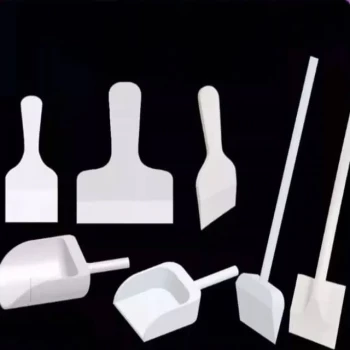
- Customizable PTFE Scrapers and Shovels for Demanding Applications
People Also Ask
- How is the pore size and permeability of a PTFE membrane controlled during the stretching process? Expert Control Guide
- How does the hydrophobicity of Polytetrafluoroethylene (PTFE) membranes improve the performance of air and gas filtration?
- How do Teflon membranes enhance chemical resistance in laboratory equipment? Maximize Purity and Durability
- How do Polytetrafluoroethylene (PTFE) membranes facilitate membrane distillation? Key Benefits for Water Treatment
- How does the non-stick surface of PTFE membranes improve dust collection efficiency? Boost release & reduce energy.