Particle size and polymerization route strongly influence how PTFE behaves before, during, and after fabrication. Suspension polymerization produces granular PTFE that is later milled into controlled particle sizes, while dispersion or emulsion polymerization produces fine powders and aqueous dispersions. Smaller granular particles generally support smoother, denser surfaces, whereas larger particles improve powder flow and mold filling. These differences affect sample retention, porosity, dimensional stability, mechanical reliability, and the performance of laboratory apparatus and CNC-machined components.
PTFE selection is a balance between surface quality and manufacturing behavior. Fine, well-controlled resin can produce dense, low-retention surfaces for trace-analysis vessels and fluidic parts, while coarser, free-flowing resin may be preferable for efficient, uniform production of large preforms.
How Polymerization Determines PTFE Resin Form
Suspension Polymerization Produces Granular Resin
In suspension polymerization, tetrafluoroethylene is polymerized in an aqueous system without surfactants. The reaction forms stringy, irregular PTFE particles that are subsequently comminuted into sizes suitable for compression molding and other fabrication processes.
The resulting resin is commonly used to produce billets, rods, tubes, and blocks that are later machined into laboratory vessels, valves, fittings, and seals.
Dispersion Polymerization Produces Fine Powders
Dispersion or emulsion polymerization uses perfluorinated surfactants to produce very fine PTFE powders or aqueous dispersions. These materials are suited to applications where very small particles, coatings, or dispersion processing are required.
They should not be treated as interchangeable with granular molding resin. Their particle structure and flow behavior differ, so the correct grade depends on the intended fabrication method.
Polymerization Conditions Affect Porosity and Shrinkage
Suspension polymerization temperature can influence the specific surface area and softness of the resulting particles. Lower-temperature polymerization, below approximately 30°C, is associated with lower specific surface area and softer particles than higher-temperature polymerization.
Parts made from suitable low-temperature resin can exhibit lower void content and lower mold shrinkage. For precision PTFE parts, that can translate into better dimensional control and lower chemical absorption.
Why Particle Size Changes Surface Finish
Fine Particles Pack More Uniformly
Smaller particles can create a more uniform compact during preforming and compression molding. After sintering, this structure generally supports a smoother, more homogeneous surface.
That characteristic is particularly important when a PTFE surface contacts samples, reagents, or process fluids. A smoother surface presents fewer locations where material can lodge or remain after cleaning.
Smooth Surfaces Reduce Sample Retention
Trace-analysis beakers, digestion tubes, electrochemical cells, and specialized liquid containers often need to minimize sample entrapment. Fine-particle PTFE grades can help produce surfaces that retain less residue and are easier to clean consistently.
This does not make PTFE inherently contamination-proof. Cleaning procedure, machining quality, tool condition, sintering, and the design of corners or transitions also affect contamination risk.
Machining Reveals the Quality of the Billet
CNC machining does not eliminate defects created during preforming or sintering. Internal micro-voids, density gradients, or nonuniform shrinkage in the billet can appear as surface irregularities, dimensional errors, or weak areas after machining.
Controlled particle size and consistent bulk density promote more uniform packing. That gives the machinist a more structurally consistent stock material for producing tight-tolerance components.
How Particle Size Affects Component Performance
Lower Porosity Improves Chemical Integrity
Micro-voids can increase fluid permeability and provide locations for chemical absorption or sample retention. Fine, high-density PTFE stock is therefore valuable for vessels, fittings, valves, and seals exposed to aggressive chemicals.
Lower porosity is especially important when the component must remain leak-tight or must not exchange material with a high-purity fluid.
Uniform Packing Supports Dimensional Stability
Bulk density and particle size determine how effectively resin compacts during preforming. Reference ranges for granular PTFE commonly place bulk density around 390 to 550 g/L and average particle size around 350 to 675 micrometers, although grades vary substantially.
Consistent values help reduce density gradients and promote more predictable shrinkage. This is important when machining complex parts with thin walls, sealing surfaces, ports, or closely controlled internal dimensions.
Mechanical Strength Depends on Grade and Processing
Fine-particle, low-flow grades can provide strong mechanical performance, with reported tensile strength values up to approximately 36 to 40 MPa and break elongation up to approximately 320 to 400% in suitable formulations and processing conditions.
These figures are not guaranteed by particle size alone. Final performance also depends on resin grade, preforming pressure, sintering temperature, cooling history, machining geometry, and any fillers or modifiers.
How Milling Changes the Resin
Comminution Creates the Usable Particle Distribution
After suspension polymerization, the stringy reactor beads must be mechanically reduced to a controlled size. Air-energy or jet milling can reduce particles from several hundred micrometers to below 20 micrometers.
The milling process changes more than the nominal particle diameter. It can also change particle shape, fibrous character, density, surface area, and how the powder behaves during molding.
Particle Shape Affects Flow and Shrinkage
High-energy milling at elevated temperatures can create fibrous particles with tentacle-like surface structures. These particles may pack differently from more compact particles and can increase mold shrinkage.
Manufacturers can adjust milling conditions and blend powders with different morphologies to balance powder flow, packing density, shrinkage, and final part quality.
Morphology Matters in Filled PTFE
Particle morphology also affects how PTFE powder interacts with fillers. Fibrous particles can wrap around filler particles, reducing voids and improving the uniformity of filled compounds.
This can improve mechanical strength, but the correct morphology depends on the compound and its application. A resin optimized for filled seals may not be the best choice for an unfilled trace-analysis vessel.
Understanding the Trade-offs
Fine Particle Size Is Not Always Better
Fine particles can improve surface finish and packing, but fine-particle grades often have poorer flow behavior. They may be more difficult to feed through hoppers and may be less convenient for filling large or complicated molds.
A grade that produces an excellent surface can still be a poor production choice if it creates inconsistent mold filling or difficult powder handling.
Larger Particles Improve Processing Efficiency
Larger, free-flowing particles can move more easily through handling equipment and fill molds more uniformly during production. Free-flow grades are commonly associated with higher bulk density and particle sizes in the range of roughly 200 to 800 micrometers or more.
Their processing advantages may outweigh the surface-finish advantage of a finer grade when the part is large, geometrically simple, or not directly exposed to high-purity samples.
Surface Finish Cannot Be Predicted from Size Alone
Particle size is only one control variable. Sintering temperature, processing pressure, cooling conditions, mold design, billet quality, machining parameters, and tool sharpness also influence the final surface.
A fine resin processed poorly can produce a worse component than a coarser resin processed under well-controlled conditions.
Shrinkage Requires Design Allowance
PTFE experiences significant dimensional change during processing, and particle morphology can influence that change. Fibrous, highly structured particles may increase mold shrinkage compared with other milled forms.
Mold and machining dimensions should therefore be based on measured material behavior for the selected grade, not on nominal resin particle size alone.
Making the Right Choice for Your Goal
The appropriate PTFE resin should be selected according to both the required surface and the realities of manufacturing.
- If your primary focus is trace analysis or sample purity: Favor a fine, well-controlled resin and a dense, low-porosity fabrication process to reduce sample retention and contamination risk.
- If your primary focus is leak-tight fluid handling: Prioritize consistent bulk density, uniform packing, low void content, and predictable shrinkage over particle size alone.
- If your primary focus is large-volume production: Favor a free-flowing, larger-particle grade that fills molds consistently and supports efficient powder handling.
- If your primary focus is precision CNC machining: Select billet stock with controlled particle distribution and density gradients, then verify shrinkage and dimensional stability for the specific grade.
- If your primary focus is mechanical strength: Consider fine-particle or appropriately filled PTFE grades, while evaluating tensile performance, permeability, chemical exposure, and processing conditions together.
The best PTFE component results from matching polymerization route, particle morphology, processing conditions, and machining requirements to the actual laboratory or fluid-handling duty.
Summary Table:
| Factor | Impact on Surface & Performance |
|---|---|
| Polymerization method | Determines resin form and properties (granular vs. fine powder) |
| Particle size | Smaller particles -> smoother, denser surfaces; larger -> better flow |
| Surface finish | Influences sample retention and cleaning ease |
| Porosity | Lower porosity improves chemical resistance and leak-tightness |
| Dimensional stability | Affected by packing uniformity and shrinkage |
| Mechanical strength | Dependent on grade, processing, and fillers |
| Milling/morphology | Changes flow, packing, and shrinkage |
| Trade-offs | Fine particles may hinder flow; larger particles easier to handle |
Looking for PTFE labware or custom parts with the right balance of surface finish and performance? At KINTEK, we specialize in high-performance fluoropolymers, offering a full range of PTFE and PFA products—from basic labware to complex custom-machined components. Our expertise in resin selection and precision machining ensures your parts meet the highest standards. Contact us today to discuss your application and discover how we can optimize your results. Get in touch!
Related Products
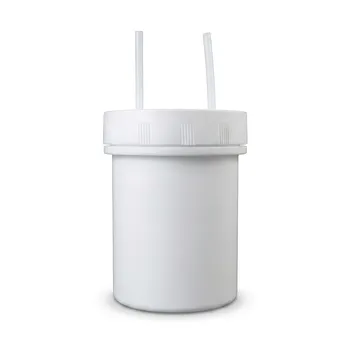
- High Purity Corrosion Resistant PTFE Raw Material Barrel 4L Screw Seal Low Background Feed Tank
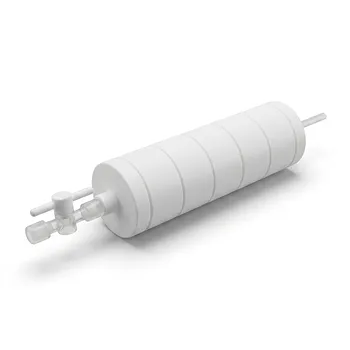
- Custom PTFE Filtration System Acid Resistant High Purity Semiconductor Grade Chemical Processing Filter
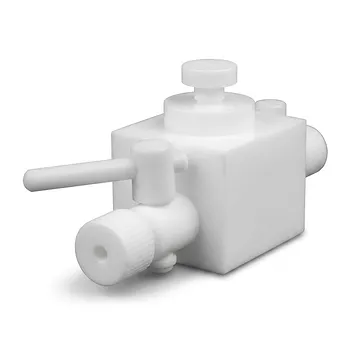
- PTFE Corrosion Resistant Filter with PFA Valve Connections and Integrated Sieve Plate
- PTFE PFA Vacuum Filtration System Corrosion Resistant Customizable Shatterproof Laboratory Device
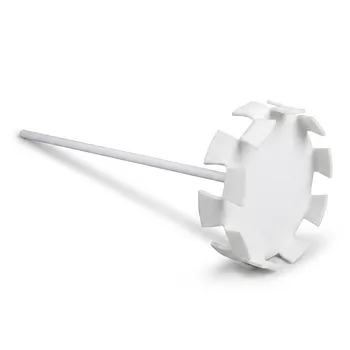
- PTFE Dispersion Disk Food Cosmetic Grade Non Stick Corrosion Resistant Large Stirring Paddle Customizable Impeller
People Also Ask
- How do Polytetrafluoroethylene (PTFE) containers perform regarding gas permeation? Expert Insights on Solvent Absorption
- What resin properties are critical when selecting PTFE raw material for manufacturing high-performance micro-porous ePTFE filtration media?
- Why is SSG used for PTFE molecular weight? Unlock Quality Control with Standardized Density Testing
- How does thixotropic flow behavior affect liquid formulation storage in PTFE chemical storage tanks and containers? Maximize Stability with PTFE
- Why is strict purity control required during PTFE synthesis, and how does resin purity impact trace analysis laboratory containers? Achieve Reliable Ultra-Trace Results with High-Purity PTFE