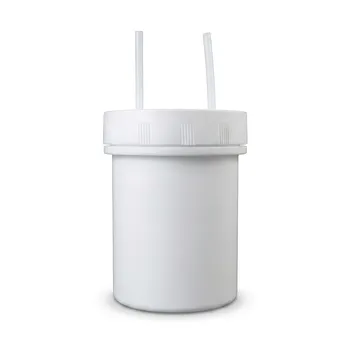
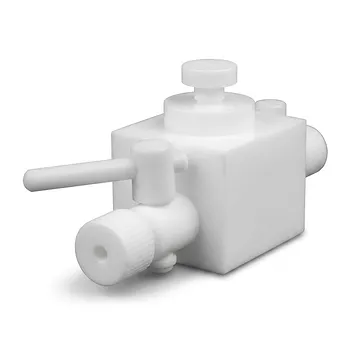
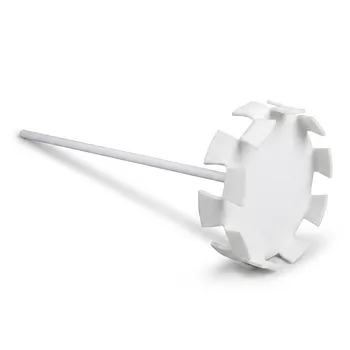
The PTFE resin grade determines how the material can be formed, how efficiently it can be processed, and what performance the finished laboratory product can deliver. Fine-cut resin is primarily compression molded into billets for subsequent machining, free-flow resin is optimized for efficient automatic or isostatic molding, and presintered resin is engineered for ram extrusion. The choice therefore affects not only manufacturing cost and throughput, but also the geometry, dimensional consistency, mechanical properties, and intended use of the final fluoropolymer component.
Fine-cut PTFE prioritizes material performance and machinability, free-flow PTFE prioritizes mold filling and production efficiency, and presintered PTFE enables continuous extrusion of thin-walled tubing and small-diameter rods.
How PTFE Grade Determines the Manufacturing Route
Fine-Cut Resin Requires Compression Molding and Machining
Fine-cut, or low-flow, granular PTFE has a low apparent density, typically below 500 g/L, and a powder-like consistency similar to flour. Its poor flowability makes it difficult to feed and distribute reliably in automated molding equipment.
Manufacturers generally place fine-cut resin into a mold, compress it into a solid billet or block, and then sinter the preform. The resulting stock shape can be CNC machined into the required laboratory component.
This route is well suited to custom or complex parts because machining can produce precise dimensions after molding. It is commonly used for valve components, reactor liners, gaskets, custom reaction cells, and high-purity fluid-handling parts.
Free-Flow Resin Improves Mold Filling
Free-flow PTFE is produced by agglomerating fine-cut particles into soft spheres several hundred microns in size. This increases apparent density and makes the resin easier to pour, meter, and distribute throughout a mold.
The improved flowability supports automatic compression molding and isostatic molding, where consistent cavity filling is essential for repeatable production. It is particularly useful for standard laboratory shapes and larger production volumes.
Free-flow resin can also be molded into stock shapes, but its primary advantage is manufacturing efficiency rather than maximum material performance.
Presintered Resin Enables Ram Extrusion
Presintered PTFE is made by premelting raw PTFE, reducing its melting point from approximately 342°C to 327°C, and then disintegrating it into a coarse, free-flowing powder.
This altered structure and processing behavior make presintered resin suitable for ram extrusion. The resin is compacted and forced through a die to produce continuous profiles rather than discrete molded billets.
The grade is specifically used for thin-walled fluoropolymer tubing and small-diameter solid rods. These forms are difficult or impractical to produce efficiently through conventional billet molding and machining.
How the Grades Affect Final Product Performance
Fine-Cut Resin Favors Strength and Purity
Fine-cut resin can produce finished components with higher tensile strength, elongation, specific gravity, and dielectric breakdown strength than parts made from more highly agglomerated free-flow material.
Those properties matter in demanding laboratory environments. High-purity reactor liners, sealing components, electrical insulation, and precision-machined fluid-contact parts benefit from the dense and mechanically robust structure produced through this route.
Fine-cut resin is also commonly selected when the product is custom, thick-walled, or geometrically complex enough to justify machining.
Free-Flow Resin Favors Consistency and Throughput
The key benefit of free-flow resin is reliable handling. Its higher bulk density and better pourability allow mold cavities to fill more quickly and uniformly, reducing the manual intervention required during production.
The trade-off is that free-flow resins can produce components with somewhat lower tensile strength, elongation, and dielectric strength than fine-cut resins. The difference may be acceptable for standard labware where production repeatability and cost are more important than peak material performance.
Presintered Resin Favors Continuous, Flexible Geometries
Presintered resin is selected primarily because it supports an extrusion process. It allows manufacturers to create long, continuous products with controlled wall thickness and small diameters.
This makes it appropriate for fluid-transfer tubing, thin-wall hoses, and related components where smooth internal surfaces, chemical resistance, low friction, and low fluid permeation are required.
The product geometry is the decisive factor. Presintered resin is not simply a higher- or lower-performance substitute for fine-cut or free-flow resin; it serves a different forming process.
Why Particle Structure Matters
Apparent Density Controls Handling
Apparent density is a practical indicator of how a PTFE powder behaves before molding. Low-density fine-cut material occupies more volume and does not flow easily, while agglomerated free-flow material packs and pours more efficiently.
This distinction affects filling speed, cavity uniformity, automation potential, and the consistency of the molded preform. A resin with excellent finished-part properties may still be unsuitable for a high-speed automated process if it cannot be handled reliably.
Particle Size Influences Consolidation
Fine-cut particles are often approximately 20 to 40 micrometers in size. Their small size supports strong consolidation and material integrity during compression molding.
Agglomeration increases the effective particle size and improves flow. However, the processing benefit can involve a modest reduction in some final mechanical and electrical properties compared with components made from fine-cut resin.
Resin Form Must Match Polymer Structure
Granular PTFE is generally associated with compression molding and machining of solid, heavy-wall forms. Fine powder PTFE, by contrast, is a separate resin form commonly designed for paste extrusion of flexible tubing, tapes, gaskets, and membranes.
The three grades in this discussion should therefore be distinguished from the broader classification of PTFE forms. Fine-cut and free-flow granular resins primarily support molded stock shapes and labware, while presintered granular resin supports ram extrusion.
Matching Each Grade to Laboratory Products
Custom Machined Components
Fine-cut resin is generally the strongest choice for custom components that begin as billets or blocks. Examples include reactor liners, crucibles, valve parts, custom vessels, and precision fluid-handling elements.
The molding step creates a stable stock shape, while CNC machining supplies the final geometry and tolerances.
Standard Molded Labware
Free-flow resin is better suited to repeatable production of standard shapes. Automatic and isostatic molding can efficiently produce containers, fittings, and other laboratory products when consistent mold filling is a priority.
This grade is especially practical when the product design is already standardized and machining every part would add unnecessary cost.
Tubing and Small-Diameter Rods
Presintered resin is the appropriate choice for ram-extruded products. It supports continuous thin-wall tubing and small-diameter rods with controlled cross-sectional dimensions.
For fluid-transfer tubing, the extrusion process must also be matched to the resin and equipment. Die design, compaction, extrusion pressure, cooling, and sintering conditions all influence wall thickness, dimensional stability, and internal surface quality.
Understanding the Trade-offs
Performance Versus Processability
Fine-cut resin generally offers stronger final material characteristics, but its low density and poor flow make it less compatible with automated handling.
Free-flow resin sacrifices some properties to gain faster, more uniform mold filling. That trade-off is often justified for standard products manufactured in substantial quantities.
Machining Requires Thermal and Mechanical Control
Virgin PTFE is soft and has a very low coefficient of friction. It can be difficult to grip securely and machine accurately, and its substantial thermal expansion can affect dimensional control.
Machining parameters, workholding, tooling, and temperature management must therefore be chosen carefully, even after selecting the correct granular resin grade.
Filled PTFE Changes the Machining Equation
Glass- or carbon-filled PTFE can improve strength, stiffness, wear resistance, or dimensional behavior. However, fillers can be abrasive, increasing tool wear and potentially changing the surface finish.
For high-purity laboratory products, the use of filled material must also be evaluated against contamination, chemical compatibility, and electrical requirements.
Presintered Material Is Not Interchangeable With Virgin Resin
Presintering changes how the resin must be processed. It is intended for pressure-based forming methods such as ram extrusion, rather than being treated as an ordinary unsintered powder for every molding operation.
Material history also matters. Recycled or reprocessed PTFE may have different purity and performance characteristics from virgin resin, so critical applications such as trace-analysis vessels require explicit control of resin source and processing history.
How to Apply This to Your Project
The correct grade follows from the desired product geometry, production volume, and performance requirements.
- If your primary focus is maximum mechanical strength and custom geometry: Use fine-cut resin for compression-molded billets followed by precision machining.
- If your primary focus is automated production of standard labware: Use free-flow resin to improve mold filling, handling, and process repeatability.
- If your primary focus is continuous thin-wall tubing or small rods: Use presintered resin designed for ram extrusion.
- If your primary focus is the highest chemical or electrical purity: Specify the appropriate virgin resin and verify the complete material and processing history.
- If your primary focus is wear resistance or dimensional stability: Consider a filled PTFE grade, while accounting for tool wear, surface finish, and purity requirements.
Selecting PTFE by manufacturing behavior as well as by chemical resistance ensures that the resin, production process, and laboratory application work as one coherent system.
Summary Table:
| Resin Grade | Typical Processing | Key Properties | Common Applications |
|---|---|---|---|
| Fine-Cut | Compression molding + machining | High strength, purity, machinability | Custom parts, liners, gaskets |
| Free-Flow | Automatic/isostatic molding | Good flow, consistency | Standard labware, fittings |
| Presintered | Ram extrusion | Continuous forms | Tubing, small rods |
Optimize your lab products with the right PTFE grade. KINTEK offers expert guidance and custom manufacturing for all your fluoropolymer needs. Contact us today to discuss your application and get a tailored solution.
Related Products
- High Purity Corrosion Resistant PTFE Raw Material Barrel 4L Screw Seal Low Background Feed Tank
- Custom PTFE Filtration System Acid Resistant High Purity Semiconductor Grade Chemical Processing Filter
- PTFE Corrosion Resistant Filter with PFA Valve Connections and Integrated Sieve Plate
- PTFE PFA Vacuum Filtration System Corrosion Resistant Customizable Shatterproof Laboratory Device
- PTFE Dispersion Disk Food Cosmetic Grade Non Stick Corrosion Resistant Large Stirring Paddle Customizable Impeller
People Also Ask
- How do Polytetrafluoroethylene (PTFE) containers perform regarding gas permeation? Expert Insights on Solvent Absorption
- What resin properties are critical when selecting PTFE raw material for manufacturing high-performance micro-porous ePTFE filtration media?
- Why is SSG used for PTFE molecular weight? Unlock Quality Control with Standardized Density Testing
- How does thixotropic flow behavior affect liquid formulation storage in PTFE chemical storage tanks and containers? Maximize Stability with PTFE
- Why is strict purity control required during PTFE synthesis, and how does resin purity impact trace analysis laboratory containers? Achieve Reliable Ultra-Trace Results with High-Purity PTFE