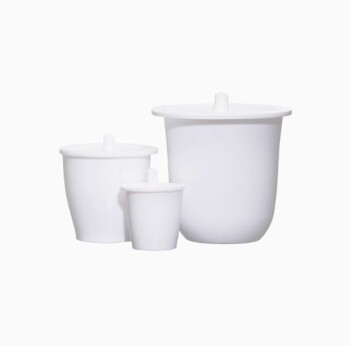
Particle size reduction is essential because it helps PTFE compact and sinter into denser, stronger, and more reliable laboratory components. Finely comminuted PTFE particles eliminate internal voids more effectively during compression molding and sintering, improving mechanical strength, reducing chemical permeation, and enhancing electrical insulation. Smaller particles also distribute fillers more uniformly and support stronger unsintered preforms.
The central benefit is better consolidation: particle size and morphology determine how well PTFE packs, releases trapped air, accepts fillers, and transforms into a dense, structurally reliable finished part.
How Particle Size Affects Molded PTFE Performance
More effective void elimination
PTFE powder contains spaces between particles after mold filling. If these voids are not adequately removed during preforming and sintering, they can become weak points or pathways for chemical permeation.
Fine particles provide more opportunities for close packing and thorough consolidation. This produces denser molded parts with fewer internal defects, which is particularly important for leak-tight vessels, fittings, and fluid-handling components.
Higher mechanical strength
A more uniform, void-free structure transfers stress more effectively throughout the finished PTFE component. This improves tensile strength, dimensional reliability, and resistance to cracking or deformation.
The benefit is especially important for laboratory equipment exposed to pressure, thermal cycling, mechanical handling, or aggressive chemicals.
Lower permeability
Micro-voids and poorly consolidated regions can allow chemicals or gases to migrate through the material. Reducing these internal pathways lowers permeability and improves containment performance.
This matters for digestion vessels, tubing, chemical-fluid components, and other laboratory products where leakage or contamination is unacceptable.
Improved electrical insulation
PTFE is valued for its electrical insulating properties, but internal voids and inconsistent consolidation can compromise dielectric performance. Finer powders support a more homogeneous structure, helping the finished component maintain more consistent electrical insulation.
Why Particle Size Matters During Processing
Stronger unsintered preforms
Before sintering, PTFE is formed into a compact commonly called a preform or green body. Fine, well-controlled particles can create a more coherent preform with better handling strength and fewer defects.
A stronger preform is less likely to crack, deform, or shed material before the final sintering cycle.
More uniform filler distribution
Fillers are added to PTFE to modify properties such as wear resistance, stiffness, thermal behavior, or dimensional stability. Smaller particles generally provide more uniform contact with the filler.
This reduces local concentrations of resin or filler and helps produce more consistent properties throughout the molded part.
Better control of molding behavior
Particle size is not the only consideration. Particle shape, bulk density, and morphology also influence powder flow, mold filling, compaction, air removal, and shrinkage.
Manufacturers therefore control the comminution method and processing conditions rather than simply pursuing the smallest possible particle size.
The Role of Sintering and Particle Packing
Compression molding creates the initial structure
During compression molding, PTFE powder is compacted into the desired shape. The effectiveness of this stage depends on how consistently the particles fill the mold and how much air remains trapped between them.
Controlled particle size supports more uniform compaction and more consistent green strength across the preform.
Sintering consolidates the material
During sintering, PTFE particles fuse into a continuous structure. Better initial packing makes it easier to remove voids and achieve uniform consolidation.
The result is a finished component with higher structural integrity, lower permeability, and more predictable dimensions.
Particle size must be optimized, not minimized
The finest powder is not automatically the best powder. Extremely small particles may reduce bulk density and impair flow during mold filling, potentially increasing handling difficulty or uneven powder distribution.
The target is a particle-size distribution and morphology that balance mold filling, compaction, air removal, shrinkage, and final density.
Understanding the Trade-offs
Fine powders can flow less effectively
Reducing particle size often lowers powder bulk density and can make the material less free-flowing. This may complicate mold filling and increase the risk of inconsistent powder distribution.
Processing equipment and compaction parameters must compensate for these effects.
Milling conditions affect morphology
Mechanical size reduction can produce particles with different shapes and surface features. Fibrous or highly irregular particles may pack and shrink differently from more compact particles.
Temperature control during milling is therefore important because PTFE morphology and pliability can change with processing conditions.
Excessive shrinkage can affect dimensional accuracy
Particle morphology influences the amount and uniformity of shrinkage during sintering. If shrinkage is not well characterized and controlled, the finished part may deviate from its intended dimensions.
This is a critical consideration for precision labware, threaded fittings, seals, and custom-machined PTFE components.
Processing quality remains essential
Fine particles cannot compensate for poor mold design, inadequate compaction, unsuitable sintering cycles, or contamination. Particle size reduction is one part of a complete process-control strategy.
For high-purity laboratory products, handling and processing must also minimize contamination and preserve material consistency.
How to Apply This to Your Project
Particle-size optimization should be matched to the product’s performance requirements and manufacturing method.
- If your primary focus is mechanical strength: Use a finely comminuted, well-controlled PTFE powder that promotes dense packing and thorough void elimination during sintering.
- If your primary focus is chemical containment: Prioritize powder characteristics and molding conditions that minimize internal voids and reduce permeation pathways.
- If your primary focus is filler performance: Select a particle size and morphology that allow uniform filler distribution throughout the PTFE matrix.
- If your primary focus is dimensional accuracy: Balance fine-particle consolidation against flow behavior, shrinkage, and the required mold-compensation strategy.
- If your primary focus is processing efficiency: Avoid choosing particle size in isolation; evaluate bulk density, flowability, particle shape, compaction, and sintering together.
The right particle-size strategy turns PTFE from a powder into a dense, dependable material capable of meeting demanding laboratory-performance requirements.
Summary Table:
| Factor | Impact of Fine Particles |
|---|---|
| Void Elimination | Better packing reduces internal voids, enhancing density and reliability. |
| Mechanical Strength | Denser structure improves tensile strength and resistance to cracking. |
| Permeability | Fewer voids decrease chemical permeation, ideal for containment. |
| Electrical Insulation | Homogeneous structure maintains consistent insulating properties. |
| Filler Distribution | Uniform filler dispersion ensures consistent material properties. |
| Preform Strength | Stronger green bodies resist cracking before sintering. |
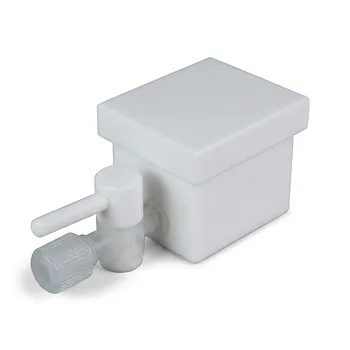
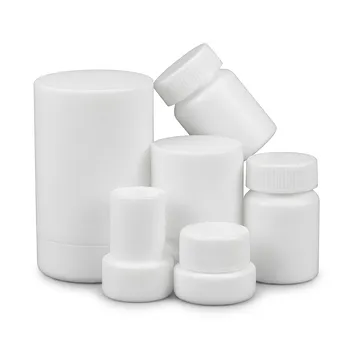
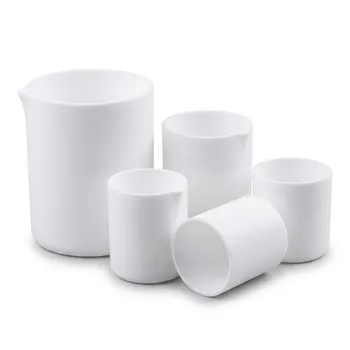
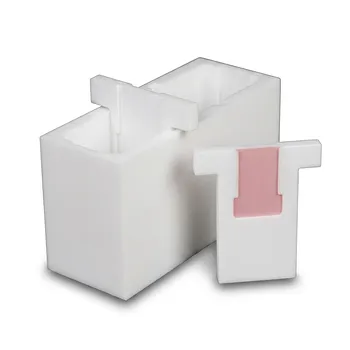
Looking to enhance the performance of your PTFE lab equipment? At KINTEK, we specialize in high-performance fluoropolymers, offering a comprehensive range of PTFE and PFA labware, from beakers and digestion vessels to custom CNC-machined parts. Our expertise in particle size optimization ensures your equipment achieves maximum density, strength, and chemical resistance. Whether you need standard labware or bespoke solutions, our end-to-end capabilities deliver reliability and precision. For distributors, we provide OEM/ODM support, certifications, and reliable supply. Contact us today to discuss your requirements and experience the KINTEK advantage! Get in touch
Related Products
- Custom PTFE Laboratory Apparatus Corrosion Resistant Low Background Reaction Cells Precision CNC Fabrication
- Corrosion Resistant PTFE Small Reaction Bottle One Piece Molded Teflon Sample Storage Tank
- Large Scale PTFE Beakers and Flasks for High Temperature Corrosion Resistant Laboratory Applications with Custom CNC Fabrication
- High Purity Custom PTFE Laboratory Reaction Tank with Baffles for Low Background Trace Analysis
- Custom Polytetrafluoroethylene PTFE Petri Dishes 60mm Corrosion Resistant Low Background Labware
People Also Ask
- How does PTFE's melting behavior affect custom lab apparatus? Key insights for manufacturing.
- What are the primary fabrication methods for PTFE laboratory apparatus? Expert Insights into Fluoropolymer Engineering
- What does the technological maturity of PTFE mean for the quality and reliability of standard laboratory apparatus? Achieve consistent lab results with mature PTFE tech.
- What is the chemical compatibility range for PTFE laboratory apparatus? Explore Near-Universal Chemical Resistance.
- What are the primary chemical resistance properties of PTFE laboratory apparatus? Unmatched Purity and Inertness