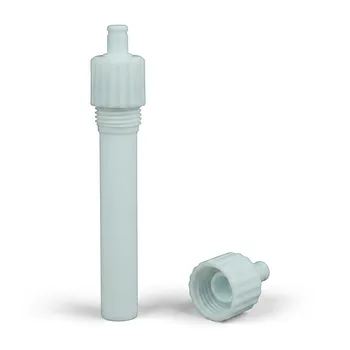
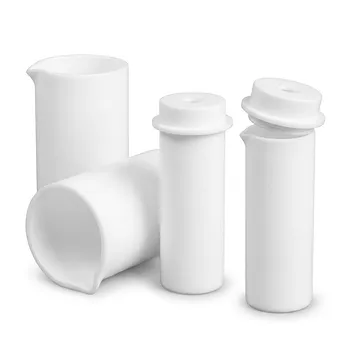
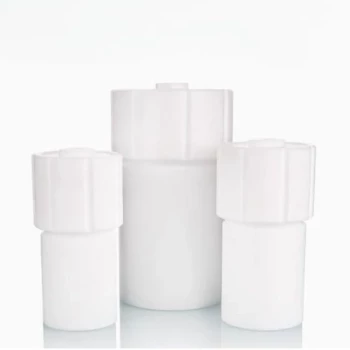
PTFE is ideal for high-purity laboratory ware because its fluorinated molecular structure is exceptionally resistant to chemical attack. The polymer contains a carbon backbone heavily shielded by fluorine atoms, with strong carbon-fluorine bonds that make it difficult for acids, bases, solvents, and other reagents to react with or dissolve the material. This chemical stability helps prevent vessel degradation, extractables, and contamination during trace analysis and chemical digestion.
PTFE’s value comes from its combination of chemical inertness, insolubility, low extractables, and thermal stability. These properties allow it to contain aggressive reagents while preserving both the vessel and the purity of the sample.
Why PTFE Resists Chemical Attack
Strong Carbon-Fluorine Bonding
PTFE’s fluorine-rich structure is its primary source of chemical stability. Strong carbon-fluorine bonds are difficult for most laboratory reagents to break, while the fluorine atoms protect the underlying polymer chain from attack.
This makes PTFE substantially less reactive than many conventional plastics used in laboratory containers.
A Chemically Shielded Polymer Chain
The fluorine atoms form a protective layer around the carbon backbone. Reagents therefore have limited access to the reactive sites that would normally enable oxidation, substitution, or polymer-chain degradation.
The result is a polymer that remains stable when exposed to many concentrated acids, strong bases, and organic solvents.
Exceptional Insolubility
PTFE is insoluble in virtually all common laboratory solvents. Because it does not dissolve or readily swell under normal laboratory conditions, it maintains its physical form and does not release dissolved polymer into the sample.
This characteristic is particularly important for trace analysis, where even small amounts of contamination can affect results.
How PTFE Protects Sample Purity
Low Extractables and Leaching
High-purity PTFE contributes very low levels of extractable substances compared with materials that can soften, dissolve, or chemically react with the sample medium. It therefore minimizes the risk that the container will introduce interfering organic or inorganic contaminants.
This is essential when measuring trace concentrations, where vessel-derived contamination may be comparable to the analyte itself.
Resistance to Corrosive Digestion Reagents
Digestion vessels may encounter concentrated acids, oxidizing mixtures, and harsh bases at elevated temperatures. PTFE generally resists these environments without significant corrosion or chemical degradation.
The vessel can therefore contain aggressive reagents while maintaining a cleaner reaction environment.
Non-Wetting Surface Behavior
PTFE has a low-energy, non-stick surface that reduces adhesion of residues to the vessel walls. This supports more complete transfer, easier cleaning, and lower carryover between samples.
The surface property is useful, but it complements rather than replaces proper cleaning and contamination-control procedures.
Why PTFE Works in Digestion Vessels
Stability During Severe Chemical Processing
Chemical digestion deliberately breaks down difficult sample matrices using highly reactive reagents. The vessel must tolerate that chemistry without becoming part of the reaction.
PTFE’s inert fluorinated structure allows it to function as a containment material while the reagents attack the sample.
Thermal Stability
PTFE remains useful across a broad laboratory temperature range and has a high melting temperature relative to many commodity plastics. Its chemical resistance is retained under many heated digestion conditions, although the exact pressure, temperature, reagent composition, and exposure time must remain within the vessel manufacturer’s specifications.
Specialized Manufacturing Behavior
PTFE does not behave like a conventional thermoplastic that readily flows into a mold after melting. Above its melting transition, it forms a highly viscous gel-like phase, so solid PTFE components are commonly produced through powder processing and sintering.
This processing behavior does not itself make PTFE chemically inert, but it explains why PTFE digestion vessels and labware require specialized manufacturing methods.
Understanding the Trade-offs
PTFE Is Not Resistant to Every Chemical
PTFE is not universally immune to chemical attack. Fluorinating agents, molten alkali metals, and certain highly reactive conditions can damage it, particularly at elevated temperatures.
Compatibility must therefore be evaluated against the complete reagent system rather than inferred from the label “acid resistant.”
Temperature and Pressure Still Matter
Chemical stability does not guarantee mechanical suitability. Heated digestion can generate substantial internal pressure, and PTFE may deform or creep under load at elevated temperatures.
For pressurized microwave digestion, the PTFE vessel or liner must be used within its specified operating limits and with the appropriate containment hardware.
Cleanliness Remains Essential
PTFE can reduce contamination, but it cannot eliminate contamination caused by dirty reagents, inadequate rinsing, airborne particles, or cross-sample carryover. High-purity work still requires validated cleaning procedures, suitable blanks, and controlled handling.
Making the Right Choice for Your Goal
PTFE is most effective when chemical compatibility and sample purity are the primary design requirements.
- If your primary focus is trace-element analysis: Use high-purity PTFE ware to minimize leaching and extractable contaminants, while controlling cleaning, reagent purity, and procedural blanks.
- If your primary focus is acid digestion: Select a PTFE vessel or liner rated for the intended acids, temperature, pressure, and digestion method.
- If your primary focus is solvent handling: Confirm compatibility with the specific solvent mixture, temperature, and exposure duration rather than relying only on PTFE’s general solvent resistance.
- If your primary focus is long service life: Account for mechanical creep, pressure cycling, surface damage, and chemical exceptions in addition to PTFE’s inherent inertness.
PTFE preserves analytical integrity by remaining chemically separate from the aggressive reagents and sensitive samples it is designed to contain.
Summary Table:
| Characteristic | Why It Matters |
|---|---|
| Strong C-F bonds | Resists chemical attack by acids, bases, solvents |
| Shielded backbone | Prevents oxidation and degradation |
| Insolubility | No dissolution or swelling, no polymer release |
| Low extractables | Minimizes contamination for trace analysis |
| Non-wetting surface | Reduces residue adhesion and carryover |
| Thermal stability | Withstands heated digestion within specifications |
Ensure the highest purity in your lab with KINTEK's PTFE and PFA labware. Our products are designed for demanding applications like trace analysis and acid digestion. With our custom CNC machining, we can create tailored solutions for your specific needs. Contact us today to discuss how we can support your high-purity requirements. Get in touch with our experts now to elevate your lab's performance and reliability!
Related Products
- 5ml High Pressure PTFE Digestion Vessel for Geological Mineral Analysis Corrosion Resistant Polytetrafluoroethylene TFM Digestion Inner Liner
- Custom High Purity PTFE Microwave Digestion Vessels and Graphite Block Compatible Acid Evaporation Tanks for Trace Metal Analysis
- PTFE Lined High Pressure Digestion Vessel 50ml High Temperature Hydrothermal Synthesis Tank
- Custom PTFE Digestion Tubes and High Purity Polytetrafluoroethylene Centrifuge Vessels 60ml for Trace Analysis
- Corrosion Resistant PTFE Digestion Bottle Solid Liquid Reaction Vessel High Purity Trace Analysis Mineral Labware
People Also Ask
- What safety features are typically incorporated into high-pressure PTFE digestion vessel designs? Ensure Lab Safety
- What is the function of high-pressure PTFE digestion vessels in mineral analysis? Optimize Sample Mineralization
- Why is a PTFE liner utilized in V2O5 synthesis? Ensure Chemical Purity and Corrosion Resistance
- What is the primary function of a PTFE liner? Key Benefits for Purity and Safety in Hydrothermal Synthesis
- What is the role of a PTFE liner in Bi2O3–TiO2 synthesis? Ensure High Purity and Controlled Crystal Growth