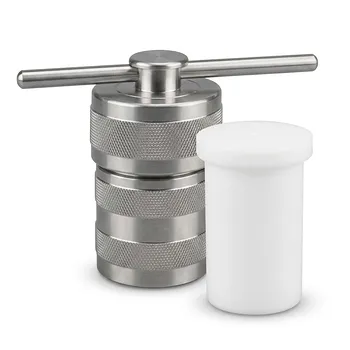
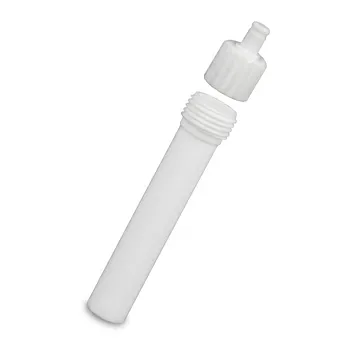
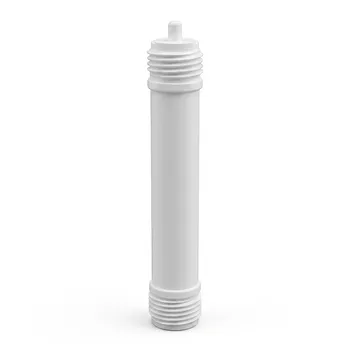
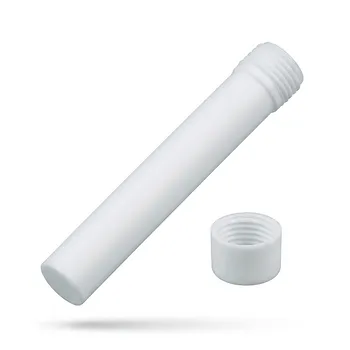
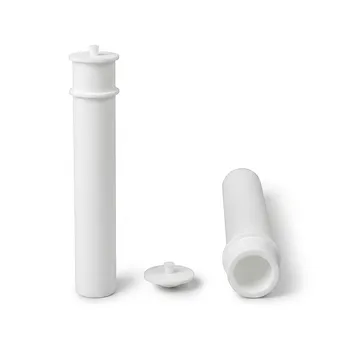
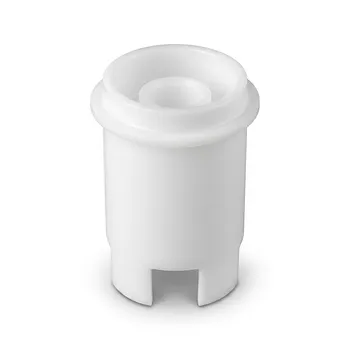
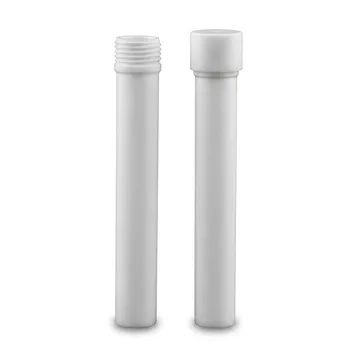
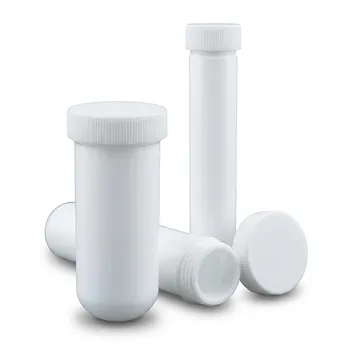
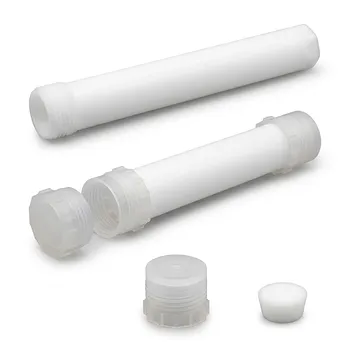
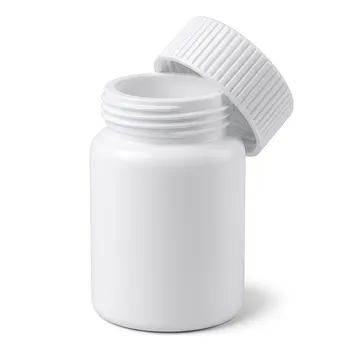
Polytetrafluoroethylene (PTFE) liners are utilized in $V_{2}O_{5}$ synthesis because they provide an inert, corrosion-resistant barrier between aggressive chemical precursors and the reaction vessel. This material maintains its structural integrity at temperatures up to 200°C, ensuring that the high-pressure environment does not lead to contamination. By isolating the reaction, the PTFE liner allows for the precise formation of pure $V_{2}O_{5}$ nanosheets and micro-flower structures.
The core function of a PTFE liner is to provide a chemically stable and non-stick reaction environment that prevents metal ion leaching and precursor interference. This isolation is critical for achieving the high purity levels required for the photocatalytic performance of synthesized Vanadium Pentoxide.
Ensuring Chemical Stability Under Extreme Conditions
Resistance to Corrosive Precursors
Solvothermal synthesis of $V_{2}O_{5}$ often involves aggressive reagents like ammonium metavanadate, oxalic acid, and ethylene glycol. PTFE is exceptionally resistant to strong acids and bases, preventing these chemicals from reacting with the container walls during the heating process.
Thermal Stability and Pressure Maintenance
The synthesis process requires a closed subcritical environment, often reaching temperatures of 200°C. PTFE remains chemically inert at these elevations, providing a stable space where the precursors can dissolve and mix without the liner degrading or outgassing.
Preventing Reagent Interference
Because PTFE does not react with the precursors, the chemical stoichiometry of the reaction remains controlled. This stability ensures that the intended chemical pathways—such as the reduction of vanadium—proceed without being diverted by side reactions with the vessel material.
Protecting Material Purity and Structure
Elimination of Metal Ion Leaching
Without a liner, the corrosive reaction mixture would attack the stainless steel body of the high-pressure vessel. This would cause metal ions (like iron or chromium) to leach into the solution, incorporating unwanted impurities into the $V_{2}O_{5}$ crystal lattice.
Facilitating Oriented Crystal Growth
The stable, sealed environment provided by the PTFE liner is essential for the oriented growth of complex nanostructures. This allows for the consistent production of specific morphologies, such as uniform nanosheets or micro-flower patterns, which are highly dependent on the purity of the environment.
Non-Stick Properties for Product Recovery
PTFE is naturally non-stick, which is a significant advantage when synthesizing crystalline products. This property allows for the complete recovery of the synthesized $V_{2}O_{5}$ samples and simplifies the cleaning process, preventing cross-contamination between different synthesis batches.
Understanding the Trade-offs and Limitations
Temperature Ceiling Constraints
While PTFE is excellent up to 200°C, it has a distinct thermal limit. Exceeding 250°C to 260°C can cause the material to soften or release toxic fluorinated vapors, making it unsuitable for ultra-high-temperature hydrothermal processes.
Pressure-Induced Deformation
PTFE is prone to "cold flow" or mechanical deformation under extreme pressure over time. If the liner is not properly seated or if the vessel is cooled too rapidly, the liner can warp, potentially compromising the seal and leading to pressure leaks.
Permeability Concerns
At high temperatures and pressures, certain small molecules or gases may slowly permeate the PTFE membrane. While usually negligible for $V_{2}O_{5}$ synthesis, this factor must be considered in highly sensitive experiments where even trace gas exchange could affect the final product's lattice defects.
How to Apply This to Your Synthesis Project
When selecting and using a PTFE liner for solvothermal synthesis, your approach should be dictated by your specific material requirements:
- If your primary focus is maximum chemical purity: Always inspect the PTFE liner for any signs of discoloration or pitting before use, as these are indicators of previous contamination or material fatigue.
- If your primary focus is specific nanostructure morphology: Ensure the vessel is sealed to the manufacturer's torque specifications to maintain the constant pressure required for oriented crystal growth.
- If your primary focus is long-term equipment durability: Avoid heating the PTFE liner above 220°C to prevent permanent deformation, ensuring the liner remains easy to insert and remove from the stainless steel jacket.
By strictly maintaining the integrity of the PTFE interface, you ensure that the resulting Vanadium Pentoxide possesses the precise structural and chemical properties required for high-performance applications.
Summary Table:
| Key Feature | Benefit for $V_{2}O_{5}$ Synthesis | Operating Limit/Constraint |
|---|---|---|
| Chemical Inertness | Prevents metal ion leaching and precursor interference | Ideal for subcritical solvothermal environments |
| Corrosion Resistance | Withstands aggressive reagents like ammonium metavanadate | Degrades if temperatures exceed 260°C |
| Non-Stick Surface | Ensures complete product recovery and easy cleaning | High pressure may cause "cold flow" deformation |
| Thermal Stability | Maintains integrity up to 200°C for crystal growth | Permeability may increase at peak temperatures |
Elevate Your Research with KINTEK’s Precision Fluoropolymer Solutions
Achieve uncompromising purity in your solvothermal synthesis with KINTEK’s high-performance PTFE and PFA laboratory supplies. We specialize exclusively in fluoropolymer materials, ensuring your experiments are protected from contamination and corrosion.
Our Comprehensive Product Range Includes:
- Essential Labware: Beakers, crucibles, reagent bottles, and digestion tubes.
- Fluid Transfer & Prep: High-purity tubing, fittings, valves, filters, and pipettes.
- Advanced Apparatus: Standard and custom electrochemical cells, battery testing fixtures, and microwave digestion vessels.
- Custom Engineering: End-to-end CNC fabrication for non-standard machined parts and bespoke laboratory setups.
Whether you need high-volume consumables or a complex, custom-engineered reaction vessel, KINTEK delivers the durability and precision your work demands.
Contact our experts today to discuss your custom project or high-volume needs!
References
- Minh Nguyet Thi Quan, Đức Dương Lã. Surfactant-tuned vanadium pentoxide for enhanced photocatalytic degradation of organic dyes: nanosheet <i>vs.</i> microflower morphologies. DOI: 10.1039/d5ra01050k
This article is also based on technical information from Kintek Knowledge Base .
Related Products
- 5ml High Pressure PTFE Digestion Vessel for Geological Mineral Analysis Corrosion Resistant Polytetrafluoroethylene TFM Digestion Inner Liner
- PTFE Lined High Pressure Digestion Vessel 50ml High Temperature Hydrothermal Synthesis Tank
- High Purity PTFE Microwave Digestion Vessel Replacement Liner for Acid Sample Preparation and Trace Analysis
- High Purity PTFE Microwave Digestion Vessel for Soil and Food Analysis Acid Resistant Fluoropolymer Sample Preparation Liners
- High Purity TFM Microwave Digestion Vessels PTFE Acid Evaporation Liners Domestic GT-400 Equivalent Laboratory Reaction Containers
People Also Ask
- What safety features are typically incorporated into high-pressure PTFE digestion vessel designs? Ensure Lab Safety
- What is the function of high-pressure PTFE digestion vessels in mineral analysis? Optimize Sample Mineralization
- What is the primary function of a PTFE liner? Key Benefits for Purity and Safety in Hydrothermal Synthesis
- What is the role of a PTFE liner in Bi2O3–TiO2 synthesis? Ensure High Purity and Controlled Crystal Growth
- What are the benefits of using a PTFE-lined vessel for carbon-sulfur cathode treatment? Maximize Purity & Performance