Suspension and dispersion polymerization produce different PTFE resin morphologies, so they require different forming methods. Suspension polymerization uses vigorous agitation and little or no surfactant to produce larger, precipitated granular PTFE resin. Dispersion polymerization uses fluorinated surfactants and milder agitation to create submicron PTFE particles that become aqueous dispersions or fine powders. These resin grades determine whether laboratory products are compression-molded and machined, paste-extruded, or applied as coatings.
The key distinction is particle structure: granular PTFE is selected for rigid, thick, machinable laboratory components, while dispersion-derived fine powder and liquid dispersion grades are selected for flexible tubing, films, membranes, and coatings.
How the Polymerization Methods Differ
Suspension Polymerization Produces Granular Resin
Suspension polymerization is typically performed in water with vigorous agitation and minimal or no dispersing agent. TFE polymerizes into precipitated, relatively large and often fibrous particles rather than remaining as a stable colloidal latex.
The resulting high-molecular-weight material is known as granular PTFE resin. It is reduced and classified into molding powders suitable for forming solid stock shapes.
The primary technical correction is that this process should not generally be described as polymerization in the gas phase. TFE is the gaseous monomer, but conventional suspension PTFE production is an aqueous polymerization process in which the polymer precipitates from the reaction medium.
Dispersion Polymerization Produces Fine Particles
Dispersion, often discussed together with emulsion polymerization, uses fluorinated surfactants or polymerization aids and comparatively mild agitation. These conditions stabilize very small, negatively charged PTFE particles in water.
The particles are generally submicron in size. The product can remain as a liquid aqueous dispersion, or it can be coagulated and dried to form a fine-powder resin.
Agitation and Surfactant Level Control Particle Morphology
The practical difference is not simply the amount of mixing. Shear, surfactant concentration, particle stabilization, and precipitation behavior work together to determine particle size and morphology.
- High agitation with little surfactant favors precipitated granular resin.
- Lower agitation with more surfactant favors stable, submicron colloidal particles.
That morphology controls how the resin consolidates, flows, stretches, or forms a coating during subsequent processing.
How Resin Grades Map to Laboratory Products
Granular PTFE for Rigid Machined Components
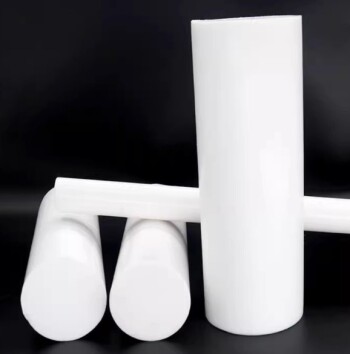
Granular PTFE is commonly processed by compression molding, followed by sintering and, where necessary, CNC machining.
This route produces dense stock shapes such as blocks, billets, tubes, and thick-walled blanks. Laboratories use these forms for:
- Thick-walled beakers and reaction vessels
- Microwave digestion vessels
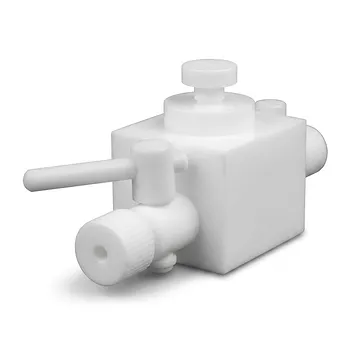
- Valve bodies and fluid fittings
- Custom electrochemical cell components
- Machined liners and structural laboratory parts
The main advantage is dimensional and structural integrity. A molded billet can be machined into a precise component with substantial wall thickness and excellent chemical resistance.
Fine-Powder PTFE for Paste Extrusion
Fine-powder PTFE produced through dispersion-type polymerization is commonly processed by paste extrusion. An extrusion aid allows the powder to form a continuous, coherent preform without conventional melt flow.
This grade is suited to:
- Flexible, thin-walled tubing
- Small-diameter fluid-transfer lines
- Thin liners
- Films and membrane structures
Fine-powder PTFE is therefore not merely a smaller version of granular PTFE. Its particle structure and fibrillation behavior are important to the paste-extrusion process.
Aqueous Dispersion PTFE for Coatings and Films
Liquid PTFE dispersions can be applied by methods such as dipping, spraying, coating, or impregnation, followed by drying and sintering.
They are used for:
- Protective anti-corrosion coatings
- Nonstick or low-friction surfaces
- Coated laboratory hardware
- Thin films and impregnated materials
Dispersion grades are useful when the product needs a thin, conformal layer rather than a thick, machined body.
Why the Difference Matters in Laboratory Applications
Structural Parts Need Bulk Resin
A digestion vessel or custom fitting must maintain its shape under mechanical handling, thermal cycling, and chemical exposure. Granular PTFE supports the compression-molding route needed to create a dense, thick section that can later be machined accurately.
The grade is chosen for bulk consolidation and machinability, not for coating behavior.
Fluid-Transfer Parts Need Processable Fine Resin
Tubing requires a resin that can form a continuous thin wall while retaining PTFE’s chemical resistance and low-friction surface. Fine-powder grades are engineered for paste extrusion and fibrillation, making them more appropriate than standard granular molding resin.
The grade is chosen for continuous forming and flexibility, not for machining a solid block.
Coated Products Need a Stable Liquid Form
A coating must spread across or penetrate a substrate before it is sintered. An aqueous dispersion provides the required liquid handling characteristics and allows a thin PTFE layer to be deposited.
The grade is chosen for application stability, film formation, and surface coverage.
Understanding the Trade-offs
Granular Resin Is Strong for Thick Shapes but Not Flexible Tubing
Granular PTFE is well suited to compression molding and machining, but it is not the preferred material for producing fine, flexible tubing by paste extrusion.
Attempting to use the wrong resin grade can lead to poor consolidation, unsuitable flow behavior, dimensional defects, or inefficient processing.
Dispersion Grades Enable Thin Products but Add Process Complexity
Dispersion and fine-powder grades support coatings, films, membranes, and tubing, but these products often require careful control of extrusion aids, drying, coagulation, sintering, and coating thickness.
A liquid dispersion may also require additional handling controls to prevent settling, contamination, or nonuniform deposition.
Surfactant Selection Can Affect Purity Requirements
Historically, some fluorinated surfactants used in dispersion polymerization included APFO/PFOA-related materials. Modern production increasingly relies on regulated, alternative surfactant systems, but the exact formulation and residual-control requirements must be confirmed with the resin supplier.
For high-purity laboratory and trace-analysis products, the relevant question is not only whether the product is PTFE. It is also whether the resin and manufacturing process meet the required extractables, leachables, and regulatory specifications.
Particle Morphology Affects Final-Part Uniformity
Granular resin morphology influences powder packing, compaction, sintering, density, surface finish, and machining behavior. Fine-powder morphology influences fibrillation and the integrity of extruded thin sections.
Consequently, two PTFE products with similar chemical resistance can behave very differently during fabrication and can deliver different mechanical results in service.
Making the Right Choice for Your Goal
The correct choice begins with the finished product form and its manufacturing route.
- If your primary focus is rigid, thick-walled laboratory equipment: Choose a granular PTFE grade designed for compression molding and subsequent machining.
- If your primary focus is flexible tubing or thin-wall fluid transfer: Choose a fine-powder PTFE grade intended for paste extrusion.
- If your primary focus is a protective or low-friction surface: Choose an aqueous dispersion grade formulated for coating, film formation, or impregnation.
- If your primary focus is trace-analysis or high-purity service: Verify the supplier’s surfactant history, residual controls, extractables data, and compliance documentation rather than relying on the PTFE designation alone.
Matching polymerization-derived resin morphology to the required forming process is the foundation of reliable fluoropolymer laboratory products.
Summary Table:
| Polymerization Method | Resin Grade | Particle Size | Forming Process | Typical Lab Products |
|---|---|---|---|---|
| Suspension | Granular PTFE | Large, precipitated | Compression molding + machining | Rigid components: beakers, vessels, fittings |
| Dispersion | Fine powder (coagulated) | Submicron | Paste extrusion | Flexible tubing, films, thin liners |
| Dispersion | Aqueous dispersion (liquid) | Submicron (in water) | Coating, dipping, spraying | Coatings, non-stick surfaces, impregnated materials |
Need high-quality PTFE labware tailored to your application? From granular PTFE for machined parts to fine-powder tubing and dispersion coatings, KINTEK offers expert guidance and custom solutions. With our advanced CNC machining and end-to-end PTFE/PFA expertise, we ensure optimal performance for your lab. Contact us today to discuss your requirements!
Related Products
- Custom PTFE Filtration System Acid Resistant High Purity Semiconductor Grade Chemical Processing Filter
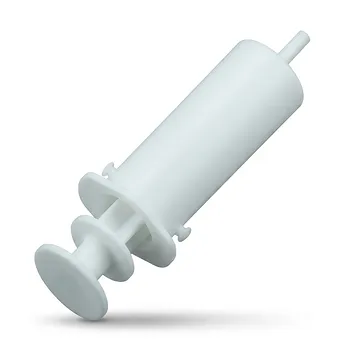
- High Purity Laboratory Grade PTFE Syringe Chemical Resistant Fluoropolymer Injector for Trace Analysis
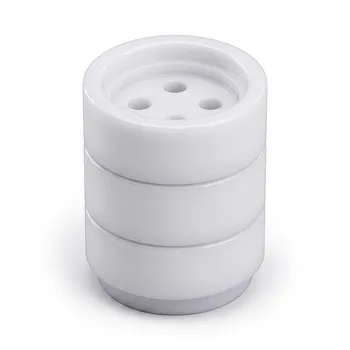
- Custom PTFE Multi Layer Filtration Plates Corrosion Resistant Low Background Lab Grade Filter Assemblies
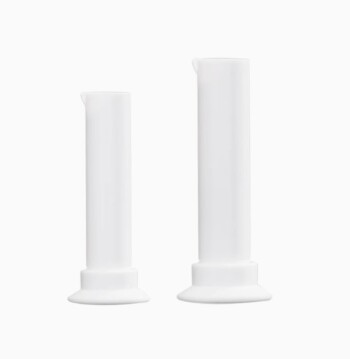
- Custom PTFE Measuring Cylinders for Advanced Scientific and Industrial Applications
- Custom PTFE Petri Dishes Corrosion Resistant High Purity Low Background Labware
People Also Ask
- What makes PTFE filtration systems advantageous for industrial and scientific use? Unmatched Chemical & Thermal Stability
- What sizes and pore options are available for PTFE filters? Choose the Right Filter for Your Application
- What steps are involved in selecting the proper PTFE filter? A 4-Step Guide to Optimal Filtration
- How does the hydrophobicity of PTFE filters benefit their use? Ensure Uninterrupted Gas Flow and Solvent Filtration
- What temperature resistance do PTFE filters offer? Unmatched Thermal Stability from -200°C to +260°C