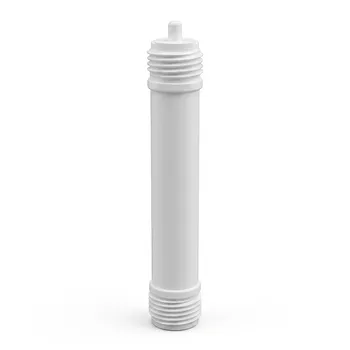
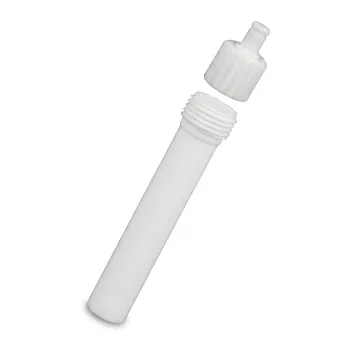
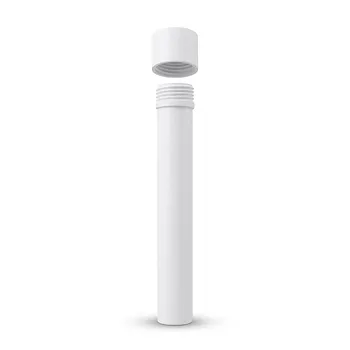
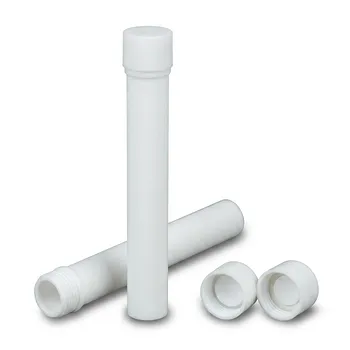
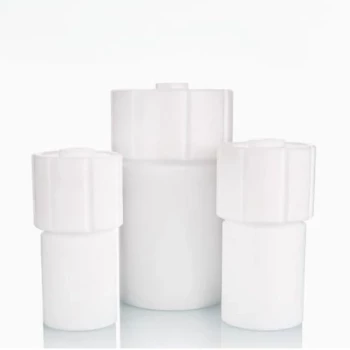
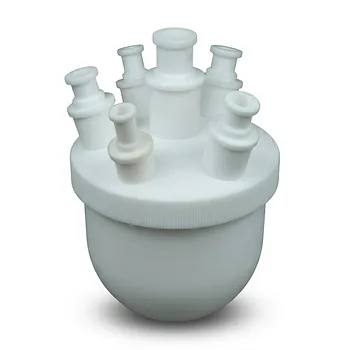
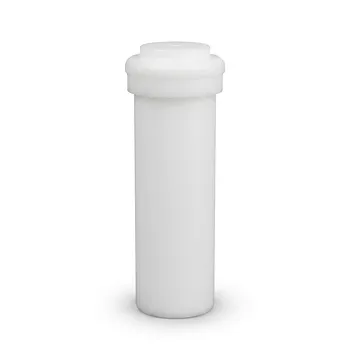
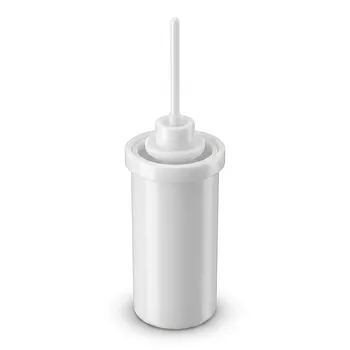
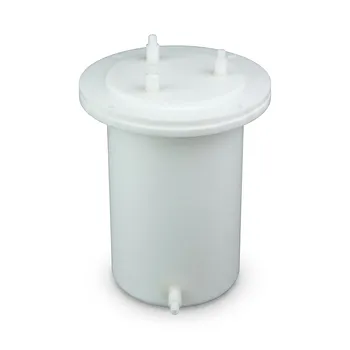
High-purity PTFE liners act as the primary, chemically inert reaction vessel during the microwave hydrothermal synthesis of cobalt-substituted zinc chromate spinel ($Zn_{1-x}Co_xCr_2O_4$). They provide a sealed, non-reactive environment that maintains the necessary reaction pressure while preventing cross-contamination between the metal precursors and the autoclave walls at temperatures up to 220 °C. This isolation is critical for ensuring the stoichiometric precision and phase purity of the resulting ceramic nanopowders.
The central role of the PTFE liner is to provide a "chemical sanctuary" that protects the purity of the spinel structure while shielding the external reactor hardware from corrosive precursors under high-pressure conditions.
The Functional Mechanics of PTFE Liners
Chemical Inertness and Ion Isolation
PTFE (Polytetrafluoroethylene) is utilized because it is virtually non-reactive with the acidic or alkaline media typically used in hydrothermal precursors.
In the synthesis of cobalt-substituted zinc chromate, the liner prevents metal ion leaching from the outer metal autoclave shell into the reaction mixture.
This isolation ensures that the delicate ratio of Cobalt to Zinc is not disrupted by external metallic impurities, which would otherwise degrade the magnetic or catalytic properties of the spinel.
Thermal and Structural Integrity
The liners are engineered to remain structurally sound at temperatures reaching 220 °C, the typical range for microwave hydrothermal processes.
By forming a high-pressure seal, the liner allows the aqueous solvent to reach supercritical or near-supercritical states, which increases the solubility of the precursors.
This pressurized environment accelerates the reaction kinetics, allowing for the formation of the spinel crystal structure in a fraction of the time required by traditional solid-state methods.
Enhancing Material Quality and Recovery
Precision in Crystal Growth
The high-purity environment created by the liner allows for the growth of nanopowders with uniform morphology and consistent crystal structure.
Because the liner is chemically neutral, it does not provide unintended nucleation sites that could lead to irregular particle sizes or secondary phases.
This consistency is vital for researchers who need to study the specific effects of cobalt substitution on the zinc chromate lattice without interference from contaminants.
Non-stick Properties and Product Yield
The low surface energy of PTFE prevents the synthesized $Zn_{1-x}Co_xCr_2O_4$ particles from adhering to the vessel walls.
This non-stick characteristic facilitates the complete recovery of the nanopowders, ensuring that the final yield accurately reflects the initial precursor concentrations.
Furthermore, the ease of cleaning the smooth internal surface reduces the risk of batch-to-batch contamination, which is essential for iterative experimental work.
Understanding the Trade-offs
Temperature and Pressure Limitations
While robust, PTFE has a definitive thermal ceiling; exceeding 220–250 °C can lead to mechanical deformation or "creeping" of the liner.
If the internal pressure exceeds the liner's structural limits, the seal may fail, potentially exposing the outer metal autoclave to corrosive vapors and damaging the equipment.
Wear and Material Memory
Over repeated cycles, PTFE liners can exhibit surface degradation or microscopic pitting, which may trap small amounts of precursors from previous experiments.
For high-precision synthesis, liners must be inspected regularly and replaced if they show signs of discoloration or deformation to maintain the "high-purity" standard.
How to Apply This to Your Project
Evaluating the role of the liner is essential for optimizing your hydrothermal synthesis workflow.
- If your primary focus is phase purity: Ensure you use high-purity, virgin PTFE liners to eliminate the risk of leaching iron or nickel ions from the autoclave shell into your cobalt-substituted spinel.
- If your primary focus is maximum yield: Leverage the non-stick properties of the liner by using a "cold-quench" method to ensure all nanopowders remain in suspension for easy collection.
- If your primary focus is equipment longevity: Never exceed the 220 °C threshold, as thermal stress on the PTFE liner is the most common cause of autoclave failure and precursor contamination.
High-purity PTFE liners are the fundamental components that enable the transition from raw metal salts to high-performance ceramic nanopowders by providing a controlled and uncontaminated reaction space.
Summary Table:
| Key Role | Benefit to Synthesis | Technical Advantage |
|---|---|---|
| Ion Isolation | Phase Purity | Prevents metal ion leaching from autoclave walls |
| Thermal Resistance | High-Pressure Stability | Maintains structural integrity up to 220 °C |
| Non-stick Surface | Maximum Product Yield | Low surface energy enables complete powder recovery |
| Chemical Inertness | Stoichiometric Precision | Neutral environment for delicate cobalt-zinc ratios |
Elevate Your Synthesis Precision with KINTEK’s Fluoropolymer Expertise
Achieve uncompromising material purity with KINTEK’s high-performance PTFE and PFA laboratory supplies. Whether your research requires everyday essentials like beakers and reagent bottles or specialized microwave digestion vessels and hydrothermal synthesis liners, we provide the chemically inert environment your complex spinel preparations demand.
Backed by end-to-end custom CNC fabrication, KINTEK delivers everything from complex non-standard machined parts to high-volume consumables, maintaining an absolute focus on high-performance fluoropolymers. Secure the stoichiometric accuracy of your next project—contact our experts today for a custom quote!
References
- Manal Hessien, Mohammed A. Taha. Optimizing Magnetic, Mechanical, and Electrical Properties of Cobalt-Substituted Zinc Chromite Spinel via Microwave-Hydrothermal Synthesis. DOI: 10.1007/s10904-025-03592-z
This article is also based on technical information from Kintek Knowledge Base .
Related Products
- High Purity TFM Microwave Digestion Vessels PTFE Acid Evaporation Liners Domestic GT-400 Equivalent Laboratory Reaction Containers
- High Purity PTFE Microwave Digestion Vessel for Soil and Food Analysis Acid Resistant Fluoropolymer Sample Preparation Liners
- High Purity PTFE Microwave Digestion Vessel Replacement Liner for Acid Sample Preparation and Trace Analysis
- High Purity PTFE Digestion Tubes for Microwave Systems Soil and Food Trace Analysis Acid Resistant Customizable
- High Purity PTFE Microwave Digestion Vessels for 44 Position Systems Trace Analysis Acid Digestion and Evaporation
People Also Ask
- Why is PTFE preferred for microwave-assisted Ln-MOF synthesis? Key Benefits for Purity & Speed
- How does the dielectric property of PTFE benefit microwave-assisted digestion? Unlock Rapid and Uniform Sample Heating
- What safety features are commonly integrated into microwave digestion vessels? Ensuring High-Pressure Laboratory Safety
- What are the advantages of using microwave digestion vessels for environmental analysis? Boost speed and sample accuracy.
- What are the advantages of using microwave digestion vessels? Optimize EG@MO synthesis with superior thermal control.