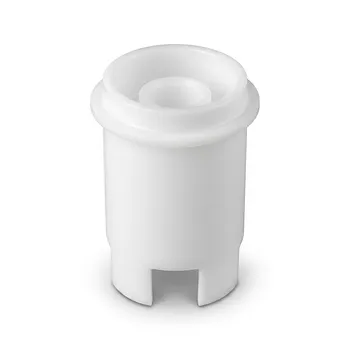
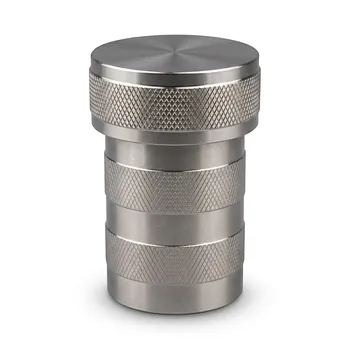
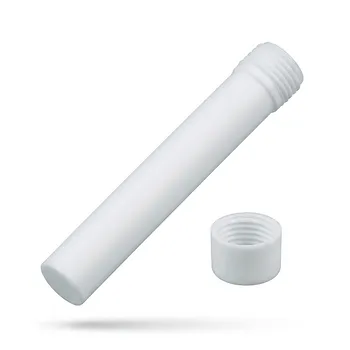
The hydrothermal synthesis of $\text{NiCo}_2\text{O}_4$ requires a PTFE-lined stainless steel autoclave to create a pressurized, chemically isolated environment. This specific equipment setup allows the reaction to occur at temperatures exceeding the boiling point of the solvent while preventing the corrosive precursor solution from reacting with the vessel walls.
Core Takeaway: The PTFE liner acts as a critical chemical barrier that prevents metal ion contamination and corrosion, while the stainless steel shell provides the structural strength necessary to contain the high autogenous pressure required for the nucleation of high-purity $\text{NiCo}_2\text{O}_4$ nanostructures.
The Dual Role of the Autoclave Components
Structural Integrity of the Stainless Steel Shell
The stainless steel outer shell serves as the "pressure vessel" that maintains a sealed environment under high temperatures. As the internal temperature rises, the liquid precursors generate autogenous pressure, which is essential for accelerating reaction kinetics and forcing the growth of specific crystal facets.
Chemical Isolation via the PTFE Liner
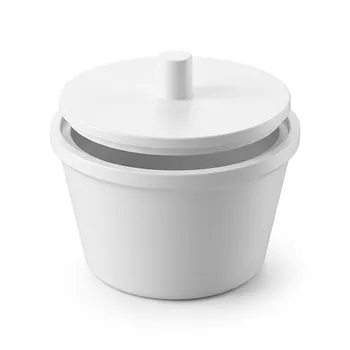
Polytetrafluoroethylene (PTFE) is used because of its exceptional chemical inertness. In $\text{NiCo}_2\text{O}_4$ synthesis, reagents like ammonium fluoride ($\text{NH}_4\text{F}$) or strong alkaline solutions are often present; the PTFE liner prevents these aggressive chemicals from eroding the metal shell.
Prevention of Metal Ion Contamination
Without the liner, the acidic or basic precursor solution would leach iron, nickel, or chromium ions from the stainless steel walls. This contamination would disrupt the stoichiometry of the $\text{NiCo}_2\text{O}_4$ crystal lattice, significantly impairing its electrochemical performance and purity.
Facilitating Controlled Nanostructure Growth
Achieving High-Purity Nucleation
The combination of high pressure and chemical isolation ensures that the nucleation and growth of $\text{NiCo}_2\text{O}_4$ occur uniformly. This controlled environment is necessary to produce high-purity nanostructures with the specific morphology required for applications like supercapacitors or catalysts.
Enhancing Reaction Kinetics
The sealed, high-pressure environment allows the reaction to proceed at temperatures (often between 150°C and 180°C) that would be impossible in an open system. This elevated energy state facilitates the transformation of precursors into the desired oxide phase more efficiently and with higher crystallinity.
Managing Morphology and Surface Area
The pressurized confined space encourages the active material to grow into two-dimensional nanosheets or complex frameworks. This results in a high specific surface area, which is vital for maximizing the active sites available for electrochemical reactions.
Understanding the Trade-offs and Limitations
Temperature Constraints of PTFE
While PTFE is highly inert, it has a functional temperature limit, typically around 220°C to 250°C. Exceeding these temperatures can cause the liner to soften or deform, potentially leading to a seal failure or "creeping" of the material.
Thermal Expansion Mismatch
PTFE and stainless steel have different coefficients of thermal expansion. If the autoclave is heated or cooled too rapidly, the liner may lose its tight fit, increasing the risk of precursor leakage between the liner and the steel shell, which leads to shell corrosion.
Pressure Limits and Safety
Hydrothermal reactions generate significant internal pressure that increases exponentially with temperature. Users must strictly adhere to filling degree limits (usually 60-80% of volume) to prevent over-pressurization and potential vessel rupture.
How to Apply This to Your Project
The choice of autoclave configuration depends heavily on your specific synthesis parameters and desired material properties.
- If your primary focus is High Purity: Ensure the PTFE liner is thoroughly cleaned with dilute acid between runs to remove residual metal ions that could act as dopants in your next $\text{NiCo}_2\text{O}_4$ batch.
- If your primary focus is Complex Morphology: Utilize the autogenous pressure by maintaining a consistent filling ratio (around 70%) to ensure the uniform growth of "cactus-like" or nanosheet structures.
- If your primary focus is Reaction Safety: Never exceed the 220°C threshold when using a standard PTFE liner; if higher temperatures are required, consider a PPL (Polyphenylene polymers) liner which can withstand up to 280°C.
By isolating the reaction chemistry from the structural hardware, the PTFE-lined autoclave ensures the reliable and repeatable synthesis of high-performance nanomaterials.
Summary Table:
| Component | Primary Function | Key Benefit for NiCo2O4 Synthesis |
|---|---|---|
| PTFE Liner | Chemical Inertness | Prevents metal ion leaching and shell corrosion from aggressive reagents. |
| Stainless Steel Shell | Pressure Containment | Maintains structural integrity under high autogenous pressure (150-180°C). |
| Sealed System | Enhanced Kinetics | Accelerates nucleation and growth of high-surface-area 2D nanosheets. |
| Environment | Controlled Isolation | Ensures stoichiometric purity and consistent electrochemical performance. |
Elevate Your Research with High-Performance Fluoropolymer Solutions
Precision in hydrothermal synthesis starts with high-purity equipment. At KINTEK, we maintain an absolute focus on high-performance fluoropolymer materials to protect your results from contamination.
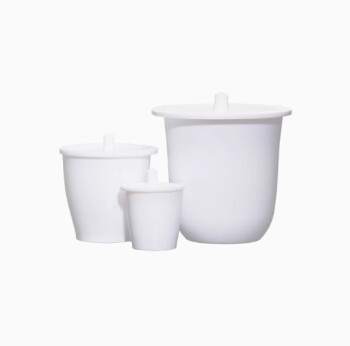
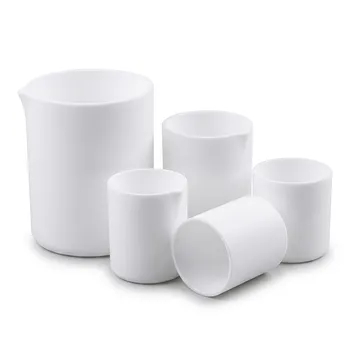
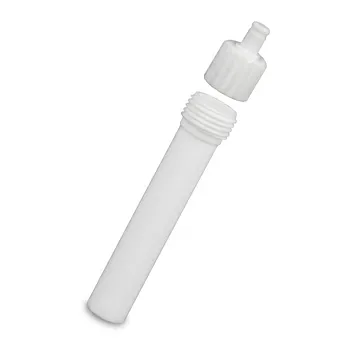
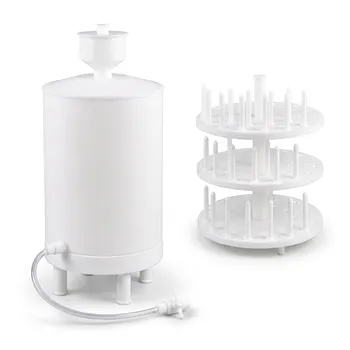
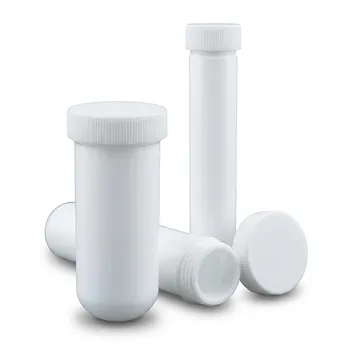
From everyday basic labware like PTFE/PFA beakers, crucibles, and digestion tubes to comprehensive fluid transfer components (tubing, fittings, valves) and advanced reaction apparatus like custom hydrothermal synthesis liners and electrochemical cells, we provide everything you need for a sterile, high-pressure environment.
Why choose KINTEK?
- Custom Fabrication: End-to-end CNC machining for complex, non-standard parts and bespoke laboratory setups.
- Total Reliability: We manufacture virtually all laboratory supplies from PFA and PTFE, ensuring uniform chemical resistance.
- Scalable Solutions: From individual research tools to high-volume orders for industrial labs.
Contact us today to discuss how our custom-engineered fluoropolymer solutions can enhance your laboratory's efficiency and purity!
References
- Ashutosh Patel, Nand Kumar Shante. Facile binder-free hydrothermal synthesis of NiCo2O4 using different reagents: a study as efficient supercapacitor electrode. DOI: 10.1038/s41598-025-21751-7
This article is also based on technical information from Kintek Knowledge Base .
Related Products
- Custom TFM Reaction Vessel with Stainless Steel Jacket and PTFE Inner Cup for High Corrosion Resistance
- PTFE Lined High Pressure Digestion Vessel 50ml High Temperature Hydrothermal Synthesis Tank
- High Pressure Custom TFM Reactor Stainless Steel Outer Vessel PTFE Inner Cup for Corrosive Synthesis
- High Pressure PTFE Digestion Vessel Inner Cup Holder Custom Corrosion Resistant Low Background Teflon
- High Temperature Corrosion Resistant Hydrothermal Synthesis Reactor with TFM Inner Liner and Straight Cylinder Design
People Also Ask
- Why are high-performance pressure-resistant reaction vessels required for oxygen-assisted hydrothermal conversion at 150 °C?
- Why are PTFE-lined reaction vessels necessary for forced degradation studies? Ensure high-purity results and accuracy.
- Why are high-quality fluoropolymer-lined reaction vessels required for alk-Ti3C2Tx MXene? Ensure Purity & HF Resistance
- How do magnetic stirring and reaction vessels impact MOF-derived carbon quality? Optimize Your Composite Performance
- Why is a high-purity PTFE lined reaction vessel required for the acidic etching of MXenes? Ensure Material Purity.