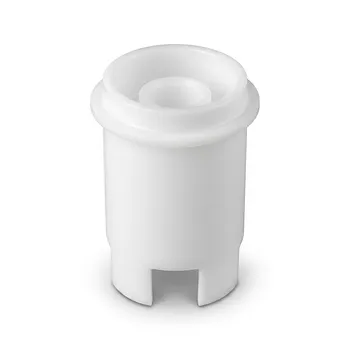
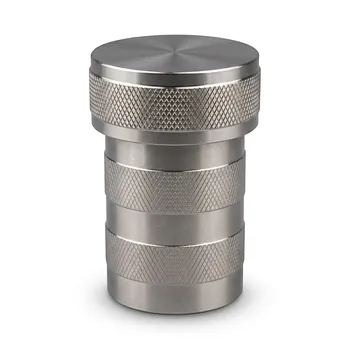
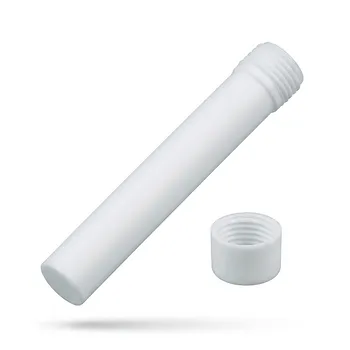
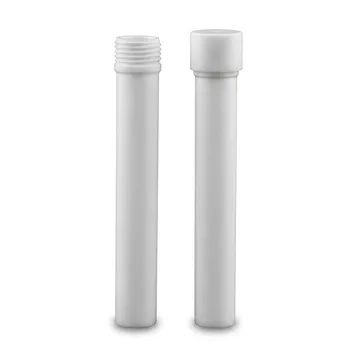
The PTFE-lined stainless steel high-pressure autoclave acts as the specialized reactor that enables the hydrothermal synthesis of hierarchical $MnSb_2O_6$ particles. It provides a sealed, high-temperature (180 °C) and high-pressure environment that triggers a dissolution-recrystallization mechanism. This specific process allows manganese and antimony precursors to transform into complex, flower-like hierarchical structures with high specific surface areas.
Core Takeaway: The autoclave provides the thermodynamic conditions necessary to drive crystal growth while the PTFE liner ensures chemical purity, collectively allowing $MnSb_2O_6$ to achieve its unique hierarchical morphology without contamination.
The Synergistic Design of the Reaction Vessel
High-Pressure Containment and Mechanical Integrity
The stainless steel outer shell of the autoclave is designed to provide the mechanical strength required to withstand autogenous pressure. During the hydrothermal process, the internal pressure rises significantly as the temperature reaches 180 °C. This pressure is vital for maintaining the liquid state of the solvent and increasing the solubility of the precursors.
Chemical Inertness and Purity Control
The PTFE (Polytetrafluoroethylene) liner is selected for its superior chemical inertness. It serves as a protective barrier that prevents highly acidic or alkaline reaction solutions from corroding the stainless steel walls. By isolating the reaction from the metal shell, it minimizes the introduction of metallic impurities into the $MnSb_2O_6$ sample.
Ease of Material Recovery
The extremely smooth surface of the PTFE lining is beneficial during the final stages of synthesis. It prevents the synthesized powder sediments from adhering strongly to the vessel walls. This ensures a more efficient recovery and collection of the solid $MnSb_2O_6$ precipitates after the reaction is complete.
Driving the Morphology of Hierarchical $MnSb_2O_6$
Facilitating the Dissolution-Recrystallization Mechanism
The autoclave enables the reaction to occur at temperatures exceeding the normal boiling point of the solvent. This high-energy environment facilitates a dissolution-recrystallization mechanism, where poorly soluble precursors are broken down and reorganized. This mechanism is the fundamental driver behind the formation of the $MnSb_2O_6$ crystal structure.
Attaining Complex Hierarchical Architectures
The stable, enclosed environment allows for precise control over the nucleation and growth phases. This stability is what permits the particles to assemble into flower-like hierarchical structures. These architectures are highly valued because they provide a significantly higher specific surface area compared to standard nanoparticles.
Understanding the Trade-offs and Constraints
Temperature and Pressure Limitations
While PTFE is highly resistant to chemicals, it has a functional temperature limit, typically around 220-250 °C. Operating the autoclave near these limits for extended periods can lead to liner deformation or "creeping." It is essential to match the reaction temperature (e.g., 180 °C) carefully to the material limits of the liner.
Safety Risks of Autogenous Pressure
The pressure inside the vessel is generated by the heating of the precursors and solvents in a confined space. If the autoclave is overfilled (typically beyond 70-80% capacity), the internal pressure can exceed the safety rating of the stainless steel shell. This presents a risk of mechanical failure or explosion if safety protocols are ignored.
How to Apply This to Your Project
When utilizing a PTFE-lined autoclave for hydrothermal synthesis, your approach should vary based on your specific material requirements:
- If your primary focus is high purity: Ensure the PTFE liner is thoroughly cleaned with acid between uses to prevent cross-contamination from previous reactions.
- If your primary focus is morphology control: Maintain a constant temperature (e.g., 180 °C) for the duration of the reaction to ensure the dissolution-recrystallization process yields uniform hierarchical structures.
- If your primary focus is safety and longevity: Never exceed the recommended filling degree of the liner to avoid over-pressurization of the stainless steel outer shell.
By leveraging the controlled environment of the autoclave, researchers can reliably produce $MnSb_2O_6$ with the precise structural characteristics required for advanced applications.
Summary Table:
| Component | Primary Function | Key Benefit for MnSb2O6 |
|---|---|---|
| Stainless Steel Shell | High-pressure containment | Maintains structural integrity at 180°C |
| PTFE Liner | Chemical isolation | Prevents metallic contamination; high purity |
| Thermal Control | Thermodynamic driver | Enables dissolution-recrystallization mechanism |
| Smooth Surface | Sediment prevention | Maximizes recovery of hierarchical powders |
Elevate Your Synthesis with KINTEK’s Precision Fluoropolymer Labware
Achieving complex hierarchical structures like MnSb2O6 requires a perfect balance of chemical purity and thermal stability. KINTEK specializes in high-performance fluoropolymer materials designed for the most demanding hydrothermal environments.
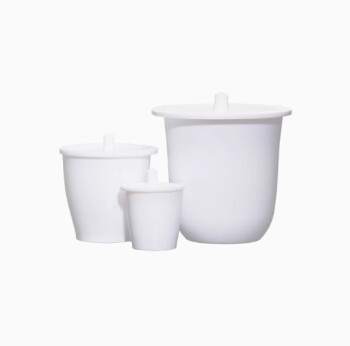
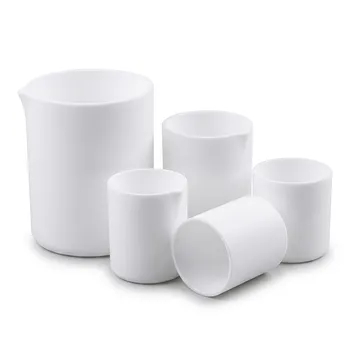
From everyday basic labware—including beakers, crucibles, and reagent bottles—to advanced reaction apparatus like PTFE-lined hydrothermal synthesis liners, microwave digestion vessels, and custom electrochemical cells, we provide the tools necessary for scientific breakthroughs. Our expertise extends to fluid transfer components (tubing, fittings, valves), sample prep tools (filters, pipettes), and high-purity trace analysis instruments.
Backed by end-to-end custom CNC fabrication, we deliver everything from complex non-standard machined parts to high-volume orders with an absolute focus on PTFE and PFA performance.
Ready to optimize your laboratory setup? Contact us today to discuss your custom project requirements!
References
- Dilges Baskin. Hierarchical MnSb₂O₆ Particles for Dispersive Solid-Phase Extraction of Co(II) from Wastewater by Flame Atomic Absorption Spectrometry. DOI: 10.53433/yyufbed.1718800
This article is also based on technical information from Kintek Knowledge Base .
Related Products
- Custom TFM Reaction Vessel with Stainless Steel Jacket and PTFE Inner Cup for High Corrosion Resistance
- PTFE Lined High Pressure Digestion Vessel 50ml High Temperature Hydrothermal Synthesis Tank
- High Pressure Custom TFM Reactor Stainless Steel Outer Vessel PTFE Inner Cup for Corrosive Synthesis
- High Pressure PTFE Digestion Vessel Inner Cup Holder Custom Corrosion Resistant Low Background Teflon
- High Temperature Corrosion Resistant Hydrothermal Synthesis Reactor with TFM Inner Liner and Straight Cylinder Design
People Also Ask
- Why are high-performance pressure-resistant reaction vessels required for oxygen-assisted hydrothermal conversion at 150 °C?
- How do magnetic stirring and reaction vessels impact MOF-derived carbon quality? Optimize Your Composite Performance
- Why are high-quality fluoropolymer-lined reaction vessels required for alk-Ti3C2Tx MXene? Ensure Purity & HF Resistance
- Why are PTFE-lined reaction vessels necessary for forced degradation studies? Ensure high-purity results and accuracy.
- Why is a high-purity PTFE lined reaction vessel required for the acidic etching of MXenes? Ensure Material Purity.