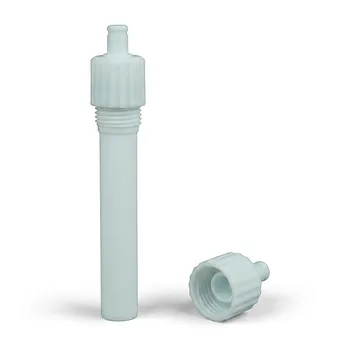
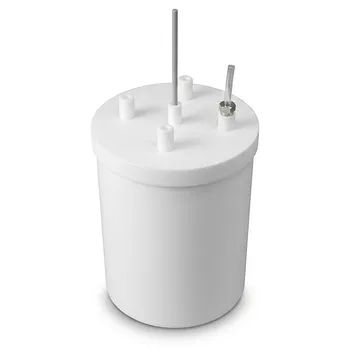
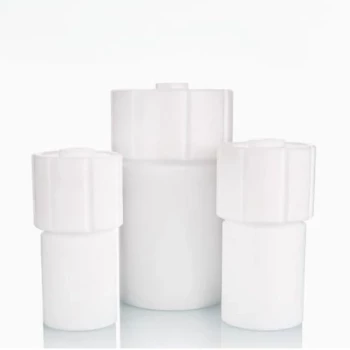
Modifying PTFE with a small amount of perfluoropropyl vinyl ether (PPVE) improves its dimensional stability, creep resistance, and weldability without sacrificing the chemical purity that makes PTFE valuable. With less than 0.5% PPVE by weight, the bulky perfluoropropyl side groups disrupt excessive recrystallization as the material cools. This reduces microvoid formation and permeability, helping digestion vessels and custom chemical components maintain their shape and containment performance under demanding conditions.
The central benefit of PPVE-modified PTFE is better physical performance with the same highly inert fluoropolymer foundation. It is especially useful when a component must resist aggressive chemistry while also maintaining low contamination, low permeability, tight dimensions, and reliable thermal welds.
Why Conventional PTFE Can Limit Vessel Performance
Cold flow reduces dimensional stability
Conventional PTFE can gradually deform when exposed to sustained mechanical loads. This behavior, commonly called cold flow or creep, can affect sealing surfaces, vessel geometry, threaded features, and machined interfaces.
In a digestion vessel or custom fluid-handling component, even small dimensional changes can influence pressure containment, fit, alignment, or the reliability of a seal.
Cooling can create microvoids
PTFE can undergo substantial recrystallization during cooling after processing. Excessive recrystallization may contribute to microscopic voids within the material structure.
These microvoids can increase permeability and reduce confidence in long-term containment, particularly where vessels must retain aggressive reagents or prevent the loss of volatile components during digestion.
Welding is challenging
Unmodified PTFE is difficult to thermally weld because its processing behavior does not readily support strong, consistent fusion between components. This limits the practical design of fabricated vessels, joined assemblies, and custom chemical apparatus.
For complex apparatus, machining alone may not provide the desired geometry. Improved weldability enables more reliable construction of integrated or customized fluoropolymer components.
How PPVE Changes the PTFE Structure
Bulky side groups interrupt recrystallization
PPVE introduces a small amount of comonomer into the PTFE molecular structure. The bulky perfluoropropyl side groups interfere with the orderly packing and excessive recrystallization of PTFE chains during cooling.
This molecular adjustment does not turn PTFE into a different chemical category. Instead, it fine-tunes the polymer structure to improve important mechanical and processing characteristics.
Lower microvoid content improves containment
By limiting excessive recrystallization, PPVE modification can substantially reduce microvoid formation. A less void-prone structure supports lower permeability and more dependable retention of liquids and vapors.
That matters in digestion workflows where an airtight vessel helps prevent sample loss, including the loss of volatile elements, while maintaining the intended chemical environment.
The modification remains chemically conservative
The PPVE concentration described in the reference is less than 0.5% by weight. The resulting material retains the strongly fluorinated structure responsible for PTFE's exceptional resistance to aggressive acids, corrosive reagents, and typical organic and inorganic solvents.
For high-purity work, the relevant point is that the mechanical improvement does not require introducing a conventional reinforcing additive that could create a source of contamination or chemical incompatibility.
Benefits for High-Purity Digestion Vessels
Improved resistance to creep under load
Microwave digestion vessels and similar containment systems can experience sustained mechanical and thermal stresses. Improved creep resistance helps the vessel preserve its geometry and sealing interfaces over repeated use.
This supports more consistent operation, especially when the vessel design depends on accurate mating surfaces, controlled closure, or stable internal volume.
Better retention during aggressive digestion
High-purity PTFE and related fluoropolymers are selected for digestion because they resist strong acids and corrosive chemical systems while contributing very low background contamination. PPVE modification adds structural reliability to that chemical-resistance platform.
The resulting vessel is better suited to workflows that require chemical containment, low permeability, and stable performance during high-temperature and high-pressure digestion conditions.
Lower risk of analytical contamination
Trace-element analysis depends on controlling contamination from the vessel itself. High-purity fluoropolymers have very low metal-ion leaching and low surface adsorption, reducing the likelihood that elements such as nickel, lead, arsenic, cadmium, or antimony will be added to or lost from the sample.
PPVE modification primarily improves the material's physical behavior. It therefore complements, rather than replaces, the importance of resin purity, manufacturing cleanliness, surface preparation, and validated cleaning procedures.
More reliable handling of difficult matrices
Plant tissues and other organic matrices may require aggressive acid systems and thorough digestion. A stable, low-permeability vessel helps maintain the closed environment needed for complete decomposition and reliable recovery.
The material supports the analytical process by resisting corrosion, minimizing background contribution, and helping contain the digestion mixture throughout the cycle.
Benefits for Custom Chemical Apparatus
More stable machined components
Custom CNC-machined PTFE parts may include thin walls, channels, seats, grooves, ports, and close-fitting interfaces. Improved creep resistance helps these features retain their intended dimensions under service loads.
This is valuable in liquid-handling components, electrochemical cells, manifolds, and custom vessels where dimensional drift can affect flow, sealing, electrode positioning, or fluid volume.
More practical welded assemblies
Improved thermal welding characteristics expand the design options for custom apparatus. Components can be joined into assemblies that would be difficult or unreliable to produce using unmodified PTFE alone.
The benefit is not simply manufacturing convenience. A better weld can support more dependable containment and reduce the need for mechanically complex joints that may introduce additional leakage paths or crevices.
Lower permeability supports cleaner processes
In chemical apparatus, low permeability helps prevent reagent loss and reduces unwanted transfer through the polymer wall. This is particularly important when working with volatile chemicals, highly purified reagents, or processes where external contamination must be minimized.
For electrochemical cells and liquid-handling systems, stable containment also helps preserve the intended composition of the working solution.
Consistent chemical compatibility
The underlying carbon-fluorine structure remains the reason PTFE-based materials perform well against strong acids, organic solvents, and other aggressive reagents. Modified PTFE is therefore suited to applications where chemical inertness and mechanical reliability must coexist.
Material selection still requires checking the actual chemicals, temperatures, pressures, loading conditions, and fabrication method for the specific apparatus.
Understanding the Trade-offs
Modification does not remove all PTFE limitations
PPVE modification reduces creep and microvoid-related weaknesses, but it does not make the material immune to deformation, wear, or processing constraints. Long-term performance still depends on temperature, load, geometry, stress concentration, and exposure conditions.
Designers should treat the modification as a performance improvement, not as a substitute for engineering analysis.
Purity depends on the complete supply chain
A low-contamination resin can still produce an unsuitable component if it is processed with contaminated tooling, improperly cleaned, or exposed to unsuitable manufacturing environments. Polymer grade alone does not guarantee analytical cleanliness.
For trace analysis, qualification should include resin specification, fabrication controls, cleaning procedures, blanks, and application-specific leach testing where appropriate.
Modified PTFE is not automatically interchangeable with PFA
PFA and modified PTFE both serve high-purity applications, but they are not identical materials. Their processing behavior, flexibility, weldability, permeability, and suitability for particular geometries can differ.
The correct choice depends on whether the priority is machining, thermal fabrication, transparency, flexibility, pressure performance, or a particular digestion-vessel design.
Operating limits remain application-specific
High-temperature and high-pressure digestion conditions require a vessel designed for the complete system, including closure hardware and pressure-control features. Chemical resistance by itself does not establish a safe pressure or temperature rating.
The final apparatus should be validated against the intended acid mixture, thermal cycle, mechanical loading, and reuse requirements.
Making the Right Choice for Your Goal
Use the material decision to match the dominant risk in the application.
- If your primary focus is trace-element accuracy: Specify a high-purity modified PTFE grade and control fabrication, cleaning, and blank-testing practices to minimize leaching, adsorption, and cross-contamination.
- If your primary focus is dimensional stability: Use PPVE-modified PTFE where sustained loads, repeated digestion cycles, or close-fitting machined features make creep resistance important.
- If your primary focus is sealed or integrated apparatus: Favor the improved thermal welding characteristics of modified PTFE, then validate weld integrity and containment under actual service conditions.
- If your primary focus is volatile-sample retention: Prioritize the lower microvoid content and low-permeability structure, together with an airtight vessel design and validated operating procedure.
- If your primary focus is chemical compatibility: Confirm that the modified PTFE grade, fabrication process, and complete assembly are compatible with the specific reagents, temperatures, pressures, and exposure duration.
PPVE-modified PTFE is most valuable when high-purity chemical resistance must be combined with reliable mechanical shape, containment, and fabrication performance.
Summary Table:
| Property | Conventional PTFE | PPVE-Modified PTFE |
|---|---|---|
| Dimensional Stability | Lower (prone to cold flow) | Higher (reduced creep) |
| Microvoid Formation | More likely (due to recrystallization) | Reduced (interrupted recrystallization) |
| Permeability | Higher (due to microvoids) | Lower (less void content) |
| Weldability | Poor | Improved (better thermal welding) |
| Chemical Purity | Very High | Very High (unchanged) |
| Suitability for Digestion Vessels | Good but may deform/leak | Better (stable, low permeability) |
| Suitability for Custom Apparatus | Limited by creep/weld issues | Enhanced (dimensional stability, weldability) |
Upgrade your high-purity digestion vessels and custom chemical apparatus with PPVE-modified PTFE. At KINTEK, we specialize in high-performance fluoropolymers, offering a complete range of labware and custom CNC-machined parts. Our expertise ensures optimal material selection and fabrication to meet your exact needs, enhancing reliability and performance in your most demanding applications. Contact us today to discuss your custom requirements and benefit from our tailored solutions.
Related Products
- High Purity PTFE Microwave Digestion Vessel for Soil and Food Analysis Acid Resistant Fluoropolymer Sample Preparation Liners
- High Purity PTFE Microwave Digestion Vessel Replacement Liner for Acid Sample Preparation and Trace Analysis
- High Purity PTFE Microwave Digestion Vessels for 44 Position Systems Trace Analysis Acid Digestion and Evaporation
- Industrial High Purity PTFE Digestion Tubes Chemical Resistant Teflon Labware Custom Fabricated Trace Analysis Vessels
- High Purity Laboratory Microwave Digestion Vessel Customizable PFA PTFE Digestion Tank for Analytical Sample Preparation Trace Metal Analysis
People Also Ask
- Why is PTFE preferred for microwave-assisted Ln-MOF synthesis? Key Benefits for Purity & Speed
- How does the dielectric property of PTFE benefit microwave-assisted digestion? Unlock Rapid and Uniform Sample Heating
- What are the advantages of using microwave digestion vessels? Optimize EG@MO synthesis with superior thermal control.
- What safety features are commonly integrated into microwave digestion vessels? Ensuring High-Pressure Laboratory Safety
- What are the advantages of using microwave digestion vessels for environmental analysis? Boost speed and sample accuracy.