PFA melts at a slightly lower temperature than PTFE and is dramatically easier to process. PTFE has a crystalline melting point of approximately 327°C, but its melt viscosity is so high that it behaves more like a non-flowing gel than a conventional thermoplastic. PFA melts at roughly 302°C to 310°C and has far lower melt viscosity, allowing injection molding, extrusion, and other standard melt-processing methods.
The practical distinction is processability, not operating temperature: both PTFE and PFA can support continuous service temperatures up to approximately 260°C and provide excellent chemical resistance, but PTFE generally requires compression molding, sintering, and machining, while PFA can be molded directly into complex laboratory components.
Why the Melting Point Does Not Tell the Whole Story
PTFE Has the Higher Melting Temperature
Granular PTFE melts at approximately 327°C. Some fabrication processes may heat PTFE above this transition to achieve proper sintering, but heating it does not produce the free-flowing melt associated with ordinary thermoplastics.
PTFE's exceptionally high molecular weight creates a melt viscosity in the approximate range of 10^10 to 10^12 Pa·s. This makes conventional injection molding and standard melt extrusion impractical.
PFA Melts at a Lower Temperature
PFA typically has a melting range of approximately 302°C to 310°C, depending on grade and formulation. Its lower melting range reduces the thermal demands of fabrication compared with PTFE.
More importantly, PFA's melt viscosity is approximately 4 × 10^3 to 3 × 10^4 Pa·s. That is low enough for the polymer to flow through molds and dies, enabling conventional thermoplastic manufacturing.
Molecular Structure Drives the Processing Difference
PTFE has a highly linear, fluorine-protected carbon backbone and very high molecular weight. When heated, it forms a stiff, highly viscous gel rather than flowing readily through processing equipment.
PFA incorporates perfluoroalkoxy side groups into the polymer structure. These groups reduce crystallinity and melt viscosity, allowing PFA to be processed more like a conventional thermoplastic while preserving much of PTFE's chemical and thermal performance.
How Each Material Is Fabricated
PTFE Requires a Non-Melt Fabrication Route
Custom PTFE equipment is commonly produced by compression molding or powder processing, followed by sintering. Finished parts may then be machined from molded blanks or solid stock using CNC equipment.
This route is well suited to robust blocks, seals, gaskets, stirrer components, and custom structural labware. It also supports highly customized dimensions without requiring a dedicated injection mold.
PFA Supports Conventional Melt Processing
PFA can be injection molded, extruded, and melt-formed into finished components. This makes it suitable for tubing, bottles, fittings, valves, reaction vessels, and fluid-handling parts with intricate geometry.
Melt processing can also support repeatable production of complex internal channels and thin-walled or translucent components. For high-purity fluid systems, this can reduce the need for extensive post-machining and help produce consistent flow paths.
Machining Still Has a Role in PFA Fabrication
PFA's melt processability does not eliminate machining. CNC machining remains useful for prototypes, low-volume parts, dimensional correction, and geometries that are difficult or uneconomical to mold.
The difference is that PFA gives designers both options: it can be molded for production efficiency or machined for customization.
Choosing Based on Laboratory Equipment Geometry
PTFE Fits Simple, Robust, or Highly Customized Parts
PTFE is often the practical choice when the component can be machined or compression molded and requires maximum non-stick behavior or low friction. Its low coefficient of friction is particularly useful for sliding seals, stir bars, and moving interfaces.
PTFE is also valuable for parts exposed to cryogenic temperatures, with structural performance extending to approximately -267°C in suitable applications. The exact limit depends on grade, design, loading, and thermal cycling.
PFA Fits Complex Molded Fluid Paths
PFA is advantageous when the equipment contains intricate channels, molded ports, thin walls, or integrated fittings. Its melt flow enables the production of complex fluid-handling components that would require substantial machining or assembly if made from PTFE.
PFA is also commonly selected when translucency or visual inspection of the contents is useful, such as in bottles, containers, and certain reaction vessels.
Both Materials Suit Aggressive Chemical Environments
PTFE and PFA provide exceptional resistance to strong acids, bases, and many organic solvents. Both are appropriate candidates for demanding laboratory containment and fluid-transfer applications, subject to the specific chemicals, temperatures, pressures, and exposure times involved.
Neither material should be selected from a general chemical-resistance table alone. The complete operating environment, including mechanical loads and permeation requirements, must be evaluated.
Performance That Is Broadly Comparable
Continuous Temperature Capability Is Similar
Both PTFE and PFA offer continuous-use temperatures of approximately 260°C. Therefore, PFA's easier processing does not generally mean that it has a lower practical continuous operating limit than PTFE.
The relevant distinction is manufacturing temperature and flow behavior, not a large difference in normal service-temperature capability.
Chemical Resistance Remains a Core Strength
PFA retains a highly fluorinated structure and offers chemical resistance comparable to PTFE for many laboratory applications. It is frequently used for high-purity fluid transfer and containment where chemical inertness and cleanability are essential.
The actual performance can vary by grade, stress state, temperature, and chemical exposure. Weld lines, molded-in stress, and thin sections may also affect long-term reliability.
Thermal and Flame Performance Are Comparable
Both materials offer high thermal stability and strong flame resistance, including UL 94 V-0 performance in the reference comparison. These properties support their use near hot processes and in chemically demanding laboratory environments.
Processing temperatures must still be controlled carefully because fabrication occurs near or above the polymers' melting ranges.
Understanding the Trade-offs
PTFE Offers Machining Freedom but Lower Production Efficiency
PTFE can be economical for one-off equipment, prototypes, and parts whose geometry is easier to machine than to mold. However, its non-melt processability makes automated, high-volume molding difficult.
Machining can also create material waste and may be limited when the design contains inaccessible internal passages or highly integrated features.
PFA Enables Complex Molding but Requires Tooling
PFA's melt processability improves design flexibility and production repeatability, but injection molding and extrusion generally require dedicated tooling and careful process control. Tooling costs may be difficult to justify for a single custom component.
PFA also has a slightly higher coefficient of friction than PTFE, so PTFE may remain preferable where minimum friction or maximum non-stick performance is the primary requirement.
Processing Can Affect Part Quality
PFA molding can introduce weld lines, residual stresses, dimensional variation, and defects if temperature, pressure, cooling, or mold design are poorly controlled. PTFE sintering can likewise affect shrinkage, porosity, and dimensional accuracy.
Critical laboratory components should therefore be specified by material grade, fabrication method, tolerances, surface finish, and inspection requirements rather than by polymer name alone.
Thermal Ratings Do Not Replace Mechanical Design
A 260°C continuous-use rating does not mean that a part will retain its full strength or dimensional stability at that temperature. Pressure, wall thickness, creep, sealing loads, thermal cycling, and chemical exposure must be assessed together.
For pressure-bearing or safety-critical equipment, the fabricator should validate the design under the actual operating conditions.
Making the Right Choice for Your Goal
Material selection should follow the part's geometry, production volume, and performance priorities.
- If your primary focus is one-off custom equipment or maximum non-stick performance: Choose PTFE when compression molding and CNC machining can produce the required geometry and its lower friction is valuable.
- If your primary focus is complex molded geometry: Choose PFA when integrated channels, fittings, thin walls, or intricate fluid paths make conventional molding advantageous.
- If your primary focus is repeated production: Favor PFA when tooling costs are justified by consistent injection-molded or extruded output.
- If your primary focus is cryogenic service: Evaluate PTFE first because it maintains structural integrity at exceptionally low temperatures, while still verifying the selected grade and design.
- If your primary focus is high-purity fluid handling: Favor PFA when molded, translucent, or smoothly integrated tubing and fittings simplify cleaning, inspection, and system assembly.
For custom laboratory equipment, PTFE is primarily a machined or sintered engineering material, while PFA is a melt-processible fluoropolymer that expands the range of complex geometries that can be manufactured without sacrificing comparable thermal and chemical resistance.
Summary Table:
| Material | Melting Point | Melt Viscosity | Processing Methods | Typical Applications |
|---|---|---|---|---|
| PTFE | ~327°C | Very high (10^10-10^12 Pa·s) | Compression molding, sintering, CNC machining | Seals, gaskets, stir bars, custom structural parts |
| PFA | ~302-310°C | Lower (4x10^3-3x10^4 Pa·s) | Injection molding, extrusion, melt-forming | Tubing, fittings, valves, complex fluid-handling components |
Ready to build custom lab equipment that meets your exact specifications? KINTEK offers a full range of PTFE and PFA labware, from standard vessels to custom-machined components. Our experts can help you choose the right material for your application. Contact us today to discuss your requirements and get a quote! Contact KINTEK Now
Related Products
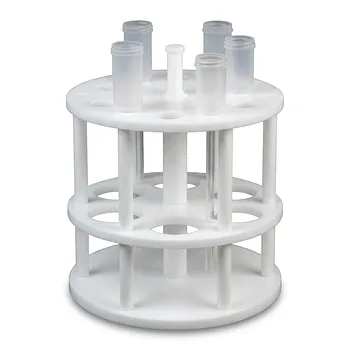
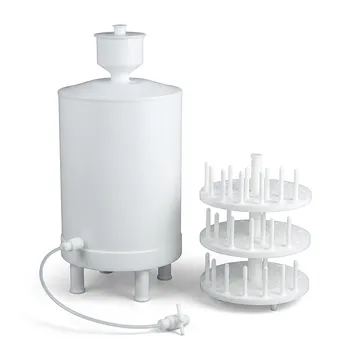
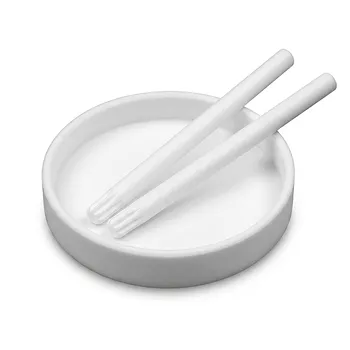
- Custom PFA Microcolumn Racks and PTFE Machined Low Background Corrosion Resistant Laboratory Fixtures
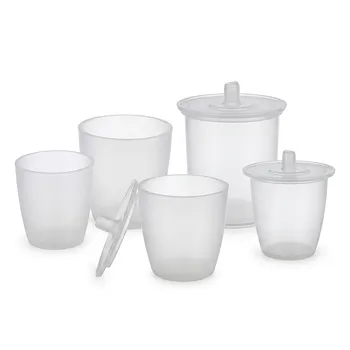
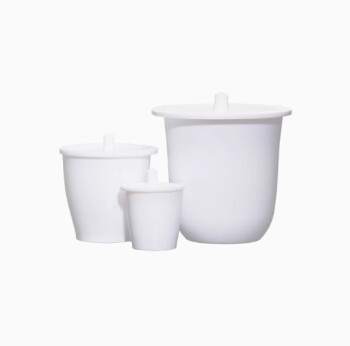
- High Purity PFA Crucible and Corrosion Resistant PTFE Beaker for Trace Analysis and Custom Laboratory Applications
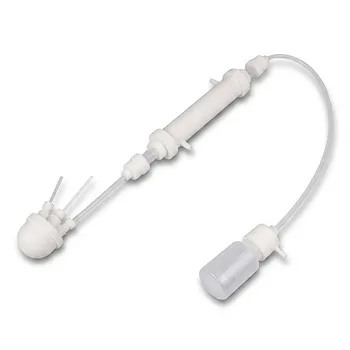
- PTFE PFA Vacuum Filtration System Corrosion Resistant Customizable Shatterproof Laboratory Device
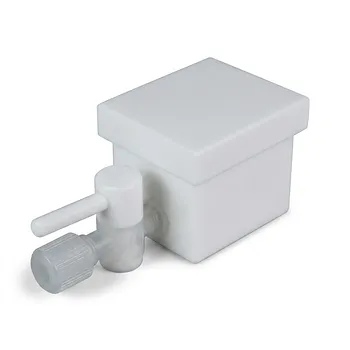
- Custom PTFE Laboratory Apparatus Corrosion Resistant Low Background Reaction Cells Precision CNC Fabrication
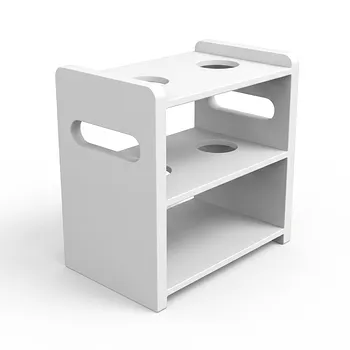
- Custom PTFE Acid Resistant Support Rack for PFA Hydrogen Absorption Systems Multi Hole Configurations
People Also Ask
- What other PTFE lab accessories are commonly used? Essential Tools for Chemical Resistance & Purity
- How does high fluorination in perfluorinated polymers improve chemical resistance and thermal stability of lab apparatus? Discover the science behind PTFE and PFA's superior performance.
- What inherent material characteristics of non-melt-processable PTFE make it suitable for manufacturing high-purity laboratory containers and custom-machined apparatus?
- What material considerations are critical for laboratory apparatus when performing cage-opening reactions on fluorinated silsesquioxanes using strong superacids? Choose PTFE/PFA for inertness and purity
- What surface chemical species and binding energy signatures are detected on PTFE fluoropolymer sample holders during XPS analysis? Key insights for accurate calcium detection.