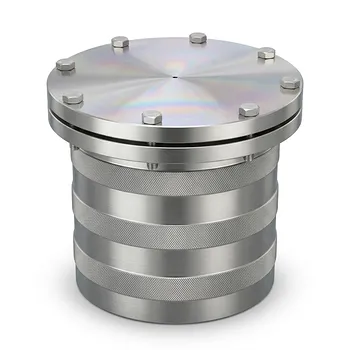
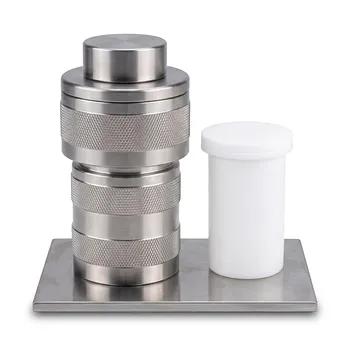
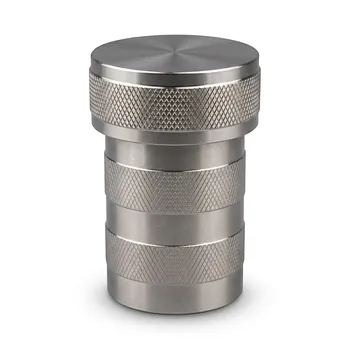
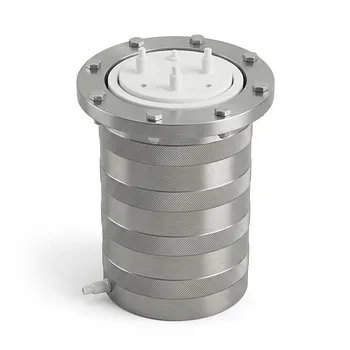
Hydrothermal synthesis of rare earth nanostructures requires a specialized reactor to manage extreme chemical and physical conditions. A PTFE-lined stainless steel autoclave is necessary because it provides a sealed, high-pressure environment that allows reactions to occur at temperatures far above the boiling point of water (typically 180°C to 200°C). The PTFE liner serves as a critical barrier, preventing corrosive precursors from attacking the metal walls and ensuring the resulting nanostructures remain free from metallic contamination.
The combination of a high-strength steel shell and a chemically inert PTFE liner creates the "pressure cooker" environment required to dissolve precursors and grow high-purity crystals that would be impossible to synthesize under standard atmospheric conditions.
Managing High Pressure and Temperature
The Role of the Stainless Steel Outer Shell
The outer shell of the autoclave is constructed from heavy-duty stainless steel to provide the mechanical strength necessary to contain autogenous pressure. As the internal temperature rises to 180°C or higher, the liquid inside expands and generates significant pressure that would destroy glass or unreinforced containers.
Enabling Supercritical Fluid Properties
By sealing the reaction, the autoclave allows the solvent to reach a subcritical state where its properties change, increasing the solubility of rare earth precursors. This heightened solubility is what enables the precursors to reorganize into complex nanostructures, such as lanthanum-doped cerium fluorocarbonate (CeCO3F) nanorods.
Safety and Structural Integrity
The stainless steel vessel acts as a safety containment unit, ensuring that the high-pressure gases and hot corrosive liquids stay within the reaction zone. This structural integrity is vital for maintaining the constant pressure levels required for oriented crystal growth over long durations, sometimes lasting 24 hours or more.
Ensuring Chemical Purity and Integrity
Preventing Corrosion from Reactive Precursors
Rare earth nitrate precursors and other additives used in synthesis can be highly corrosive to metal surfaces at elevated temperatures. The PTFE (Polytetrafluoroethylene) liner is chosen for its exceptional chemical inertness, which resists attack from strong acids, bases, and organic solvents.
Eliminating Metal Ion Contamination
Without the PTFE liner, the reaction solution would come into direct contact with the stainless steel walls, causing metal ions (like iron, nickel, or chromium) to leach into the product. For rare earth nanostructures, even trace amounts of these impurities can disrupt the crystal lattice and degrade the material's functional properties.
Facilitating Uniform Nanostructure Growth
A clean, non-reactive environment provided by the PTFE liner ensures that the growth of nanostructures is governed only by the intended chemical precursors. This allows for the pure and uniform growth of nanorods or crystals onto substrates like nanofibers without interference from secondary chemical reactions with the container.
Understanding the Trade-offs
Temperature Limitations of PTFE
While PTFE is highly inert, it has a functional temperature ceiling, typically around 220°C to 250°C. Exceeding these temperatures can cause the liner to deform ("cold flow") or release toxic vapors, which can compromise the seal and the experiment.
Pressure Seal Vulnerability
The effectiveness of the autoclave depends heavily on the quality of the seal between the PTFE liner and the stainless steel cap. If the liner is not seated correctly or if the cooling process is too rapid, the seal can fail, leading to pressure loss and incomplete crystallization of the nanostructures.
Cleaning and Cross-Contamination
PTFE is porous at a microscopic level, meaning it can sometimes retain trace amounts of chemicals from previous experiments. Rigorous cleaning protocols are required to ensure that rare earth synthesis is not contaminated by residues from prior uses of the liner.
How to Apply This to Your Project
Success in hydrothermal synthesis depends on matching your equipment to your specific chemical environment and goals.
- If your primary focus is Maximum Purity: Always use a fresh or ultra-cleaned PTFE liner to ensure no metal ions or previous residues interfere with the rare earth crystal lattice.
- If your primary focus is High-Temperature Growth (above 220°C): Consider using a PPL (Polyphenylene polymers) liner instead of PTFE, as it can withstand temperatures up to 280°C.
- If your primary focus is Corrosive Alkaline Solutions: Verify that your PTFE liner is high-quality and thick enough to withstand prolonged exposure to 3M or 6M NaOH without thinning.
Using the right autoclave configuration ensures your rare earth nanostructures achieve the precise phase purity and morphology required for advanced technical applications.
Summary Table:
| Component | Function | Key Benefit |
|---|---|---|
| Stainless Steel Shell | Mechanical Strength | Contains high autogenous pressure at temperatures up to 200°C+ |
| PTFE Liner | Chemical Inertness | Prevents corrosion and eliminates metallic ion contamination |
| Sealed Design | Supercritical Fluid Control | Increases precursor solubility for oriented crystal growth |
| Temperature Limit | Thermal Stability | Operates safely up to 220°C-250°C without liner deformation |
Elevate Your Research with KINTEK’s Precision Fluoropolymer Solutions
Achieving high-purity rare earth nanostructures demands equipment that can withstand extreme chemical environments without compromising sample integrity. KINTEK specializes in high-performance PTFE and PFA laboratory supplies designed for the most rigorous synthesis protocols.
We manufacture virtually all imaginable lab supplies, from basic labware (beakers, crucibles, and reagent bottles) and fluid transfer components (tubing, fittings, valves) to advanced reaction apparatus like hydrothermal synthesis liners, electrochemical cells, and microwave digestion vessels. Backed by end-to-end custom CNC fabrication, we deliver everything from complex non-standard machined parts to high-volume orders with an absolute focus on material performance.
Don't let metallic contamination or equipment failure stall your breakthroughs. Contact KINTEK today to discover how our expert-crafted fluoropolymer solutions can enhance your laboratory's efficiency and precision.
References
- Aditya Rianjanu, Januar Widakdo. 3D hierarchical rare-earth metal composite nanofiber membranes for highly durable and efficient photodegradations of organic pollutants. DOI: 10.1039/d4ma01144a
This article is also based on technical information from Kintek Knowledge Base .
Related Products
- Custom TFM Reaction Vessel with Stainless Steel Jacket and PTFE Inner Cup for High Corrosion Resistance
- PTFE Lined High Pressure Digestion Vessel 50ml High Temperature Hydrothermal Synthesis Tank
- High Temperature Corrosion Resistant Hydrothermal Synthesis Reactor with TFM Inner Liner and Straight Cylinder Design
- High Pressure Custom TFM Reactor Stainless Steel Outer Vessel PTFE Inner Cup for Corrosive Synthesis
- PTFE Acid Steam Cleaning System HF Resistant Trace Analysis Beaker Digestion Tank Customizable
People Also Ask
- Why are high-performance pressure-resistant reaction vessels required for oxygen-assisted hydrothermal conversion at 150 °C?
- How do magnetic stirring and reaction vessels impact MOF-derived carbon quality? Optimize Your Composite Performance
- Why are high-quality fluoropolymer-lined reaction vessels required for alk-Ti3C2Tx MXene? Ensure Purity & HF Resistance
- Why are PTFE-lined reaction vessels necessary for forced degradation studies? Ensure high-purity results and accuracy.
- Why is a high-purity PTFE lined reaction vessel required for the acidic etching of MXenes? Ensure Material Purity.