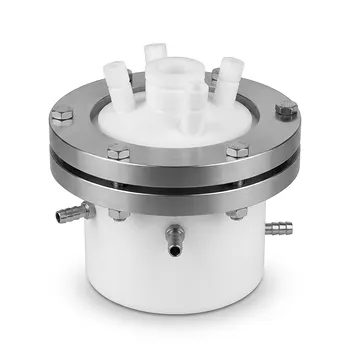
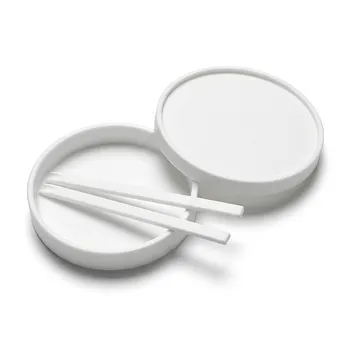
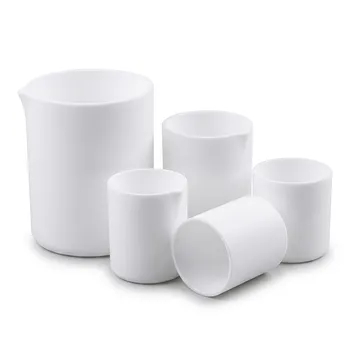
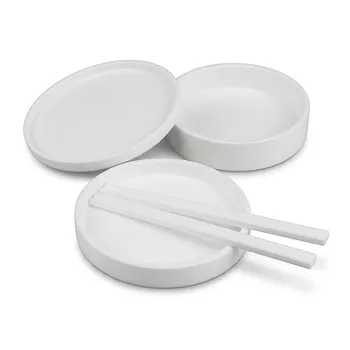
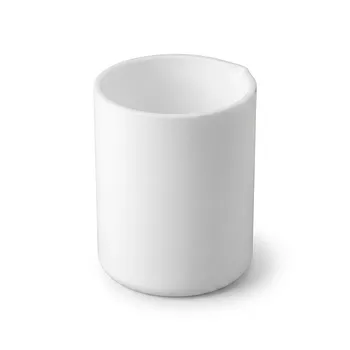
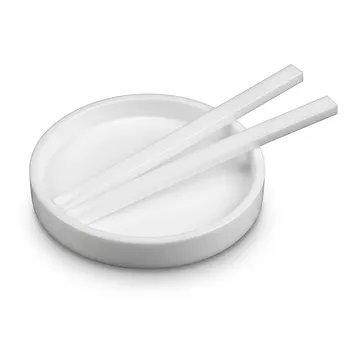
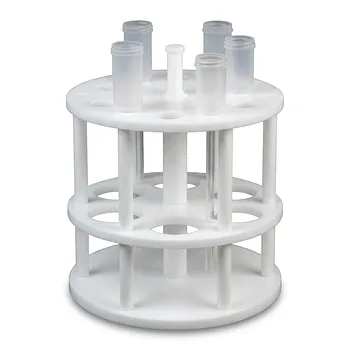
PCTFE is chosen when a fluoropolymer must act as both a precision mechanical component and a highly effective barrier. Its chlorine-containing polymer structure increases rigidity and resistance to cold flow, while maintaining fluoropolymer chemical inertness and negligible moisture absorption. The result is labware and sealing components that hold tight tolerances, resist deformation, and significantly restrict gas, vapor, and moisture permeation.
The central advantage of PCTFE is its balance of low permeability, dimensional stability, and processability. It is especially valuable where seal compression, temperature changes, vacuum exposure, or cryogenic service could cause less rigid polymers to creep or lose their fit.
Why PCTFE Maintains Precise Dimensions
Chlorine increases rigidity
PCTFE contains chlorine atoms in addition to fluorine in its polymer chain. This structure produces a relatively high modulus, strong compressive performance, and greater resistance to deformation than many conventional fluoropolymers.
That rigidity helps machined labware, valve seats, fittings, and seals retain their geometry under pressure and assembly loads.
It resists cold flow
Cold flow, or creep, is the gradual deformation of a polymer under sustained mechanical stress. In a seal, excessive creep can reduce contact pressure and eventually create a leak path.
PCTFE’s resistance to cold flow makes it suitable for precision seals and components that must maintain compression over time, particularly in static sealing and high-pressure applications.
It absorbs virtually no moisture
Moisture absorption can cause swelling, dimensional changes, contamination, and altered mechanical properties. PCTFE’s negligible moisture uptake helps components maintain predictable dimensions in humid environments and in contact with aqueous laboratory fluids.
This is important for parts manufactured to tight tolerances, where even small dimensional changes can affect sealing force or fluid alignment.
Why PCTFE Provides Strong Barrier Performance
Its gas and vapor permeability is exceptionally low
PCTFE is among the strongest polymeric barrier materials for limiting the passage of air, water, water vapor, and volatile fluids. This makes it useful when the seal or container must prevent atmospheric ingress or retain a controlled internal environment.
For laboratory systems, low permeability can protect sensitive reagents, reduce sample exposure, and help maintain vacuum or gas purity.
It limits contamination and outgassing
PCTFE combines chemical inertness with favorable outgassing behavior compared with many conventional plastics. That reduces the release of volatile species into controlled, vacuum, or analytical environments.
The material is therefore useful for barrier components, protective linings, reagent storage, and seals near sensitive samples or instruments.
It protects against moisture ingress
Moisture control is often as important as gas containment. A PCTFE barrier can help prevent water vapor from entering a sealed package or fluid system, reducing the risk of reagent degradation, corrosion, or measurement interference.
Why It Performs Well in Demanding Laboratory Conditions
It retains integrity at low temperatures
PCTFE remains mechanically useful at very low temperatures, including cryogenic service, where many standard plastics become brittle or lose toughness. This supports its use in cryogenic apparatus, low-temperature fluid lines, and liquid-oxygen-related sealing applications when the design is properly validated.
The combination of toughness, low permeability, and dimensional stability is particularly valuable in systems exposed to cold gases or liquefied fluids.
It resists aggressive chemicals
Like other fluoropolymers, PCTFE provides strong resistance to many corrosive and oxidizing chemicals. It is used where seals and labware must contact demanding reagents without significant chemical reaction or rapid degradation.
However, chemical compatibility should still be verified for the specific temperature, concentration, exposure time, and mechanical stress involved.
It can be precision molded and machined
PCTFE offers a useful processing advantage: its melt behavior supports precision molding while its finished structure provides rigidity and low creep. This combination helps manufacturers produce complex, dimensionally controlled components rather than relying only on soft, easily deformable fluoropolymers.
It can also be machined into custom laboratory parts, including fittings, valve components, holders, and sealing elements.
How PCTFE Compares With Softer Fluoropolymers
PCTFE prioritizes dimensional control
Materials such as PTFE offer outstanding chemical resistance and very low friction, but PTFE is comparatively susceptible to creep under sustained load. For a precision seal, that deformation can change the contact geometry over time.
PCTFE is often selected instead when maintaining a fixed shape and compression load is more important than maximizing flexibility or minimizing friction.
PCTFE prioritizes barrier performance
PCTFE’s low permeability is a defining advantage. It is especially appropriate when the component must restrict gas or vapor transfer, rather than merely withstand chemical exposure.
This makes it a strong candidate for containment seals, low-permeability liners, and laboratory systems where atmospheric contamination or product loss is unacceptable.
It offers a useful balance of properties
The material is not selected for one property alone. Its value comes from the combined performance of chemical resistance, low moisture uptake, low permeability, rigidity, creep resistance, and low-temperature capability.
That balance explains its use in specialized labware and seals rather than in general-purpose plastic components.
Understanding the Trade-offs
PCTFE is not the best choice for every temperature range
Although PCTFE performs exceptionally well at low temperatures, its upper-temperature capability and thermal history require attention. Prolonged or repeated exposure near its melting and processing limits can promote crystallization and affect toughness or dimensional behavior.
Thermal cycling should therefore be evaluated as part of the component design, not treated as an afterthought.
Rigidity can reduce flexibility
The same rigidity that improves dimensional stability can make PCTFE less forgiving in dynamic seals or assemblies requiring substantial elastic movement. A design intended for repeated flexing may require a different fluoropolymer or a specialized PCTFE grade.
Low permeability does not eliminate design leakage
Material permeability is only one part of system leak performance. Surface finish, seal geometry, compression, machining tolerances, installation damage, and joint design can dominate the final result.
PCTFE provides an excellent barrier, but it cannot compensate for an incorrectly designed or improperly installed seal.
Processing and grade selection matter
PCTFE properties vary with grade, molecular structure, crystallinity, processing history, and component geometry. The selected material should be qualified under the actual pressure, temperature, chemical, vacuum, and sterilization conditions.
Making the Right Choice for Your Goal
PCTFE is most appropriate when the application requires several of these properties simultaneously:
- If your primary focus is low gas or moisture permeation: Choose PCTFE for seals, barriers, and containment components where preventing atmospheric ingress, vapor transmission, or volatile-fluid loss is critical.
- If your primary focus is dimensional stability: Use PCTFE where tight tolerances, compression retention, and resistance to cold flow must be maintained under sustained load.
- If your primary focus is cryogenic service: Consider PCTFE for low-temperature labware, fluid lines, and seals that must retain toughness and barrier performance in cryogenic environments.
- If your primary focus is precision manufacturing: Select PCTFE when the component must be molded or machined accurately while resisting moisture-driven dimensional changes.
- If your primary focus is chemical containment: Evaluate PCTFE for chemically demanding laboratory systems, while confirming compatibility under the exact operating conditions.
- If your primary focus is repeated flexing or high-temperature cycling: Compare PCTFE with alternative fluoropolymers, because its rigidity and thermal limitations may outweigh its barrier advantages.
PCTFE is a strong engineering choice when a laboratory component must remain dimensionally accurate while simultaneously controlling gas, vapor, and moisture transport.
Summary Table:
| Property | PCTFE Benefit |
|---|---|
| Dimensional Stability | High rigidity and resistance to cold flow maintain tight tolerances under load. |
| Low Permeability | Exceptional barrier to gases, vapors, and moisture, protecting sensitive samples. |
| Chemical Inertness | Resists aggressive chemicals, reducing degradation and contamination risks. |
| Low-Temperature Performance | Retains toughness and barrier properties in cryogenic conditions. |
| Precision Manufacturing | Suitable for precision molding and machining, enabling complex custom components. |
Enhance Your Lab's Precision and Performance
At KINTEK, we're dedicated to high-performance fluoropolymer solutions. Our extensive range of PCTFE labware and custom components ensures dimensional accuracy and superior barrier properties, meeting the most demanding standards.
Why choose us?
- Expertise: Specialists in PTFE and PFA, with PCTFE capabilities for high-precision needs.
- Customization: End-to-end CNC machining for custom parts, from prototypes to high-volume orders.
- Quality: Rigorous material selection and manufacturing to ensure reliability.
Ready to upgrade your lab? Contact us today to discuss your specific application and discover how our PCTFE solutions can enhance your research and processes.
Related Products
- High Purity PTFE Trays Corrosion Resistant Laboratory Labware Customizable Square Round Fluoropolymer Trays
- Custom PTFE Gas Washing Bottle Cap Multi Port Reaction Lid Corrosion Resistant High Sealing Laboratory Fluoropolymer Closure
- High Purity PFA Crucible and Corrosion Resistant PTFE Beaker for Trace Analysis and Custom Laboratory Applications
- Custom PTFE Petri Dish 30mm Corrosion Resistant Low Background Non Leaching Laboratory Ware
- Custom PTFE Reaction System with Hose Barb Fittings Corrosion Resistant High Sealing 2L 4L Lab Reactor with Separatory Funnel
People Also Ask
- Why use PTFE or PFA for MnWO4 precursor solutions? Ensure Chemical Purity and Performance
- What core chemical and thermal properties of polytetrafluoroethylene (PTFE) make it ideal for high-purity laboratory supplies and fluid handling components? Discover PTFE's superior chemical resistance and thermal stability for your lab.
- Why is PFA or PTFE labware critical for Bismuth Ferrite (BFO) stoichiometry? Achieve Stoichiometric Precision
- Why is high-purity PFA or PTFE labware necessary for preparing VS2/MoS2? Ensure Phase Purity & Catalyst Performance
- Why is the use of high-purity PFA or PTFE labware critical during TiO2 nanoparticle purification? Protect Sample Purity