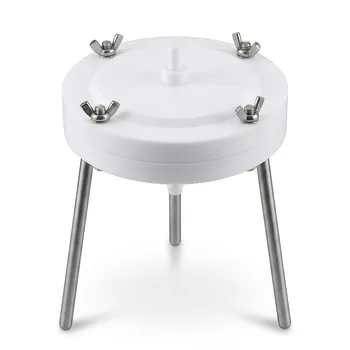
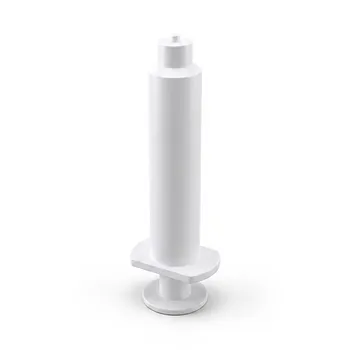
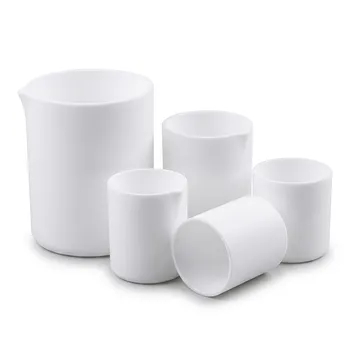
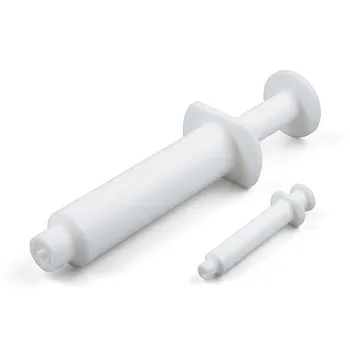
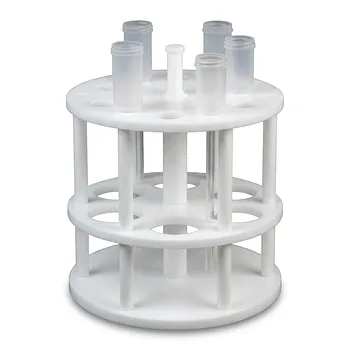
PTFE is ideal for high-purity laboratory and fluid-handling applications because it combines exceptional chemical inertness with broad thermal stability. Its fully fluorinated carbon backbone resists attack from strong acids, bases, solvents, and aggressive organic chemicals, while its high melting point, above 340°C, helps it retain structural integrity during demanding thermal processes. PTFE also has a low-energy, nonstick surface that limits sample adhesion, fluid retention, and potential sources of contamination.
PTFE protects sample integrity by remaining chemically stable and difficult to dissolve or degrade under harsh conditions. Its thermal resistance, low friction, and nonadhesive surface make it well suited to digestion vessels, reagent containers, tubing, valves, and other high-purity fluid-contact components.
Why PTFE Resists Chemical Attack
The Fluorinated Molecular Structure
PTFE consists of a carbon backbone surrounded by fluorine atoms. The strong carbon-fluorine bonds and dense fluorine sheath shield the backbone from chemical attack.
This structure gives PTFE its characteristic chemical inertness, especially when compared with many conventional plastics and elastomers.
Resistance to Acids, Bases, and Solvents
PTFE resists reaction with many strong acids, bases, and aggressive organic chemicals. It is also insoluble in common solvents, which helps prevent the material from swelling, dissolving, or releasing polymer components into the process fluid.
That resistance is valuable in acid digestion, reagent storage, trace analysis, and corrosive fluid transfer, where even small material changes can affect results or equipment reliability.
Low Risk of Leaching and Chemical Degradation
Because PTFE is difficult to chemically attack, it minimizes degradation-related contamination. A PTFE vessel or valve is less likely to contribute dissolved material to a sample or to lose its functional properties after repeated exposure to harsh reagents.
The material is not literally inert to every possible chemical condition. Extreme environments, including some highly reactive fluorinating systems and molten alkali metals, require separate compatibility evaluation.
Why PTFE Performs Under Heat
High Melting Point
PTFE has a melting point above 340°C, giving it substantial thermal tolerance for laboratory heating and chemical processing. This is particularly useful in digestion vessels and other applications that combine elevated temperature with corrosive reagents.
A high melting point does not mean PTFE can be used indefinitely at that temperature. Actual operating limits depend on exposure time, mechanical load, pressure, design, and the surrounding chemistry.
Stable Behavior During Thermal Processing
When heated beyond its melting point, PTFE forms a high-viscosity gel rather than flowing like many conventional thermoplastics. This unusual behavior helps explain its dimensional stability in service, but it also affects how PTFE components are manufactured.
PTFE is commonly formed through specialized processes such as powder compaction, sintering, ram extrusion, powder coating, or machining from stock material.
Resistance to Thermal and Oxidative Degradation
PTFE maintains its chemical and structural properties across a broad thermal range and resists degradation in demanding environments. For fluid-handling components, this supports reliable sealing, containment, and repeated chemical exposure.
At sufficiently high temperatures, however, PTFE can decompose and generate hazardous products. Ventilation, temperature controls, and manufacturer-specific limits remain necessary.
Why PTFE Supports High Purity
Low Surface Energy
PTFE has very low surface energy, which gives it a highly nonadhesive surface. Samples and reagents are less likely to cling to the material, reducing carryover and making vessels easier to drain and clean.
This characteristic is important in trace analysis, where residual material from a previous process can compromise the next measurement.
Low Friction
PTFE has a low coefficient of friction, allowing fluids and moving components to interact with relatively little resistance. In valves, seals, fittings, and tubing, this can support smooth operation and reduce sticking.
Low friction also helps limit material transfer caused by rubbing between components, although seal design and wear conditions still matter.
Low Fluid Retention
The combination of low surface energy and nonstick behavior reduces fluid retention on internal surfaces. This supports more complete transfer of valuable or sensitive samples through tubing, fittings, and valves.
The practical result is better control over sample recovery, cleaning, and cross-contamination risk.
Where These Properties Matter Most
Digestion Vessels
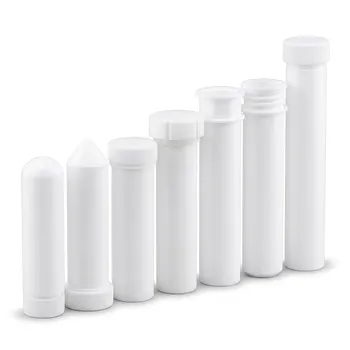
PTFE digestion vessels can contain aggressive acids and other reagents while tolerating substantial process heat. Their chemical resistance helps prevent vessel corrosion and reduces the risk that the container will alter the sample.
Reagent Bottles and Storage Containers
PTFE containers are useful when reagents could attack ordinary plastics, metals, or elastomers. Their resistance to dissolution and chemical reaction helps preserve both the container and the stored material.
Tubing, Fittings, and Valves
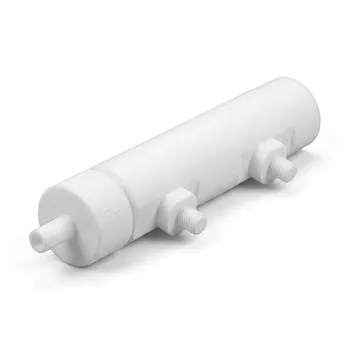
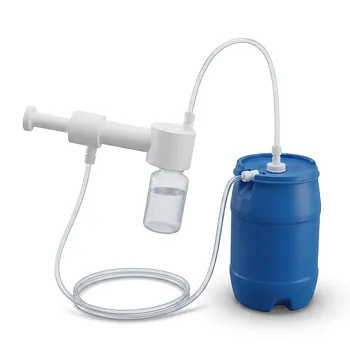
In fluid-handling systems, PTFE provides a chemically resistant contact surface for corrosive or high-purity fluids. Its low friction and nonadhesive surface further support reliable flow control and reduced residue.
Understanding the Trade-offs
Chemical Inertness Is Not Universal
PTFE resists most laboratory chemicals, but no material is compatible with every reagent, concentration, temperature, or pressure. Compatibility should be checked for the exact operating conditions rather than inferred from the material name alone.
Thermal Stability Has Practical Limits
The melting point describes a material transition, not a recommended service temperature. Mechanical strength, creep, pressure containment, and chemical exposure can impose lower limits than the melting point itself.
Manufacturing Is Specialized
PTFE’s high melt viscosity prevents conventional melt processing. This increases manufacturing complexity and can affect component geometry, tolerances, surface finish, and cost.
Mechanical Design Still Matters
PTFE’s chemical resistance does not eliminate the need for proper engineering. Seals, valves, and tubing must be selected for pressure, dimensional stability, wear, permeation, and temperature as well as chemical compatibility.
Making the Right Choice for Your Goal
PTFE is most valuable when chemical purity and resistance to harsh processing conditions are more important than ease of conventional molding or maximum mechanical strength.
- If your primary focus is sample purity: Choose PTFE for its low surface energy, low adhesion, and resistance to dissolution and leaching under the intended chemical conditions.
- If your primary focus is corrosive chemical handling: Use PTFE for contact with aggressive acids, bases, solvents, and organic chemicals after verifying application-specific compatibility.
- If your primary focus is high-temperature processing: Use PTFE where its thermal stability matches the actual time, temperature, pressure, and load requirements.
- If your primary focus is fluid-control reliability: Consider PTFE tubing, fittings, valves, and seals where low friction, low fluid retention, and chemical resistance support clean and repeatable operation.
- If your primary focus is component cost or complex molded geometry: Account for PTFE’s specialized manufacturing requirements before selecting it over other materials.
PTFE is a strong choice when maintaining sample integrity and resisting chemical and thermal damage are the primary design requirements.
Summary Table:
| Property | Benefits | Applications |
|---|---|---|
| Chemical Inertness | Resists acids, bases, solvents; low leaching | Digestion vessels, reagent bottles, tubing |
| Thermal Stability | Melting point >340°C; stable under heat | High-temperature digestion, autoclaving |
| Low Surface Energy | Non-stick, minimal sample adhesion | Trace analysis, sample storage |
| Low Friction | Smooth fluid flow, reduced sticking | Valves, fittings, seals |
| Low Fluid Retention | Complete sample recovery, easy cleaning | Syringes, tubing, connectors |
Elevate Your Lab with High-Purity PTFE Solutions
At KINTEK, we specialize in PTFE and PFA laboratory supplies, from basic beakers to custom electrochemical cells. Our products ensure sample integrity, chemical resistance, and thermal stability for your most demanding applications. Whether you need standard labware or custom CNC-machined parts, our expertise guarantees precision and purity. Contact us today to discuss your requirements and experience the KINTEK advantage. Get in touch with our team and let us help you achieve reliable, contamination-free results.
Related Products
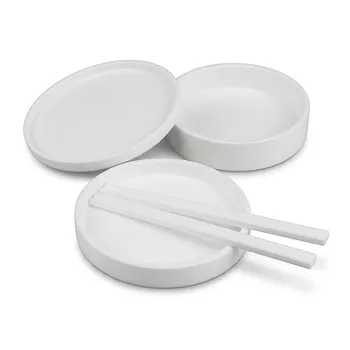
- Custom PTFE Petri Dish 200mm High Purity Corrosion Resistant Low Background Laboratory Ware
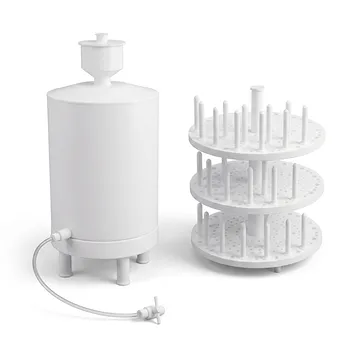
- High Purity Corrosion Resistant PTFE Acid Reflux Cleaning System for Laboratory Trace Analysis
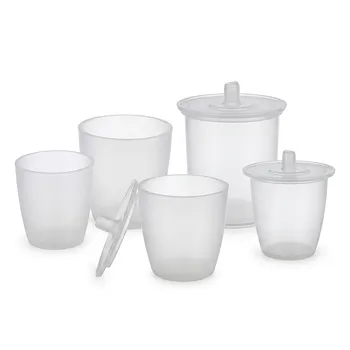
- High Purity PFA Crucible and Corrosion Resistant PTFE Beaker for Trace Analysis and Custom Laboratory Applications
- High Purity PTFE Trays Corrosion Resistant Laboratory Labware Customizable Square Round Fluoropolymer Trays
- Custom PTFE Petri Dishes Corrosion Resistant High Purity Low Background Labware
People Also Ask
- Why are PTFE or PFA Petri dishes preferred for membrane casting? Ensure Damage-Free Recovery & Chemical Purity
- Why use PTFE or PFA for MnWO4 precursor solutions? Ensure Chemical Purity and Performance
- What key physical parameter differences should laboratory engineers evaluate when choosing between PTFE fluoropolymers and polyethylene for corrosion-resistant custom labware? Key factors explained.
- What PTFE chemical properties make it safe for hydrofluoric acid? Discover inertness & high-temp stability.
- What atomic and structural characteristics give PTFE fluoropolymer labware superior thermal stability and chemical inertness compared to conventional polyethylene (PE)?