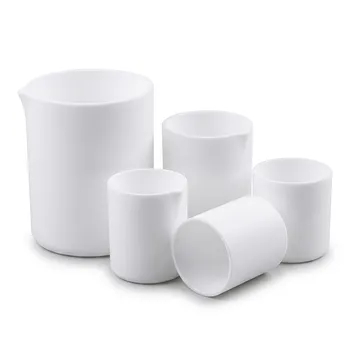
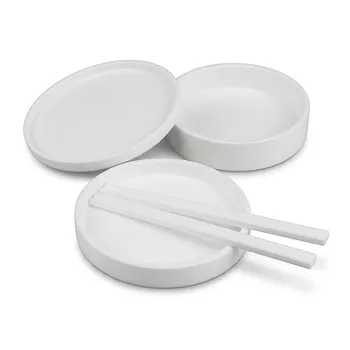
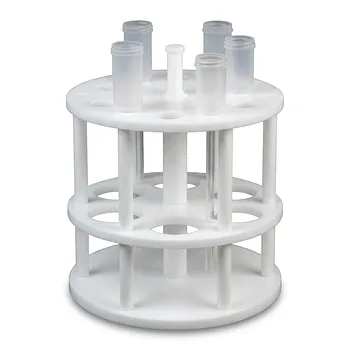
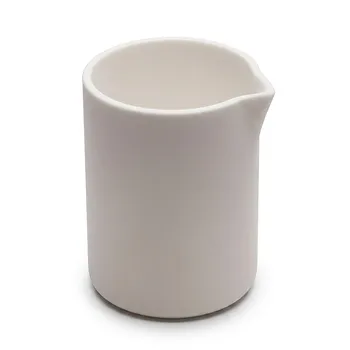
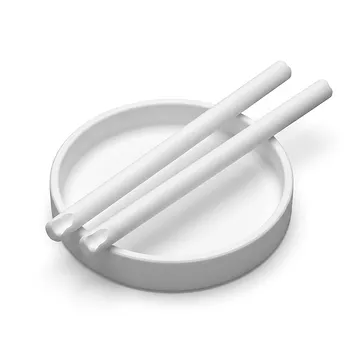
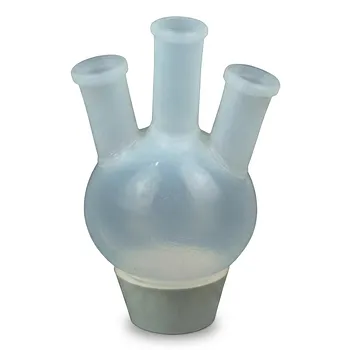
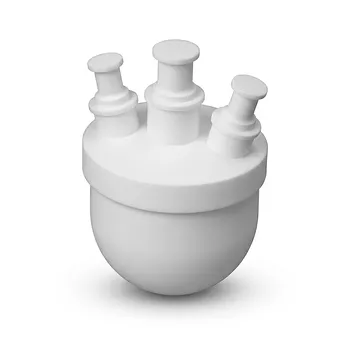
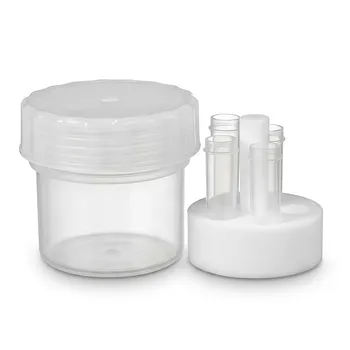
PTFE fluoropolymer labware is suitable for hydrofluoric acid because it combines exceptional chemical resistance with unusual thermal melt behavior. Its highly fluorinated carbon backbone resists attack from HF, other strong acids, concentrated bases, organic solvents, and many oxidizing or reducing reagents. Physically, PTFE does not dissolve or become a free-flowing liquid at its melting transition; it forms a stiff, clear gel that helps labware retain its shape under severe thermal conditions.
The key advantage is the combination of chemical inertness and dimensional stability. Strong carbon-fluorine bonds prevent most chemical reactions, while PTFE's non-flowing melt behavior helps containers, liners, and digestion vessels maintain their form during high-temperature processing.
Why PTFE Resists Hydrofluoric Acid
Strong Carbon-Fluorine Bonds
PTFE contains a fully fluorinated carbon backbone. The high bond strength and stability of its carbon-fluorine structure create a protective molecular environment that is difficult for aggressive reagents to penetrate or disrupt.
This makes PTFE largely unreactive toward hydrofluoric acid, mineral acids, concentrated bases, and most organic solvents under appropriate operating conditions.
Resistance to Dissolution and Chemical Attack
Unlike many plastics, PTFE is not readily dissolved by laboratory solvents. It also resists swelling, corrosion, and chemical degradation across a broad usable temperature range.
For HF handling, this means the container itself is unlikely to become a significant source of dissolved material or reaction products. That property is especially important in trace analysis, where small amounts of contamination can affect results.
Stability in Heated Acid Applications
Fluoropolymer materials have demonstrated resistance to approximately 30% to 50% hydrofluoric acid at temperatures up to about 121°C to 149°C, depending on the specific material, exposure time, and test conditions.
These conditions are relevant to acid digestion, sample preparation, and other procedures in which HF is heated or maintained under pressure. Actual suitability must still be confirmed against the product's temperature, pressure, concentration, and exposure-time limits.
How PTFE's Melt Behavior Protects Labware
PTFE Does Not Become a Free-Flowing Liquid
At its melting transition, PTFE does not behave like an ordinary thermoplastic that liquefies and flows readily. Instead, it changes into a stiff, clear gel with very high melt viscosity.
This characteristic helps PTFE components resist sagging, dripping, or sudden loss of shape when exposed to high temperatures near the melting range.
Structural Integrity Under Thermal Stress
PTFE's unusual melt behavior supports the dimensional stability of digestion tubes, vessel liners, containers, tubing, and fittings during demanding chemical procedures.
The material can tolerate substantial thermal stress without immediately losing its containment geometry. However, this does not mean PTFE can be used indefinitely at its melting transition; mechanical strength and pressure capability still decline as temperature rises.
Low Risk of Sample Interaction
PTFE is hydrophobic and has very low surface energy. It generally does not absorb or retain sample constituents as readily as more reactive or higher-energy materials.
Combined with its chemical resistance, this reduces the risk of container-derived ions, organic residues, or corrosion products entering sensitive samples.
What This Means for HF Laboratory Applications
Acid Digestion Vessels
PTFE digestion vessels and liners can contain HF-based digestions while minimizing reaction between the vessel and reagent.
Their resistance is valuable when samples require aggressive treatment to dissolve silicates, oxides, or other chemically resistant matrices.
High-Purity Containers
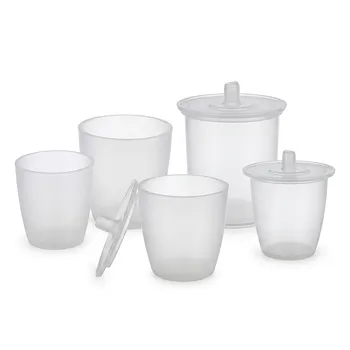
PTFE bottles and trace-analysis vessels are used where maintaining sample purity is more important than minimizing material cost.
Because PTFE resists chemical attack and leaching, it can help preserve the composition of samples during storage and preparation.
Fluid Handling Components
PTFE tubing, valves, fittings, and transfer components provide a chemically resistant path for moving HF and other aggressive reagents.
Component selection must account for more than chemical compatibility. Threads, seals, connections, pressure ratings, and mechanical loads can determine whether the complete assembly is suitable.
How Resistance Is Evaluated
Chemical Compatibility Ratings
Chemical resistance is commonly assessed by measuring changes in material properties after exposure. Relevant measurements include weight, dimensions, tensile strength, elongation, modulus, impact strength, and visible damage such as crazing, swelling, or discoloration.
On rating systems such as the Plastics Design Library scale, ratings near 9 or 10 indicate little measurable effect and strong retention of mechanical performance. A rating describes tested conditions; it is not an unconditional guarantee for every HF application.
Exposure Conditions Matter
HF compatibility depends on concentration, temperature, pressure, exposure duration, mechanical stress, and the exact fluoropolymer formulation.
A PTFE vessel may be chemically resistant while still being unsuitable for a particular pressure vessel, seal design, or thermal cycle. The complete product specification is therefore more important than the polymer name alone.
Understanding the Trade-offs
Chemical Resistance Is Not Universal
PTFE is highly resistant to most laboratory reagents, but it is not absolutely inert under every condition. Notable exceptions include molten alkali metals and certain highly reactive fluorinating agents, particularly at elevated temperatures.
These exceptions are uncommon in routine HF handling but matter in specialized chemical processing.
High Temperature Reduces Mechanical Margin
PTFE's stiff-gel behavior near its melting transition helps explain its thermal stability, but it should not be interpreted as full mechanical stability at that temperature.
Load-bearing strength, pressure resistance, creep performance, and dimensional precision can deteriorate before the material visibly melts. Use the manufacturer's continuous-use and pressure limits rather than relying only on the melting point.
HF Remains a Severe Safety Hazard
A chemically compatible container does not make HF safe to handle. Hydrofluoric acid can cause serious systemic toxicity and deep tissue injury, so containment must be combined with appropriate engineering controls, personal protective equipment, operating procedures, and emergency planning.
PTFE and PFA Are Not Identical
PTFE and PFA are both highly resistant fluoropolymers, but they differ in processing behavior, flexibility, transparency, purity options, and mechanical performance.
The correct choice depends on whether the application prioritizes chemical resistance, molded geometry, flexibility, visibility, pressure handling, or trace-metal cleanliness.
How to Apply This to Your Project
PTFE's chemistry and melt behavior provide a strong basis for HF service, but the final selection should be tied to the actual operating envelope.
- If your primary focus is chemical resistance: Choose a verified PTFE or equivalent fluoropolymer component rated for the specific HF concentration, temperature, exposure duration, and chemical mixture.
- If your primary focus is high-temperature digestion: Confirm the vessel's pressure, thermal-cycle, and mechanical-load limits rather than using the polymer's melting point as the operating limit.
- If your primary focus is trace analysis: Select high-purity labware and evaluate potential leachables, contamination controls, and surface condition in addition to bulk chemical compatibility.
- If your primary focus is fluid transfer: Check the entire assembly, including tubing, valves, fittings, seals, connections, and pressure ratings, because the weakest component controls system suitability.
- If your primary focus is laboratory safety: Treat HF as a high-consequence reagent and validate containment, ventilation, protective equipment, and emergency procedures independently of the material choice.
PTFE labware is effective for aggressive-acid handling because its stable fluorinated structure resists chemical attack while its high-viscosity, non-flowing melt behavior helps preserve containment under demanding thermal conditions.
Summary Table:
| Property | PTFE Behavior | Why It Matters |
|---|---|---|
| Chemical Resistance | Excellent resistance to HF, strong acids, bases, solvents | Prevents corrosion and sample contamination |
| Melt Behavior | Forms stiff, high-viscosity gel, not free-flowing liquid | Maintains shape under high-temperature exposure |
| Thermal Stability | Withstands temperatures up to 260°C (max continuous) | Suitable for hot acid digestion |
| Dimensional Stability | Retains geometry near melt range | Ensures containment integrity |
| High-Purity | Low leaching and hydrophobic surface | Reduces trace analysis interference |
| Application | Example Products |
|---|---|
| Acid Digestion | Vessels, liners, digestion tubes |
| Trace Analysis | Bottles, crucibles, high-purity containers |
| Fluid Handling | Tubing, valves, fittings |
| Sample Prep | Centrifuge tubes, filtration tools |
Looking for high-quality PTFE labware for your HF applications? At KINTEK, we specialize in PTFE and PFA products designed to withstand aggressive acids and demanding thermal conditions. Our range includes digestion vessels, high-purity containers, and custom fluoropolymer components, all backed by our end-to-end CNC machining capabilities. Whether you need standard labware or tailored solutions, we ensure reliability and purity for your critical work. Contact us today to find the perfect PTFE solution for your laboratory! Get in touch
Related Products
- High Purity PFA Crucible and Corrosion Resistant PTFE Beaker for Trace Analysis and Custom Laboratory Applications
- Custom Polytetrafluoroethylene PTFE Petri Dishes 60mm Corrosion Resistant Low Background Labware
- Custom PTFE Petri Dish 30mm Corrosion Resistant Low Background Non Leaching Laboratory Ware
- Custom PTFE Petri Dish 120mm Diameter Corrosion Resistant Low Background High Purity Labware
- Large Scale PTFE Beakers and Flasks for High Temperature Corrosion Resistant Laboratory Applications with Custom CNC Fabrication
People Also Ask
- Why are high-purity vessels critical for BiFeO3 synthesis? Ensuring Phase Purity
- Why is the use of high-purity PFA or PTFE labware critical during TiO2 nanoparticle purification? Protect Sample Purity
- Why is high-purity PFA labware necessary for Znx@LS-2 zeolite ICP-OES analysis? Ensure Trace-Level Precision
- Why is high-purity PFA trace analysis labware used for MXene? Ensure Superior Material Integrity in Research
- Why is high-purity PFA trace analysis labware used for sample processing when preparing Mo2CTx@MoS2? Ensure Material Purity