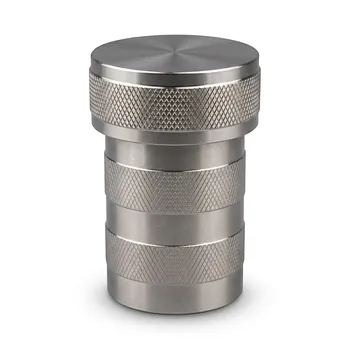
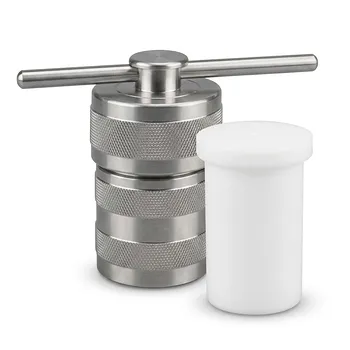
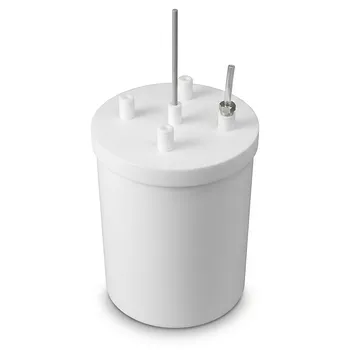
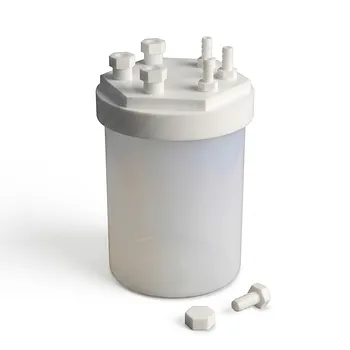
The primary function of a high-pressure digestion tank is to provide a hermetically sealed environment that maintains solvents in a liquid state at temperatures significantly exceeding their normal boiling points. At 170°C, the vessel generates autogenous internal pressure that facilitates the depolymerization of stable mineral structures, such as feldspar, and drives their transformation into high-purity crystalline phases like sodalite.
By creating a superheated, high-pressure closed system, the reactor enables the dissolution of otherwise insoluble precursors and provides the kinetic energy required for precise molecular self-assembly.
Facilitating Phase Transformation and Solubility
Maintaining Solvents Above Boiling Points
In a standard open environment, aqueous solvents evaporate upon reaching 100°C, limiting the reaction temperature. The high-pressure digestion tank prevents this loss, allowing the solvent to remain liquid at 170°C to act as a powerful medium for chemical transport.
Enhancing Precursor Solubility
High-pressure environments significantly increase the solubility of precursors that are typically insoluble or poorly soluble under ambient conditions. This "superheated" state allows iron sources, organic ligands, or mineral oxides to dissolve and interact more effectively.
Driving Structural Depolymerization
The internal pressure generated at 170°C is essential for breaking down complex mineral frameworks, such as the feldspar structure. This depolymerization is a prerequisite for the material to reorganize into a new, stable crystal phase.
Ensuring Product Quality and Crystallinity
Promoting High Crystallinity
The stable, pressurized environment allows for the slow and controlled growth of crystals with minimal structural defects. This results in final products, such as perovskite powders or MOFs, characterized by uniform particle size and superior thermal stability.
Facilitating Molecular Self-Assembly
The reactor provides the necessary energy for coordination reactions between metal ions and organic ligands. This high-energy state is critical for achieving the complex self-assembly required for metal-organic framework (MOF) structures.
Maintaining Chemical Purity
By utilizing a PTFE (polytetrafluoroethylene) liner within the stainless steel jacket, the reactor creates a chemically inert environment. This liner resists strong acids and bases, preventing impurities from the outer metal shell from leaching into the reaction.
Understanding the Trade-offs and Limitations
Safety Risks and Pressure Management
Operating at 170°C creates significant autogenous pressure that requires rigorous safety protocols to prevent vessel failure. Users must strictly adhere to the fill-level limits of the liner to allow for thermal expansion of the liquid phase.
Material Temperature Constraints
While PTFE liners provide excellent chemical resistance, they have a thermal ceiling, typically around 220°C. Exceeding these limits can lead to liner deformation or the release of toxic fluorinated vapors, compromising both the sample and the equipment.
Cooling Rate Dependencies
The thick stainless steel walls of the digestion tank provide high thermal mass, which means the cooling process is inherently slow. This can be a disadvantage if a project requires "quenching" to freeze a specific metastable phase.
Applying This Technology to Your Project
Recommendations Based on Your Objectives
- If your primary focus is high crystallinity: Ensure the reactor remains undisturbed during the heating cycle to allow for defect-free crystal growth.
- If your primary focus is synthesizing nanomaterials: Use a high-quality PTFE liner to prevent metallic contamination and ensure a stable, closed reaction environment.
- If your primary focus is mineral transformation: Maintain the temperature at the specified 170°C to ensure sufficient autogenous pressure for the depolymerization of the source material.
- If your primary focus is equipment longevity: Never exceed the recommended filling volume (usually 60-80%) to prevent over-pressurization during the heating phase.
The high-pressure digestion tank is the essential tool for overcoming the kinetic barriers of solid-phase transformation, turning insoluble precursors into highly ordered crystalline structures.
Summary Table:
| Feature | Primary Function | Benefit for Synthesis |
|---|---|---|
| Hermetic Seal | Prevents solvent evaporation at 170°C | Maintains liquid phase above boiling point |
| Autogenous Pressure | Drives structural depolymerization | Breaks down stable minerals like feldspar |
| PTFE/PFA Liner | Provides a chemically inert environment | Eliminates metallic contamination and leaching |
| Thermal Mass | Ensures slow, controlled cooling | Promotes high crystallinity and defect-free growth |
| Self-Assembly Support | Provides kinetic energy for coordination | Facilitates complex MOF and perovskite formation |
Elevate Your Research with KINTEK’s High-Performance Fluoropolymer Solutions
Achieving precision in high-temperature hydrothermal synthesis requires equipment that stands up to extreme chemical and thermal stress. KINTEK specializes in manufacturing virtually all imaginable laboratory supplies crafted from high-performance PTFE and PFA.
Whether you need everyday basic labware (beakers, crucibles, reagent bottles) or advanced derivative apparatus like hydrothermal synthesis liners, microwave digestion vessels, and custom electrochemical cells, we provide the purity and durability your research demands. Our expertise extends to high-purity trace analysis instruments, complex fluid transfer components (tubing, valves, fittings), and bespoke laboratory setups designed via end-to-end custom CNC fabrication.
From high-volume orders of general consumables to one-off, non-standard machined parts, KINTEK is your ultimate partner for fluoropolymer excellence.
Ready to optimize your lab’s efficiency and purity? Contact us today to discuss your custom requirements!
References
- Ida Ifdaliah Amin, Hijrah A. Azis. Hydrothermal Synthesis and Characterization of Sodalite from Feldspar Mesawa Minerals. DOI: 10.30598/ijcr.2025.12-ami
This article is also based on technical information from Kintek Knowledge Base .
Related Products
- PTFE Lined High Pressure Digestion Vessel 50ml High Temperature Hydrothermal Synthesis Tank
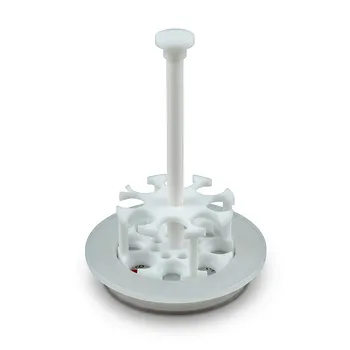
- High Performance TFM Microwave Digestion Vessel Rack 15 Position Customizable Sample Preparation Support
- High Temperature Corrosion Resistant Hydrothermal Synthesis Reactor with TFM Inner Liner and Straight Cylinder Design
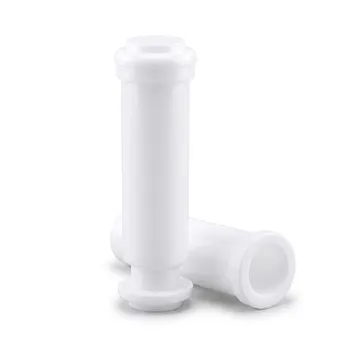
- 5ml High Pressure PTFE Digestion Vessel for Geological Mineral Analysis Corrosion Resistant Polytetrafluoroethylene TFM Digestion Inner Liner
- High Purity TFM Microwave Digestion Vessels for Trace Analysis and Custom Sample Preparation Systems
People Also Ask
- What are the benefits of using a PTFE-lined vessel for carbon-sulfur cathode treatment? Maximize Purity & Performance
- Why are PTFE-lined pressure digestion vessels required for the preparation of Ag/CeO2 catalysts? Purity & Performance
- What safety features are typically incorporated into high-pressure PTFE digestion vessel designs? Ensure Lab Safety
- What is the function of PTFE lined high-pressure vessels in g-C3N4 synthesis? Achieve High-Purity Material Growth
- Role of High-Pressure Digestion Tanks in Perovskite Synthesis: Achieve Superior Stability and Latent Heat