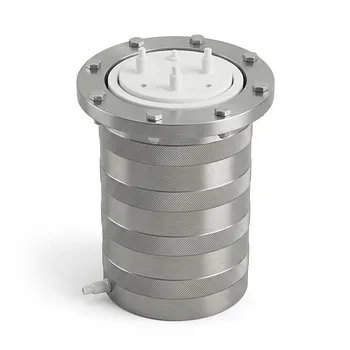
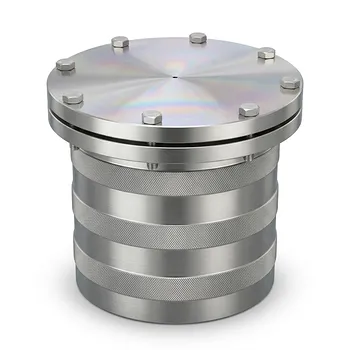
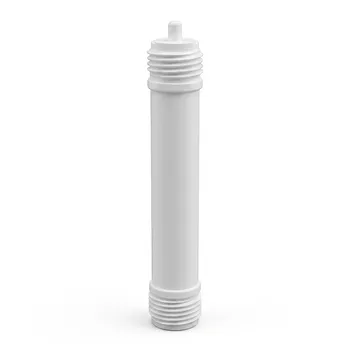
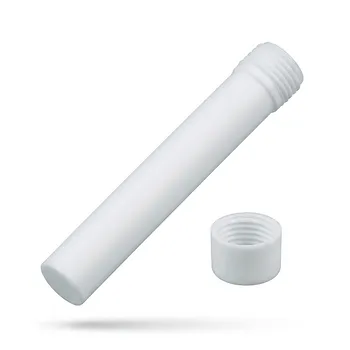
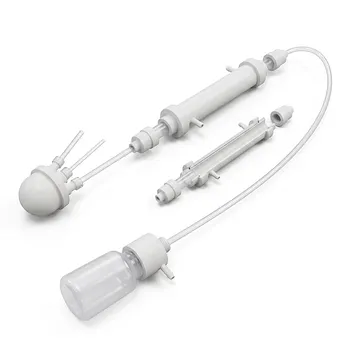
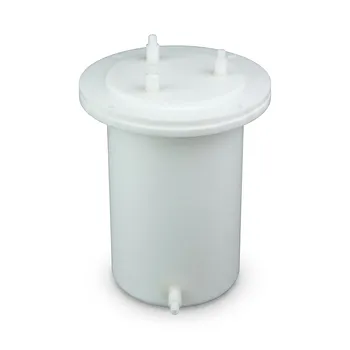
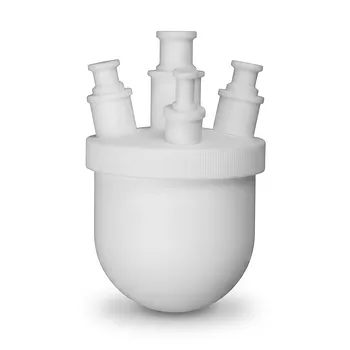
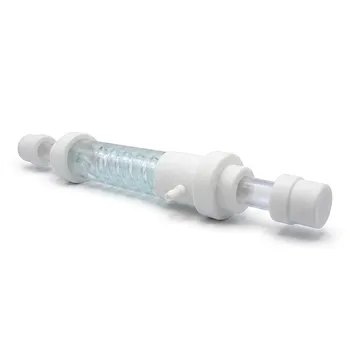
The PTFE liner acts as a chemically inert containment vessel specifically designed to withstand the harsh environments required for hydrothermal synthesis. It provides an essential barrier against strong alkaline corrosion—typically from high concentrations of Potassium Hydroxide (KOH) or Sodium Hydroxide (NaOH)—while preventing metallic ion contamination from the reactor walls. By maintaining a stable, sealed environment for autogenous pressure at temperatures up to 240°C, the liner facilitates the complete conversion of precursors into high-purity Barium Titanate ($BaTiO_3$) nanoparticles.
Core Takeaway: In $BaTiO_3$ synthesis, the PTFE liner is the critical interface that enables high-pressure alkaline reactions to occur without degrading the reactor or contaminating the crystal lattice, ensuring the production of high-purity tetragonal phases.
Protecting the Purity of the Crystal Lattice
Prevention of Metallic Ion Contamination
Hydrothermal reactors are typically constructed from stainless steel or other high-strength alloys that can leach metal ions when exposed to corrosive media. The PTFE liner completely isolates the precursor solution from these metal walls, ensuring that foreign ions do not incorporate into the $BaTiO_3$ crystal structure. This is vital because even trace metallic impurities can significantly degrade the ferroelectric performance of the resulting nanoparticles.
Stability in Aggressive Alkaline Fluxes
The synthesis of $BaTiO_3$ requires high concentrations of alkaline fluxes to facilitate the dissolution and recrystallization of Titanium Dioxide ($TiO_2$). PTFE (Polytetrafluoroethylene) is uniquely resistant to these strong bases, which would otherwise cause rapid pitting and erosion of metal surfaces. This chemical inertness ensures that the reaction stoichiometry remains precise and the environment stays "clean" throughout the synthesis duration.
Facilitating the Phase Transformation
Maintenance of Autogenous Pressure
Achieving the tetragonal phase of $BaTiO_3$ requires specific temperature and pressure conditions that occur within a sealed vessel. The PTFE liner’s superior sealing capabilities allow the reactor to maintain stable autogenous pressure as the internal temperature rises. This pressurized environment is the driving force that allows $TiO_2$ to react fully with Barium sources, leading to complete conversion.
Thermal Stability and Surface Energy
PTFE remains stable at temperatures up to 240°C, providing a consistent environment for controlled nanocrystal growth. Furthermore, the non-stick properties of the liner minimize the surface energy interactions between the vessel and the growing particles. This facilitates the recovery of uniform morphology nanoparticles and makes the post-synthesis cleaning process more efficient.
Understanding the Trade-offs and Limitations
Thermal Deformation and "Creep"
While PTFE is excellent for many hydrothermal applications, it is a thermoplastic that begins to soften as it approaches its upper temperature limits. At temperatures near 240°C, the liner may experience "creep" or permanent deformation under high pressure. This can lead to sealing failures or difficulty removing the liner from the stainless steel autoclave body.
Pressure Limitations and Gas Permeability
PTFE liners are not entirely impermeable to gases at extreme pressures and temperatures. Over long reaction times, small amounts of vapor can migrate through the PTFE wall and condense between the liner and the stainless steel shell. If not managed, this can lead to "collapsed" liners or unexpected corrosion of the outer reactor vessel.
How to Apply This to Your Synthesis Goals
Strategic Recommendations
Effective synthesis depends on matching your liner material to your specific experimental parameters.
- If your primary focus is Maximum Phase Purity: Use a high-purity, virgin PTFE liner to ensure zero metallic contamination from the reactor walls, especially when using high-molarity KOH.
- If your primary focus is High-Temperature Kinetics (>250°C): Consider alternatives to PTFE, such as PPL (Para-polyphenyl) liners or gold/platinum-lined reactors, as standard PTFE may deform or fail.
- If your primary focus is Product Yield and Recovery: Utilize the non-stick properties of PTFE to ensure that the $BaTiO_3$ precipitate does not adhere to the vessel walls, maximizing the collection of the tetragonal powder.
By understanding the protective and mechanical roles of the PTFE liner, you can maintain the integrity of your hydrothermal process and ensure the consistent production of high-quality $BaTiO_3$ nanoparticles.
Summary Table:
| Feature | Benefit to $BaTiO_3$ Synthesis | Limitation / Consideration |
|---|---|---|
| Chemical Inertness | Resists high concentrations of KOH/NaOH fluxes | Maximum temperature limited to 240-250°C |
| High Purity | Prevents metallic leaching from autoclave walls | Slight gas permeability at extreme pressures |
| Non-Stick Surface | Maximizes yield and simplifies particle recovery | Susceptible to "creep" or thermal deformation |
| Sealing Design | Maintains autogenous pressure for phase growth | Requires precise fit to avoid liner collapse |
Precision Fluoropolymer Solutions for Your Research
At KINTEK, we understand that the success of your hydrothermal synthesis depends on the integrity of your materials. We offer an exhaustive range of high-performance laboratory supplies crafted exclusively from PTFE and PFA to ensure zero contamination and total chemical resistance for your most sensitive applications.
Our expertise spans the entire laboratory workflow:
- Core Labware: Beakers, measuring cylinders, crucibles, and reagent bottles.
- Sample Prep & Fluid Transfer: Tubing, fittings, valves, filters, and high-purity trace analysis tools.
- Advanced Apparatus: Standard and custom hydrothermal synthesis liners, microwave digestion vessels, and electrochemical cells.
- Bespoke Engineering: End-to-end custom CNC fabrication for non-standard machined parts and specialized laboratory setups.
Whether you need high-volume consumables like stirring bars and O-rings or a one-of-a-kind reaction vessel, KINTEK delivers the absolute focus on quality your research demands.
Ready to optimize your synthesis purity? Contact us today to discuss your custom requirements and discover the KINTEK advantage.
References
- Woo Jun Sung, Do-Kyun Kwon. Carbonate-Suppressed Hydrothermal Synthesis of Tetragonal BaTiO3 Nanoparticles. DOI: 10.3740/mrsk.2025.35.12.574
This article is also based on technical information from Kintek Knowledge Base .
Related Products
- PTFE Lined High Pressure Digestion Vessel 50ml High Temperature Hydrothermal Synthesis Tank
- High Pressure Custom TFM Reactor Stainless Steel Outer Vessel PTFE Inner Cup for Corrosive Synthesis
- Custom TFM Reaction Vessel with Stainless Steel Jacket and PTFE Inner Cup for High Corrosion Resistance
- High Purity PTFE Microwave Digestion Vessel for Soil and Food Analysis Acid Resistant Fluoropolymer Sample Preparation Liners
- High Purity TFM Microwave Digestion Vessels PTFE Acid Evaporation Liners Domestic GT-400 Equivalent Laboratory Reaction Containers
People Also Ask
- What are the benefits of using a PTFE-lined vessel for carbon-sulfur cathode treatment? Maximize Purity & Performance
- Why are PTFE-lined pressure digestion vessels required for the preparation of Ag/CeO2 catalysts? Purity & Performance
- What safety features are typically incorporated into high-pressure PTFE digestion vessel designs? Ensure Lab Safety
- What is the function of PTFE lined high-pressure vessels in g-C3N4 synthesis? Achieve High-Purity Material Growth
- Role of High-Pressure Digestion Tanks in Perovskite Synthesis: Achieve Superior Stability and Latent Heat