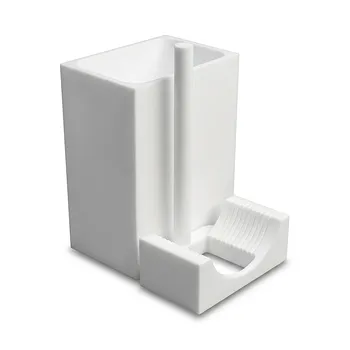
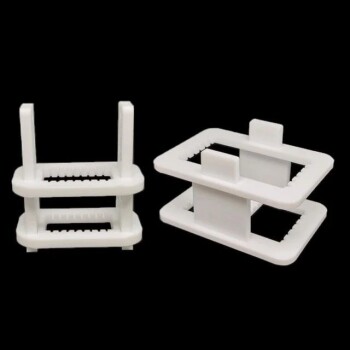
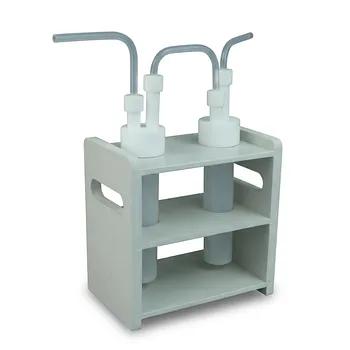
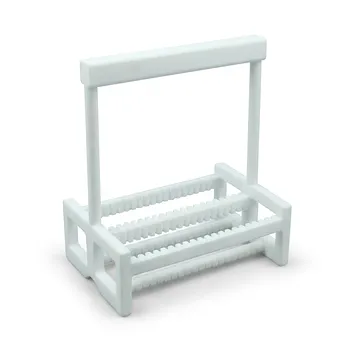
The substrate fixation bracket is a precision spatial regulator designed to control the chemical environment surrounding the substrate during hydrothermal synthesis. Specifically, it suspends the substrate at a fixed height and orientation to manipulate mass transfer and flow dynamics, which drives the formation of a continuous compositional gradient within the thin film.
The bracket serves as a critical interface between fluid dynamics and chemical kinetics, ensuring that the substrate remains isolated from sediment while maintaining a specific distance from the vessel floor. By regulating this spatial positioning, the bracket allows for the time-dependent deposition of varying ion concentrations, such as zirconium, to create a graded ferroelectric structure.
The Role of Spatial Positioning in Hydrothermal Growth
Precision Horizontal Suspension
In the synthesis of compositional gradient films, the bracket is used to suspend the substrate horizontally at a precise height, often exactly 15mm from the bottom of the autoclave. This specific distance is not arbitrary; it defines the volume of the reaction zone and the proximity to precursor concentrations.
Managing Mass Transfer and Kinetics
The bracket’s primary function is to balance mass transfer and kinetic competition within the precursor solution. By fixing the substrate's location, the system ensures that ion diffusion occurs at a controlled rate, allowing for predictable crystal growth.
Preventing Sediment Interference
The bracket, often constructed from Polytetrafluoroethylene (PTFE), acts as a protective barrier that prevents the substrate from contacting precipitates. By keeping the growth surface away from the bottom of the vessel, it ensures that only desired ions nucleate on the substrate rather than bulk sediment or debris.
Driving the Compositional Gradient
Controlling Flow Field Dynamics
The bracket facilitates the formation of a gradient by controlling the flow field distribution between the substrate and the vessel floor. As the hydrothermal reaction progresses over time, these dynamics shift, altering the local chemistry available at the substrate surface.
Dynamic Epitaxy of Ion Concentrations
The spatial control provided by the bracket allows for the dynamic epitaxy of specific elements, such as zirconium. Because the flow field is regulated, the concentration of these elements incorporated into the film changes as a function of reaction time, resulting in a smooth compositional transition.
Ensuring Surface Continuity and Flatness
Beyond chemistry, the bracket is essential for achieving high surface flatness and continuity. By providing a stable, vibration-resistant platform, it allows precursor ions to nucleate uniformly across the entire surface of the single-crystal substrate.
Understanding the Trade-offs
Orientation vs. Goal
While a horizontal orientation is used to drive compositional gradients through flow field manipulation, it can sometimes lead to different growth rates compared to vertical positioning. A vertical or angled orientation is often preferred when the primary goal is maximizing thickness uniformity and avoiding any potential settling of secondary particles.
Height Sensitivity
The effectiveness of the bracket is highly sensitive to height accuracy. Placing the substrate too close to the vessel bottom can lead to non-uniform mass transfer, while placing it too high may move it into a zone with different thermal gradients, potentially stalling the epitaxial growth or altering the intended gradient slope.
How to Apply This to Your Process
Choosing the Right Configuration for Your Goal
- If your primary focus is creating a continuous compositional gradient: You must use a bracket that supports a horizontal orientation at a precise, repeatable height (e.g., 15mm) to exploit time-dependent flow field changes.
- If your primary focus is maximum surface uniformity and flatness: Opt for a vertical or angled PTFE fixture to minimize the impact of gravity-induced sedimentation and ensure uniform ion diffusion across both sides of the substrate.
- If your primary focus is preventing contamination: Ensure the bracket is made of high-grade PTFE to remain chemically inert and prevent the substrate from touching the bottom of the reaction vessel where precipitates collect.
By precisely controlling the spatial environment of the substrate, the fixation bracket transforms a simple hydrothermal reaction into a sophisticated tool for engineering complex ferroelectric thin films.
Summary Table:
| Key Function | Impact on Hydrothermal Growth |
|---|---|
| Spatial Positioning | Regulates ion diffusion and mass transfer rates |
| Horizontal Suspension | Manipulates flow field dynamics for gradient formation |
| Sediment Prevention | Isolates the substrate from vessel floor precipitates |
| Chemical Inertness | PTFE construction prevents precursor contamination |
| Surface Stability | Ensures high flatness and continuity of single crystals |
Elevate Your Synthesis with KINTEK Precision
Optimize your hydrothermal growth and thin film deposition with high-performance fluoropolymer solutions from KINTEK. From everyday basic labware like beakers, crucibles, and reagent bottles to specialized high-purity trace analysis instruments, we provide the chemical resistance and precision your research demands.
Our expertise covers everything from fluid transfer components (tubing, valves) and sample prep tools (separatory funnels, filters) to advanced hydrothermal synthesis liners, microwave digestion vessels, and custom electrochemical cells. Backed by end-to-end custom CNC fabrication, KINTEK can deliver everything from high-volume standard consumables to complex, bespoke non-standard machined parts designed specifically for your substrate fixation needs.
Ready to achieve superior film quality? Contact us today to discuss your custom PTFE/PFA laboratory requirements!
References
- Ruian Zhang, Gaorong Han. Compositionally-graded ferroelectric thin films by solution epitaxy produce excellent dielectric stability. DOI: 10.1038/s41467-024-55411-7
This article is also based on technical information from Kintek Knowledge Base .
Related Products
- Customizable Square PTFE Silicon Wafer Cleaning Flower Basket for Semiconductor Wet Process Etching and Substrate Handling
- Custom PTFE Teflon Parts Manufacturer Conductive Glass Substrate Cleaning Rack
- Custom PTFE Acid Resistant Support Rack Multi Hole PFA Hydrogen Absorption System Bracket
- PTFE Polytetrafluoroethylene Flower Basket Small Silicon Wafer Cleaning Rack Carrier for Laboratory Acid Pickling
People Also Ask
- What are the specific applications of PTFE flower baskets in the semiconductor industry? Expert Wafer Processing Guide
- What are the key chemical resistance properties of PTFE flower baskets used in semiconductor wet processing? Ultra-Purity
- What is the continuous service temperature range for PTFE laboratory cleaning baskets? Durable Lab Solutions Explained
- What structural components are typically found in a high-purity PTFE wafer cleaning rack? Optimize Your Cleaning Process
- How is PTFE utilized in the semiconductor industry? Essential for High-Purity and Yield