The more completely fluorinated the polymer, the lower its surface energy and dynamic friction generally become. Partially fluorinated polyvinyl fluoride (PVF) has a critical surface tension of about 28 dynes/cm and a dynamic friction coefficient near 0.3, while fully fluorinated PTFE reaches approximately 18 dynes/cm and 0.04, respectively. This produces a surface that fluids, residues, and biological samples are less likely to wet, spread across, or adhere to.
For low-adhesion laboratory components, higher fluorination usually means better non-stick behavior, lower surface drag, easier cleaning, and less sample retention. Fully fluorinated materials such as PTFE are therefore strong choices when trace recovery, chemical purity, and contamination control are more important than mechanical strength or dimensional rigidity.
How Fluorination Changes Surface Behavior
Fluorine lowers surface energy
Fluorinated polymer chains have exceptionally low polarizability. Their outermost surfaces therefore develop weak intermolecular attractions with many liquids and solids.
Fluorinated segments also tend to migrate toward interfaces with air or liquids because doing so lowers interfacial energy. The resulting fluorine-rich surface is chemically non-reactive and resistant to wetting by both water-based and many oily substances.
Lower surface energy reduces adhesion
A liquid with poor affinity for a polymer surface forms less contact with that surface. Instead of spreading and leaving a continuous film, it is more likely to remain mobile and drain away.
This matters in laboratory equipment because samples can otherwise remain on tubing walls, vessel surfaces, valve seats, and fittings. Lower surface energy helps reduce residue, improve fluid recovery, and limit carryover between samples.
Fluorination affects friction as well
Fluorinated surfaces provide weak adhesion at the contact interface, which contributes to low sliding resistance. PTFE is a notable example: its dynamic friction coefficient is approximately 0.04, compared with about 0.3 for the partially fluorinated PVF cited in the reference.
Lower friction reduces surface drag during sliding contact and can make fluid-handling components less prone to sticking, clogging, or buildup. It is especially useful where samples or viscous materials repeatedly pass through narrow passages.
Why Fully Fluorinated Materials Perform Differently
PTFE provides an extreme low-adhesion surface
PTFE's fully fluorinated carbon backbone gives it a critical surface tension of approximately 18 dynes/cm, lower than the approximately 28 dynes/cm reported for PVF. This difference indicates substantially weaker attraction between the PTFE surface and many contacting substances.
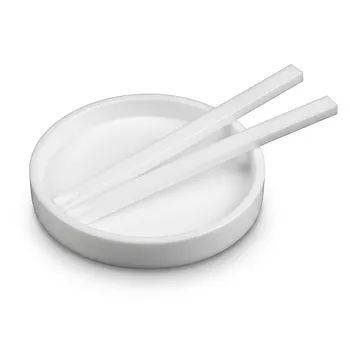
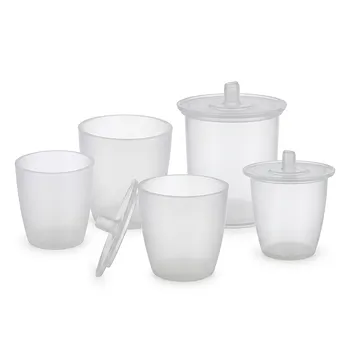
For beakers, dishes, tubing, valves, and vessel linings, that low surface energy supports strong non-stick and fluid-repellent performance.
Surface chemistry supports cleanability
Because less material wets and bonds to a fluoropolymer surface, cleaning generally requires less mechanical effort and leaves less residual film. This is valuable when components are reused across chemical batches or when cleaning steps could introduce contamination.
The practical result is not merely convenience. Reduced retention can improve analytical precision by helping the operator recover more of the intended sample and reducing the risk of cross-contamination.
Low friction supports fluid handling
In tubing and fittings, a low-friction, low-adhesion interface can reduce resistance to movement and limit deposition on the internal wall. In valves and connectors, it can also reduce the tendency of contacting parts or residues to bind.
These benefits occur alongside the chemical resistance associated with fluoropolymers, making them useful for aggressive reagents and high-purity fluid transfer.
How This Matters for Laboratory Component Selection
Trace analysis requires minimal retention
In trace analysis, even a small amount of retained sample can distort recovery, produce carryover, or contaminate a subsequent measurement. A low-energy surface helps minimize the amount left behind on container walls and flow paths.
Fully fluorinated components are therefore most valuable when maximum fluid recovery and low background contamination are central requirements.
Complex fluid paths benefit from low drag
Tubing, valves, and narrow fittings have a high surface-area-to-volume ratio. Surface interactions that seem minor in an open vessel can become significant when a sample travels through a long or constricted path.
Low surface energy and low friction help maintain flow, reduce buildup, and make cleaning of the fluid path more reliable.
Surface stability must also be considered
Fluorinated segments can reorganize at interfaces, and some fluoropolymer systems may undergo surface phase changes over time, particularly under certain aqueous conditions. Material formulation, processing, temperature, and exposure history can therefore affect long-term surface consistency.
For critical applications, selection should consider the specific grade and construction of the component rather than fluorine content alone.
Understanding the Trade-offs
Friction is not determined by fluorination alone
The quoted friction coefficients are useful comparisons, but friction also depends on surface roughness, contact pressure, temperature, wear, counterface material, and the presence of liquids or particles. A highly fluorinated polymer will not automatically produce the same friction value in every assembly.
Testing under the actual operating conditions is important when friction affects actuator force, valve life, flow control, or wear.
Low adhesion does not mean universal chemical compatibility
Fluoropolymers resist a wide range of chemicals, but no polymer is suitable for every reagent, temperature, pressure, or mechanical load. Permeation, creep, deformation, and compatibility with seals or reinforcing layers may still limit component performance.
The complete component design must be evaluated, including fittings, gaskets, supports, and joining methods.
PTFE may not be the best structural material
PTFE offers exceptionally low surface energy and friction, but it can be less dimensionally rigid and more susceptible to creep than some alternative materials. A component that must hold tight tolerances or withstand substantial mechanical loading may require a different fluoropolymer, a reinforcement, or a composite design.
The best choice balances non-stick performance with strength, flexibility, pressure capability, and dimensional stability.
“Zero absorption” should be treated carefully
Fluoropolymer laboratory components are generally selected for negligible wetting and low sample retention, not because every configuration is absolutely incapable of absorbing or permeating every substance. Porosity, processing defects, wall thickness, temperature, and the chemical involved can influence real behavior.
For demanding applications, verify extractables, permeation, and recovery performance using representative samples and cleaning conditions.
Making the Right Choice for Your Goal
The selection should begin with the consequence of surface retention, drag, or contamination in the workflow.
- If your primary focus is maximum non-stick performance: Choose a fully fluorinated material such as PTFE when its mechanical and dimensional limits are acceptable.
- If your primary focus is trace-sample recovery: Prioritize low-surface-energy PTFE or comparable high-purity fluoropolymer components, then verify recovery and carryover experimentally.
- If your primary focus is low-friction fluid handling: Use a fluoropolymer for tubing, valves, and fittings, while evaluating friction under the actual pressure, temperature, counterface, and fluid conditions.
- If your primary focus is dimensional stability or mechanical load: Compare PTFE with other fluoropolymers or reinforced constructions rather than selecting solely by fluorine content.
- If your primary focus is long-term analytical consistency: Review material grade, processing quality, extractables, permeation, and surface stability in the intended chemical environment.
Fluorination is a powerful predictor of low adhesion and low friction, but reliable component selection requires matching that surface advantage to the laboratory system's chemical, mechanical, and analytical demands.
Summary Table:
| Fluorination Level | Surface Energy (dynes/cm) | Dynamic Friction | Typical Materials | Implications for Lab Components |
|---|---|---|---|---|
| High (Fully) | ~18 | ~0.04 | PTFE | Excellent non-stick, low residue, easier cleaning, low friction |
| Medium (Partial) | ~28 | ~0.3 | PVF | Moderate non-stick, higher residue potential |
| Low (None) | Higher | Higher | Non-fluorinated polymers | More wetting, higher adhesion, potential sample retention |
Looking for superior low-adhesion lab components? At KINTEK, we specialize in high-performance fluoropolymers (PTFE and PFA) designed to minimize surface energy and friction for maximum sample recovery and contamination control. From beakers and tubing to custom CNC machined parts, our products offer exceptional non-stick properties and chemical resistance. Contact us today to discuss your requirements.
Related Products
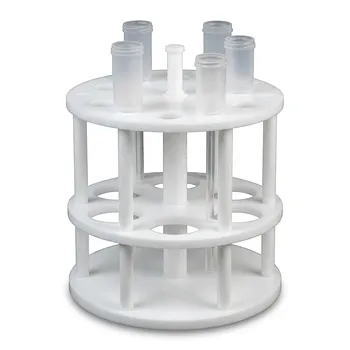
- Custom PFA Microcolumn Racks and PTFE Machined Low Background Corrosion Resistant Laboratory Fixtures
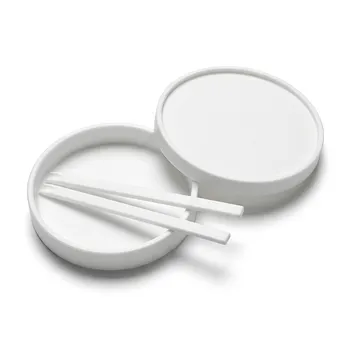
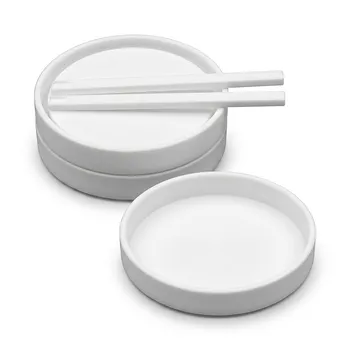
- Custom PTFE Petri Dish 30mm Corrosion Resistant Low Background Non Leaching Laboratory Ware
- Custom PTFE Petri Dish 80mm Diameter Corrosion Resistant Low Background High Purity Laboratory Culture Vessel
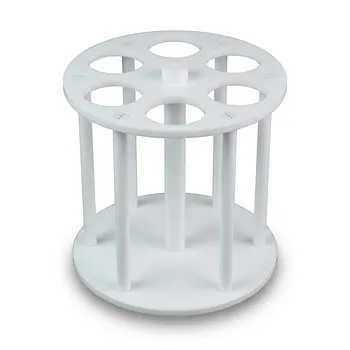
- Custom PFA Separatory Funnel Rack PTFE Machined Laboratory Support Stand Corrosion Resistant Low Background Fluoropolymer Fixture
- Custom Polytetrafluoroethylene PTFE Petri Dishes 60mm Corrosion Resistant Low Background Labware
People Also Ask
- What other PTFE lab accessories are commonly used? Essential Tools for Chemical Resistance & Purity
- How does high fluorination in perfluorinated polymers improve chemical resistance and thermal stability of lab apparatus? Discover the science behind PTFE and PFA's superior performance.
- How does using chemical-resistant PTFE and PFA laboratory apparatus benefit the purification and isolation of synthesized fluoropolymers? Boost yield and purity with non-stick, low-leach labware.
- What inherent material characteristics of non-melt-processable PTFE make it suitable for manufacturing high-purity laboratory containers and custom-machined apparatus?
- How do extreme temperatures and harsh chemical environments affect PTFE and PFA lab apparatus? Achieve Reliable Performance in Demanding Conditions