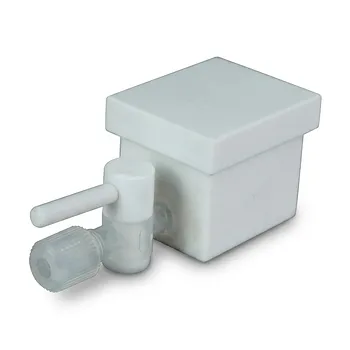
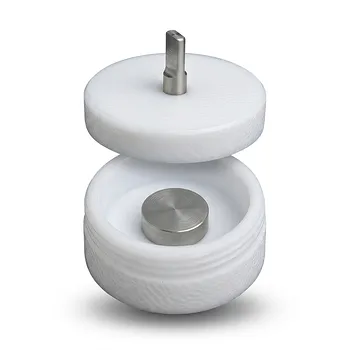
The design of a three-electrode electrolytic cell is the primary factor in ensuring that electrochemical data for transition metal borides reflects the material's intrinsic properties rather than experimental artifacts. By isolating the working electrode from the counter electrode's influence and utilizing a dedicated reference electrode, this configuration allows for the precise measurement of potential, the minimization of ohmic resistance (IR drop), and the collection of accurate kinetic data such as Tafel slopes and overpotentials.
A three-electrode cell provides a stable environment that isolates the catalyst’s behavior, ensuring that the measured current and potential originate solely from the reaction at the transition metal boride surface. This configuration is essential for obtaining high-fidelity data that is free from counter-electrode polarization and background interference.
Isolating the Reaction at the Catalyst Surface
Elimination of Counter-Electrode Polarization
In a two-electrode setup, the measured potential is the sum of the processes at both the anode and the cathode, making it impossible to study a single material in isolation. The three-electrode design uses a reference electrode with a constant, known potential to act as a benchmark, ensuring that any changes in voltage are attributed exclusively to the transition metal boride (TMB) catalyst.
Precise Potential Control
By decoupling the current-carrying circuit from the potential-sensing circuit, the three-electrode cell maintains a stable potential at the working electrode. This stability is critical for transition metal borides, as it allows researchers to accurately determine the flat-band potential and conduction band positions, which define the material's electronic structure.
Accurate Kinetic Measurements
The isolation provided by this design is necessary for calculating the Tafel slope and overpotential. These metrics describe how efficiently a TMB catalyst facilitates reactions like the Hydrogen Evolution Reaction (HER) or Oxygen Evolution Reaction (OER) by revealing the relationship between the reaction rate and the applied voltage.
Optimizing Cell Geometry for High-Fidelity Data
Minimizing Ohmic Drop (IR Drop)
The physical spacing between the working electrode and the reference electrode is a critical design element. Optimized geometry minimizes the internal solution resistance, or IR drop, which can otherwise artificially inflate the measured overpotential and lead to an underestimation of the catalyst's true performance.
Enhancing Surface Wetting
A well-designed cell ensures that the electrolyte thoroughly wets the nanostructured surface of the transition metal boride. Proper wetting is essential for the accurate measurement of the Electrochemical Active Surface Area (ECSA), which determines how many active sites are actually contributing to the reaction.
Maintaining Fluid Stability
Dedicated hardware provides a stable fluid environment that prevents fluctuations in the electrolyte concentration at the electrode interface. This stability is vital for long-term cycling stability tests, ensuring that any degradation observed is due to the material itself and not changes in the testing environment.
Mitigating Interference and Product Cross-Contamination
The Role of H-Type Cell Isolation
For reactions where products at the anode could interfere with the cathode (such as oxygen diffusion), an H-type cell with an ion exchange membrane is used. This design prevents oxygen generated at the counter electrode from diffusing to the TMB working electrode, which would otherwise reduce the apparent Faradaic efficiency.
Eliminating Background Charging Currents
Advanced cell designs, when used with techniques like differential pulse voltammetry, help eliminate background charging currents. This isolation allows for the detection of trace ions and the study of subtle charge transfer rates that are often masked in simpler cell configurations.
Preventing Organic Interference
In specific applications like polymerization, a transfer cell design allows the TMB electrode to be moved between different solutions. This physical separation prevents monomers or organic solvents from creating background noise during the final electrochemical analysis.
Understanding the Trade-offs and Challenges
Increased Complexity and Cost
While a three-electrode setup provides superior data accuracy, it is significantly more complex to assemble and maintain than a two-electrode system. The need for high-purity platinum counter electrodes and calibrated reference electrodes increases the overall cost of the experimental setup.
Potential for Membrane Resistance
In H-type cells, the introduction of an ion exchange membrane can increase the overall resistance of the system. If the membrane is not properly maintained or chosen, it can introduce new variables that complicate the interpretation of impedance data (EIS).
Reference Electrode Sensitivity
The accuracy of the entire system depends on the stability of the reference electrode (e.g., Ag/AgCl or Saturated Calomel Electrode). If the reference electrode is contaminated or improperly positioned, it can lead to systematic errors in potential measurement that invalidate the performance data of the transition metal boride.
How to Apply This to Your Research
Effective testing of transition metal borides requires matching the cell design to your specific analytical goals.
- If your primary focus is determining intrinsic catalytic activity: Use a standard three-electrode cell with minimized electrode spacing and perform IR compensation to ensure overpotential and Tafel slope data are accurate.
- If your primary focus is long-term durability and product purity: Utilize an H-type cell with a high-quality ion exchange membrane to prevent product crossover and counter-electrode interference.
- If your primary focus is semiconductor characterization (e.g., bandgap): Ensure a three-electrode configuration is used in a setup that allows for precise Mott-Schottky analysis and stable potential control.
The integrity of electrochemical performance testing for transition metal borides depends entirely on a cell design that isolates the catalyst and eliminates environmental interference.
Summary Table:
| Design Feature | Impact on Performance | Key Research Benefit |
|---|---|---|
| Reference Electrode | Decouples current/potential sensing | Precise measurement of overpotentials |
| H-Type Configuration | Isolates anode and cathode products | Prevents product cross-contamination |
| Optimized Geometry | Minimizes solution resistance | Reduces IR drop for accurate Tafel slopes |
| Membrane Separation | Blocks species diffusion | Ensures high Faradaic efficiency |
Elevate Your Electrochemical Research with KINTEK
Achieving high-fidelity data for transition metal borides requires a precision-engineered testing environment. KINTEK provides high-performance labware crafted from PTFE and PFA, ensuring zero contamination and maximum chemical resistance for your most sensitive experiments.
Whether you need everyday essentials like beakers, crucibles, and reagent bottles, or advanced standard and custom electrochemical cells and battery testing fixtures, KINTEK is your dedicated partner. Our capabilities include:
- High-Purity Trace Analysis Tools: Digestion tubes, cleaning tanks, and filters.
- Fluid Transfer Components: Precision tubing, fittings, and valves.
- Custom CNC Fabrication: Bespoke laboratory setups and complex non-standard machined parts tailored to your specific research needs.
Ready to optimize your experimental accuracy?
Contact KINTEK today to see how our absolute focus on high-performance fluoropolymers can deliver the durability and precision your laboratory demands.
References
- Tongzhou Hong, Zhong‐Shuai Wu. Fundamental Mechanisms, Synthesis Strategies and Key Challenges of Transition Metal Borides for Electrocatalytic Hydrogen Evolution. DOI: 10.1007/s41918-025-00255-y
This article is also based on technical information from Kintek Knowledge Base .
Related Products
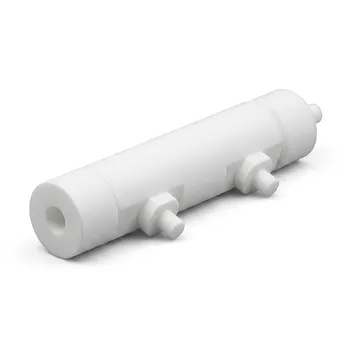
- Custom PTFE Electrolytic Cell Corrosion Resistant Low Background Reaction Vessel with Inlet Outlet Ports
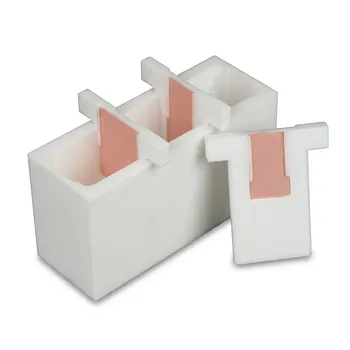
- White PTFE Electrolytic Cell with Movable Slider and Insulated Lid for Fluorine Corrosion Resistance
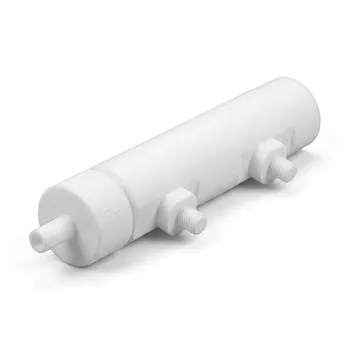
- High Purity Custom PTFE Reaction Cell Electrolytic Tank for Semiconductor and Polysilicon Industrial Applications
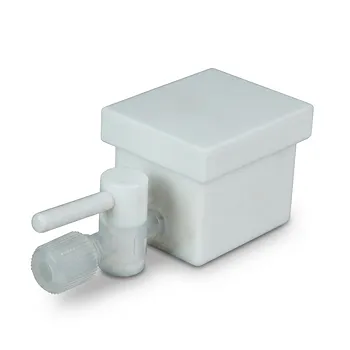
- Custom PTFE Corrosion Resistant Insulating Electrophoresis Reaction Cell with Septum and Valves for Low Background Trace Analysis
- Square PTFE Electrochemical Cell for Silicon Wafer Processing and Hydrofluoric Acid Resistance in Semiconductor and New Energy Research
People Also Ask
- Why are high-purity PTFE or PFA reaction vessels recommended for the synthesis of PANI-TiC hybrid materials? - Guide
- Ion Activation Reaction Vessel Requirements: Why PTFE is Critical for Membrane Performance
- Why is a PTFE reaction vessel required for Ti3C2Tx MXene synthesis? Ensure Safe HF Etching & High Purity
- Why are fluoroplastic (PTFE) reaction vessels recommended for Methylene Blue (MB) adsorption kinetic experiments?
- What reaction vessel and fluid handling considerations are necessary for living cationic polymerization of fluorinated monomers involving Lewis acid catalysts? Key design and safety tips