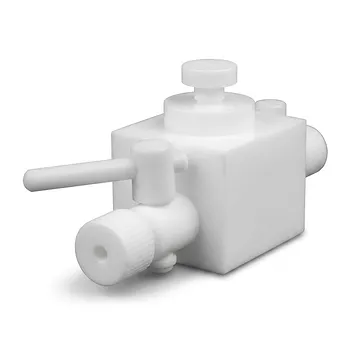
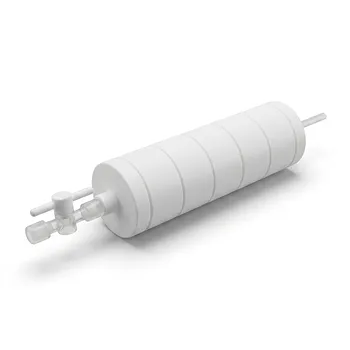
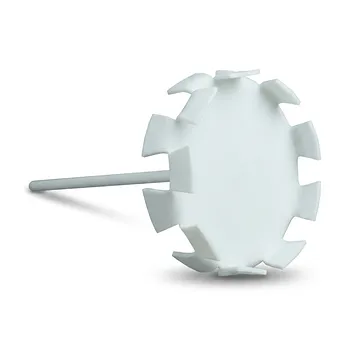
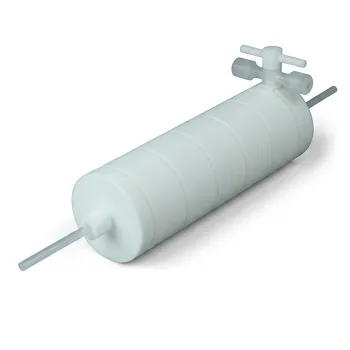
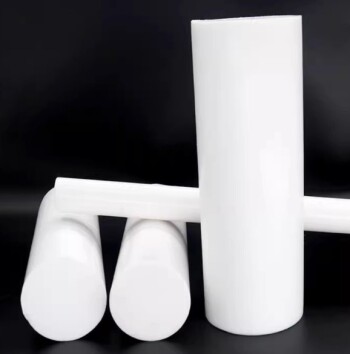
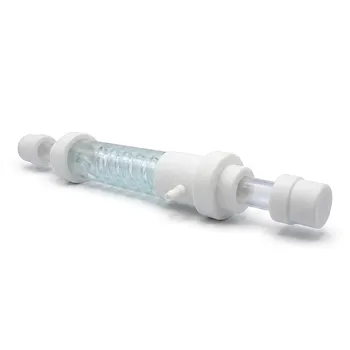
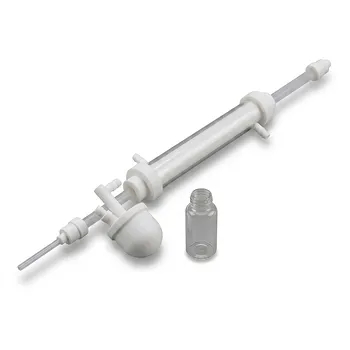
Adding a small amount of perfluoro(alkyl vinyl ether) (PAVE), especially perfluoropropyl vinyl ether (PPVE), makes PTFE less rigid and easier to process without sacrificing its defining chemical and thermal resistance. The comonomer disrupts PTFE crystallization, reducing microvoid formation and improving flexibility, toughness, creep resistance, weldability, and surface quality. Fluoropolymer labware components are essential during synthesis because they withstand highly reactive fluorinated chemicals and solvents while minimizing corrosion, contamination, and leakage.
The central benefit is controlled structural disruption: PAVE-modified PTFE closes more completely during processing and performs better mechanically, while remaining close to homopolymer PTFE in chemical resistance and continuous-use temperature. In the synthesis, PTFE and PFA apparatus provide an inert, high-purity environment for handling aggressive fluorination chemistry.
How PAVE Changes PTFE Resin Performance
It suppresses excessive crystallization
Pure PTFE forms a highly crystalline, rigid structure. That structure provides excellent chemical and thermal resistance, but it also contributes to very high melt viscosity and limited flexibility.
PAVE side chains interrupt the regular packing of the PTFE molecular chains. This lowers crystallinity and reduces excessive recrystallization after processing, producing a resin with better resistance to cracking and deformation.
It improves toughness and flex life
The modified structure allows the resin to absorb more mechanical strain before failure. This is particularly valuable for tubing, seals, valves, and labware exposed to repeated flexing or pressure changes.
PAVE-modified PTFE can also reduce the formation of residual voids after sintering. Fewer microvoids improve flex fatigue resistance and reduce pathways through which chemicals or gases could permeate.
It improves processing behavior
Pure PTFE has extremely high melt viscosity and is generally processed through techniques such as paste extrusion, compression molding, and sintering rather than conventional melt flow.
A low concentration of PAVE slightly reduces processing resistance and helps the material consolidate more completely during sintering. The result can include smoother surfaces, lower porosity, improved dimensional integrity, and more reliable welds.
This modification should not be confused with producing PFA. Higher or differently controlled comonomer incorporation can create melt-processable PFA, but low-level PAVE-modified PTFE generally retains the processing behavior of PTFE while improving its sintering and mechanical performance.
It preserves thermal and chemical resistance
PAVE modification is valuable because the ether-containing side chain does not significantly compromise PTFE's core performance at appropriately controlled concentrations.
The resulting resin can retain chemical inertness and a continuous-use temperature near that of standard PTFE, commonly cited around 260°C for many PTFE applications. Actual limits still depend on resin grade, mechanical loading, exposure conditions, and design.
It reduces permeability and contaminant absorption
Improved consolidation and reduced microvoid volume produce a denser material. This limits chemical permeation and reduces the internal surface area available for trace contaminant absorption.
That benefit matters in high-purity vessels, trace-analysis equipment, digestion systems, and fluid-handling components where a small amount of absorbed or leached material can affect results.
Why PPVE Performs Better Than Some Alternatives
PPVE disrupts the crystal structure efficiently
PPVE has a relatively large perfluoroalkyl vinyl ether side group. Even at low concentration, this side group interferes with the regular PTFE chain arrangement and suppresses crystallization.
The modification therefore produces meaningful changes in toughness and processability without requiring a large change to the fluorinated backbone.
HFP involves a different performance balance
Hexafluoropropylene can also modify PTFE crystallinity and processing behavior. However, the reference material indicates that HFP can reduce thermal stability when copolymerized with tetrafluoroethylene.
PAVE modification offers a more favorable balance when the application requires improved flexibility or consolidation while preserving PTFE-like thermal stability and chemical resistance.
Modifier concentration must remain controlled
The objective is not simply to add as much comonomer as possible. Small concentrations, often below 1% by weight and in some formulations below 0.5%, are used to tune crystallinity, molecular weight, molecular-weight distribution, and processing behavior.
Excessive modification can move the material toward a different fluoropolymer behavior, including melt-processable PFA-type characteristics, rather than delivering a conventional modified-PTFE resin.
What This Means for Laboratory Components
Reaction vessels must resist fluorination chemistry
PAVE synthesis and PTFE polymerization can involve reactive fluorinated intermediates, aggressive reagents, and fluorinated solvents. Ordinary glass, metals, elastomers, or polymer components may corrode, swell, shed particles, or introduce extractables under these conditions.
PTFE and PFA provide chemically inert contact surfaces that tolerate many aggressive fluorinated environments. The correct material still depends on the specific reagent, temperature, pressure, and exposure time.
Tubing and fittings protect fluid purity
Fluid-transfer tubing, valves, and fittings must maintain chemical compatibility throughout charging, reaction, sampling, and transfer. A chemically resistant reaction vessel is insufficient if the connected tubing or seals become the contamination source.
PFA is often useful for transparent or more readily fabricated fluid paths, while PTFE is commonly used for highly inert tubing, seals, machined parts, and fittings. Leak-tight connections are especially important when handling volatile or reactive fluorinated materials.
Labware prevents trace contamination
High-purity fluoropolymer components reduce the risk that metallic ions, corrosion products, plasticizers, or degraded vessel material will enter the reaction mixture.
This is important not only for product quality but also for reproducible polymerization. Trace impurities can affect initiator behavior, particle formation, molecular weight, and the resulting crystallinity or processing characteristics of the resin.
Components support controlled synthesis
Custom PTFE or PFA vessels can be designed around the required pressure rating, agitation, thermal control, sampling, and fluid-transfer geometry. Their role is therefore both protective and functional: they provide a chemically compatible environment in which the comonomer concentration and reaction conditions can be controlled.
The labware does not create the resin modification itself. It enables the polymerization to proceed without apparatus degradation, uncontrolled contamination, or loss of reaction integrity.
Understanding the Trade-offs
Modified PTFE is not automatically melt-processable
Low-level PAVE incorporation improves consolidation and processing behavior, but it does not necessarily convert PTFE into a conventional melt-processable resin.
If a design requires injection molding or continuous melt extrusion, a PFA or another melt-processable fluoropolymer may be more appropriate. Material selection should follow the manufacturing method as well as the chemical environment.
Mechanical gains depend on formulation and processing
The magnitude of the improvement depends on comonomer type and concentration, molecular weight, particle structure, sintering conditions, and the final component geometry.
A resin that performs well in flexible tubing may not be the optimum choice for a heavily loaded pressure vessel or a precision seal.
Chemical compatibility remains application-specific
PTFE and PFA are broadly resistant, but no fluoropolymer should be treated as universally compatible. Highly reactive fluorinating agents, unusual temperatures, permeating gases, pressure cycling, and mechanical stress can change the practical compatibility outcome.
The entire fluid path must be evaluated, including fittings, valve seats, gaskets, welds, and any non-fluoropolymer supports.
More flexibility can affect stiffness
Disrupting crystallinity generally improves toughness and flex life, but it can also change modulus, creep behavior, extrusion pressure, and dimensional response under load.
The relevant trade-off is not simply “modified is better.” It is whether the modified resin provides the right balance of rigidity, permeability, fatigue resistance, and processability for the component.
Making the Right Choice for Your Goal
The best selection depends on whether the priority is resin performance, component fabrication, or chemical purity.
- If your primary focus is mechanical flexibility and flex fatigue: Choose a controlled low-level PAVE-modified PTFE grade and verify its elongation, creep, tear strength, and pressure-cycle performance in the intended geometry.
- If your primary focus is maximum chemical and thermal resistance: Use a fluoropolymer grade with documented compatibility for the specific reagents and temperatures, recognizing that PAVE modification is intended to preserve, not universally increase, those limits.
- If your primary focus is low permeability and trace purity: Prioritize dense, well-consolidated modified PTFE or suitable PFA, together with high-purity PTFE/PFA vessels, tubing, fittings, and seals throughout the fluid path.
- If your primary focus is conventional melt fabrication: Evaluate PFA or another melt-processable fluoropolymer rather than assuming low-level modified PTFE can be injection molded or melt extruded.
- If your primary focus is reliable fluorinated polymer synthesis: Specify corrosion-resistant, low-extractable PTFE or PFA apparatus with leak-tight connections and compatibility verified against the complete reaction recipe.
PAVE modification gives PTFE a more useful balance of crystallinity, toughness, consolidation, and processability while fluoropolymer labware preserves the purity and integrity required to produce that resin reliably.
Summary Table:
| Aspect | Unmodified PTFE | PAVE-Modified PTFE |
|---|---|---|
| Crystallinity | High, rigid structure | Lower crystallinity, more flexible |
| Melt Viscosity | Very high, difficult to process | Slightly reduced, better consolidation |
| Mechanical Toughness | Brittle, prone to cracking | Improved flexibility, flex life, creep resistance |
| Chemical Resistance | Excellent | Maintained, with controlled comonomer concentration |
| Thermal Resistance | Continuous-use ~260°C | Close to unmodified, preserving thermal stability |
| Permeability | Potential microvoids | Reduced microvoids, lower permeability |
Ensure the highest purity and performance in your fluoropolymer synthesis with KINTEK's precision-machined PTFE/PFA labware. Our extensive range of custom vessels, tubing, and components are designed to withstand aggressive fluorination chemistry while preventing contamination. Whether you need standard reaction vessels or bespoke apparatus for PAVE-modified PTFE production, our end-to-end machining services deliver reliable, leak-tight solutions. Contact us today to discuss your requirements and enhance your synthesis efficiency!
Related Products
- PTFE PFA Vacuum Filtration System Corrosion Resistant Customizable Shatterproof Laboratory Device
- High Purity PFA Coiled Tubing Custom PTFE Machining PFA Welding and Precision Bending Solutions
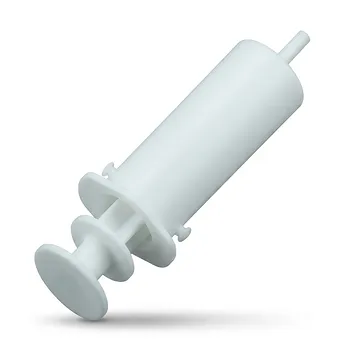
- High Purity Laboratory Grade PTFE Syringe Chemical Resistant Fluoropolymer Injector for Trace Analysis
- Custom PTFE Teflon Balls for Advanced Industrial Applications
- Custom PTFE Petri Dishes Corrosion Resistant High Purity Low Background Labware
People Also Ask
- What makes PTFE filtration systems advantageous for industrial and scientific use? Unmatched Chemical & Thermal Stability
- What temperature resistance do PTFE filters offer? Unmatched Thermal Stability from -200°C to +260°C
- How does the hydrophobicity of PTFE filters benefit their use? Ensure Uninterrupted Gas Flow and Solvent Filtration
- Which chemicals are fully compatible with PTFE filters? Discover Unmatched Chemical Resistance
- What sizes and pore options are available for PTFE filters? Choose the Right Filter for Your Application