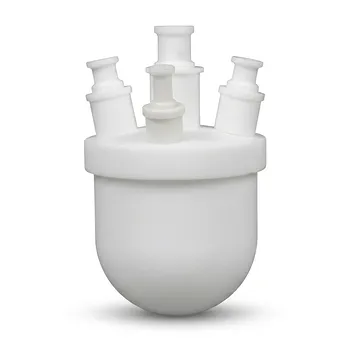
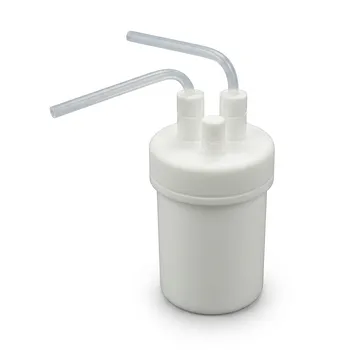
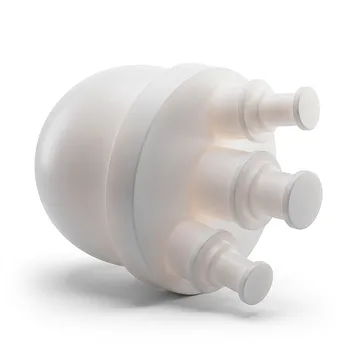
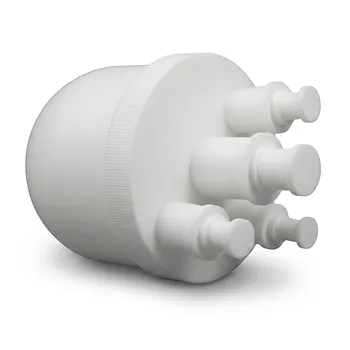
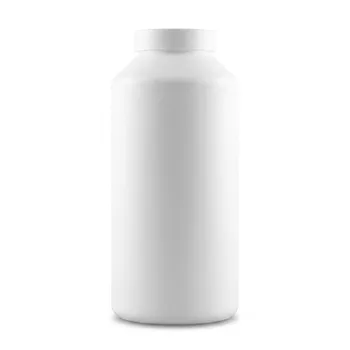
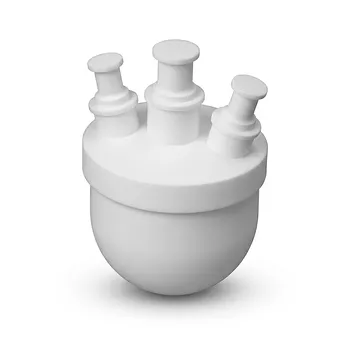
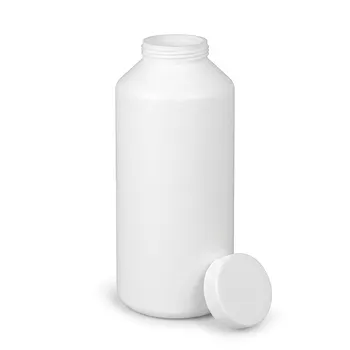
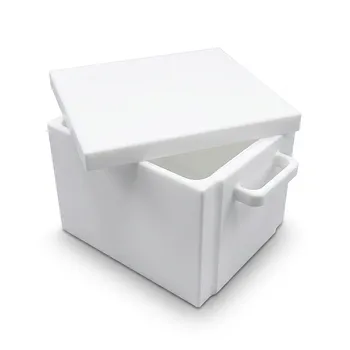
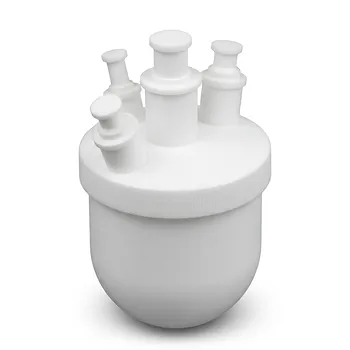
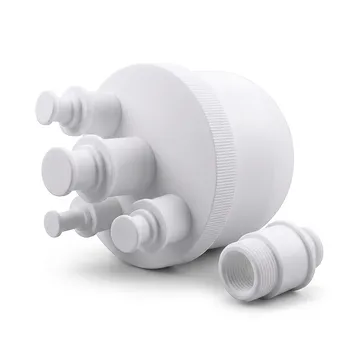
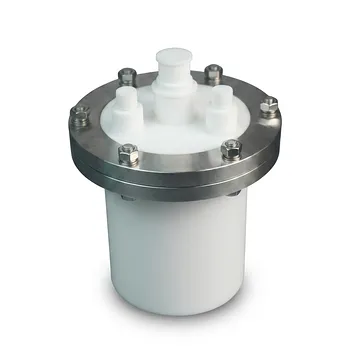
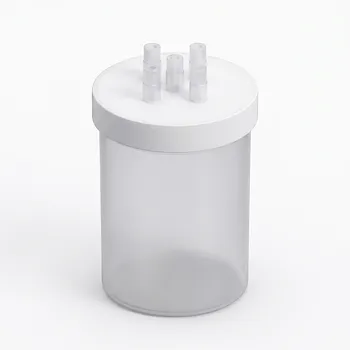
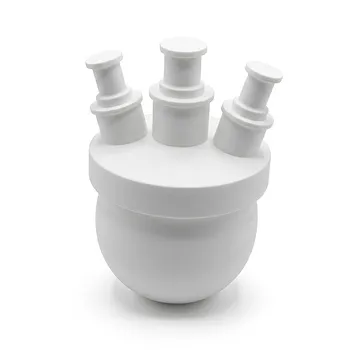
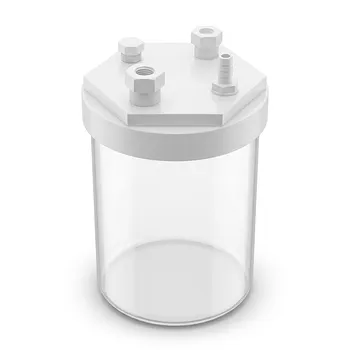
Strict environmental sealing is essential because open-cage fluorinated silanol intermediates can rapidly dehydrate or revert to their closed-cage parent compounds when exposed to atmospheric moisture or trace contaminants. Functionalization with dichlorosilanes also generates corrosive hydrogen chloride (HCl), so the vessel must both exclude water and contain acidic vapors. Custom PTFE/PFA vessels address these requirements through hermetic sealing, inert-gas purge capability, chemical resistance, and non-stick surfaces that simplify product recovery.
The vessel is part of the reaction control system: it protects the moisture-sensitive open cage, safely manages HCl evolution, and preserves a clean surface for recovering the fluorinated product.
Why the Open-Cage Structure Requires Protection
Moisture can change the molecular framework
Open-cage fluorinated disilanols are highly sensitive to environmental moisture and trace impurities. Uncontrolled exposure can promote dehydration, causing the desired open structure to revert to a more stable closed-cage parent compound.
This is not merely a contamination concern. It can directly alter the identity and yield of the material being functionalized.
Solvent conditions also matter
The reaction environment must be controlled not only for atmospheric humidity but also for solvent behavior. Changes in solvent composition, evaporation, or contamination can affect the stability of the silanol intermediates and the reproducibility of the reaction.
For long-duration solvothermal processes, airtight sealing helps limit solvent volatilization and maintain a more consistent internal environment.
Why Dichlorosilane Functionalization Raises the Safety Requirement
HCl is an unavoidable corrosive byproduct
When a silanol reacts with a functional dichlorosilane, chlorine substituents are displaced and hydrogen chloride gas is released. The vessel must therefore tolerate acidic vapors without degrading, swelling, or introducing contaminants.
A properly sealed system also reduces the escape of HCl into the laboratory environment and limits contact between the byproduct and moisture-sensitive reaction components.
Inert-gas purging supports reproducibility
Purge ports allow the vessel to be cleared of humid air before charging or heating the reaction. Maintaining an inert atmosphere reduces the opportunity for atmospheric water to reach the open-cage silanol.
The purge system should be integrated with suitable containment and exhaust procedures; sealing alone is not a substitute for appropriate HCl handling.
How Custom PTFE/PFA Vessels Assist
Hermetic sealing isolates the reaction
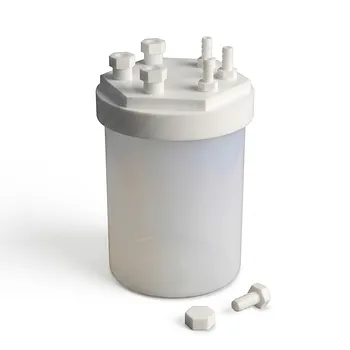
Custom vessels can incorporate tight closures, high-quality fluoropolymer seal tape, and inert-gas ports. Together, these features help maintain an isolated reaction environment during extended heating periods, including reactions lasting approximately 24 hours.
The sealed design also helps reduce solvent loss, such as volatilization of DMSO, and supports a more stable internal pressure and composition.
Fluoropolymers resist acidic vapors
PTFE and PFA provide strong resistance to released HCl and other chemically aggressive reaction components. This is especially important when the vessel is heated, because elevated temperature can intensify solvent and vapor interactions with unsuitable construction materials.
The fluoropolymer construction also avoids introducing reactive metal surfaces that could complicate a sensitive synthesis.
Non-stick surfaces improve recovery
The high-purity, non-stick interior reduces adhesion of fluorinated products and resinous side products. This makes precipitation, transfer, and collection easier while reducing material loss during vessel cleaning.
For difficult-to-handle fluorinated derivatives, this recovery advantage can be as important as chemical compatibility.
Understanding the Trade-offs
Sealing must be balanced with pressure management
A vessel designed to retain solvent and HCl vapors must be operated with appropriate pressure and temperature controls. Hermetic sealing improves environmental control, but it does not eliminate the need to assess pressure development and provide a safe route for inerting, venting, or scrubbing.
Fluoropolymer compatibility is not the entire system design
PTFE/PFA protects the reaction from chemical attack, but seals, fittings, tubing, and purge connections must also be compatible with HCl, the solvent, temperature, and pressure conditions. A chemically resistant vessel can still fail if its closure or ancillary components are inadequate.
Cleanliness remains critical
A sealed vessel prevents new contamination but does not remove residues already present. Moisture, solvent residues, or previous reaction products can still affect the open-cage silanol, so drying and cleaning procedures remain essential.
How to Apply This to Your Project
The correct vessel specification should reflect both the silanol’s moisture sensitivity and the dichlorosilane reaction’s corrosive gas evolution.
- If your primary focus is preserving the open-cage intermediate: Use a hermetically sealed PTFE/PFA vessel with inert-gas purge capability and rigorously controlled drying and charging procedures.
- If your primary focus is safe dichlorosilane functionalization: Select fluoropolymer components that resist HCl and design the system for controlled containment, venting, and appropriate acid-gas management.
- If your primary focus is long-duration solvothermal processing: Use reliable fluoropolymer sealing to limit solvent volatilization and maintain stable reaction conditions throughout the heating period.
- If your primary focus is product recovery: Favor high-purity, non-stick PTFE/PFA interiors that minimize adhesion and simplify precipitation, transfer, and cleaning.
A custom fluoropolymer vessel preserves the chemistry, contains the hazards, and improves recovery by controlling the entire reaction environment rather than merely holding the reagents.
Summary Table:
| Challenge | Why It Matters | How Custom PTFE/PFA Vessels Help |
|---|---|---|
| Moisture sensitivity | Open-cage silanols can revert to closed-cage form | Hermetic sealing and inert-gas purge protect the intermediate |
| Corrosive HCl byproduct | HCl can degrade equipment and harm lab safety | Acid-resistant PTFE/PFA construction contains vapors safely |
| Long-duration reactions | Solvent loss affects reproducibility | Airtight seals minimize volatilization, maintaining stable conditions |
| Product recovery | Adhesive residues lower yield | Non-stick surfaces simplify precipitation and transfer |
Enhance your synthesis with KINTEK's custom PTFE/PFA vessels. Our high-purity fluoropolymer labware, including reaction vessels and custom machined parts, provides hermetic sealing, acid resistance, and non-stick surfaces to protect your moisture-sensitive chemistry and maximize recovery. Whether you need standard vessels or bespoke designs for your specific process, our custom CNC machining ensures a perfect fit. Contact us today for a tailored solution that enhances safety, reproducibility, and yield — get in touch!
Related Products
- Custom PTFE Flask 250ml High Purity Fluoropolymer Laboratory Vessel for Chemical Research
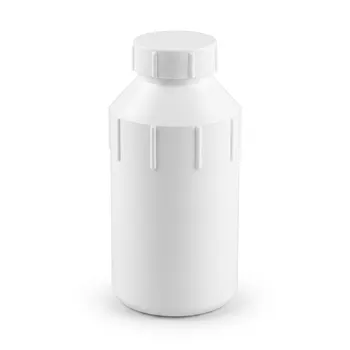
- Custom PTFE Continuous Reaction Bottles Virgin Fluoropolymer High Purity Low Background Synthesis Vessels
- High Purity Custom PTFE Large Volume 15L Flask Corrosion Resistant Low Trace Background Fluoropolymer Reaction Vessel
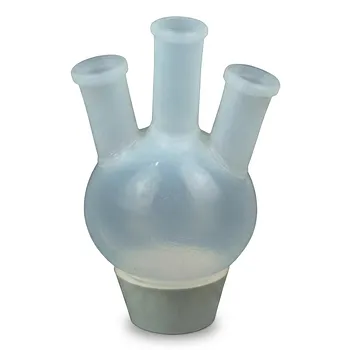
- Laboratory PTFE Three Neck Reaction Flask Corrosion Resistant 2000ml Low Background Fluoropolymer Vessel
- Large Capacity PTFE Reaction Bottle 2L Wide Mouth Fluoropolymer Extraction Vessel Compatible with Rotary Agitators
People Also Ask
- What are the key steps for structural integrity in molded PTFE lab reaction vessels? Master fine powder processing.
- Why Are High-Purity Fluoropolymer Vessels and Tubing Critical for Trace Analysis? Prevent Contamination Reliably
- Why do PTFE fluoropolymer laboratory vessels and containers exhibit superior chemical resistance against harsh solvents and corrosive acids compared to standard plastic labware? Discover the molecular secrets
- How do choice of solvent and chain transfer activity affect molecular weight during vinylidene fluoride (VDF) radical polymerization? Learn Key Factors for High-MW PVDF
- Why are fluoropolymer reaction vessels essential for SnO2/rGO synthesis? The Key to High-Performance Composites