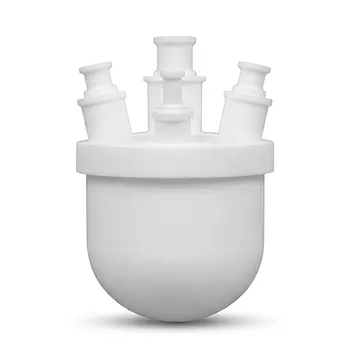
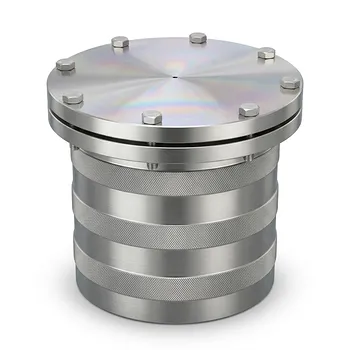
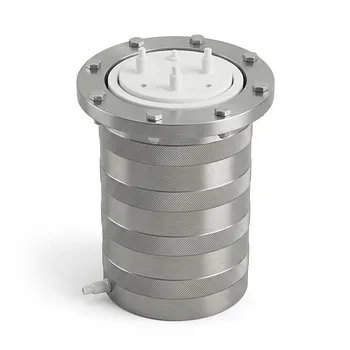
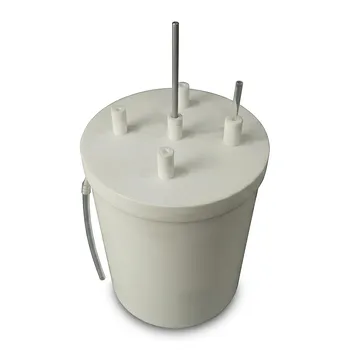
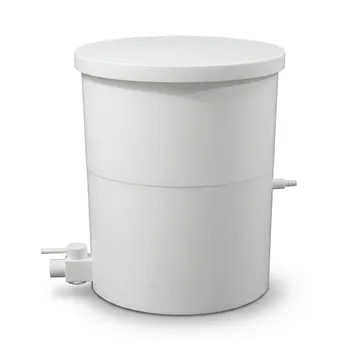
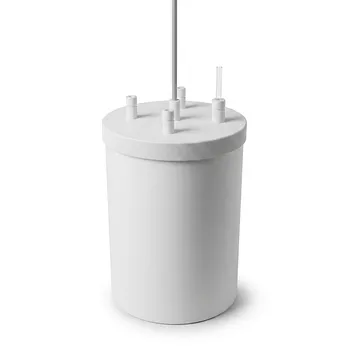
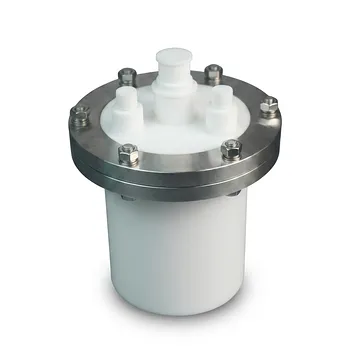
The necessity of a Teflon (PTFE) liner in hydrothermal synthesis stems from its dual role as a chemical shield and a structural barrier against extreme reaction conditions. It is required because it remains chemically inert when exposed to the aggressive precursors used for $V_{2}O_{5}$ and $SnO_{2}$ synthesis, while simultaneously protecting the stainless steel autoclave from corrosion and preventing metallic contamination of the nanostructures.
Core Takeaway: PTFE liners are indispensable because they allow for high-temperature, high-pressure "autogenous" reactions involving corrosive acids and bases without contaminating the nanomaterials. By isolating the reaction from the metal autoclave body, they ensure the purity and precise crystallization of $V_{2}O_{5}$ and $SnO_{2}$.
Protecting Product Purity and Material Integrity
Prevention of Metal Ion Contamination
The primary function of the PTFE liner is to prevent the reaction solution from directly contacting the stainless steel outer shell of the reactor. Without this barrier, the aggressive chemicals required to synthesize $SnO_{2}$ and $V_{2}O_{5}$ would leach metal ions (such as iron, nickel, or chromium) from the autoclave walls into the product.
Chemical Inertness Against Aggressive Reagents
Hydrothermal synthesis of these nanomaterials often involves harsh reagents like tin tetrachloride ($SnCl_{4}$), oxalic acid, and nitric acid. PTFE provides exceptional resistance to these chemicals, as well as to highly acidic environments with a pH as low as 2, which are common in $V_{2}O_{5}$ precursor solutions.
Facilitating the Hydrothermal Environment
Enabling High-Temperature and High-Pressure Reactions
Synthesis typically occurs at temperatures ranging from 160°C to 205°C. The PTFE liner, when sealed inside a stainless steel autoclave, allows the mixture to reach these temperatures safely while maintaining the autogenous pressure necessary for chemical transformation.
Promoting Proper Nucleation and Crystallization
The sealed, high-pressure environment created by the liner is essential for the complete hydrolysis of precursors like $SnCl_{4}$. This controlled environment ensures the formation of specific structures, such as tetragonal rutile $SnO_{2}$ or $V_{2}O_{5}$ nanosheets, which require stable physical conditions to grow with high crystallinity.
Practical Advantages in Material Recovery
Non-Stick Surface and Scaling Prevention
PTFE is naturally non-stick, which prevents synthesized nanoparticles from scaling or adhering to the reactor walls. This is critical for $VO_{2}$ and $V_{2}O_{5}$ synthesis, as it ensures high product recovery and makes the collection of precursor powders more efficient.
Maintaining a Pure Reaction Environment
The sealing performance of a PTFE liner ensures that the reaction remains a closed system, free from external contaminants. This stability allows for long-term reactions—sometimes lasting several hours or days—without the risk of solvent loss or environmental interference.
Understanding the Trade-offs
Temperature Limitations of PTFE
While PTFE is highly versatile, it has a strict upper temperature limit, generally around 250°C. Exceeding this temperature can cause the liner to soften or deform, compromising the seal and potentially releasing toxic fluorinated vapors.
Thermal Expansion Disparity
PTFE has a much higher coefficient of thermal expansion than the stainless steel that surrounds it. This requires careful design of the autoclave to ensure the liner does not crack or become permanently misshapen during the heating and cooling cycles.
How to Apply This to Your Project
Recommendations for Synthesis Planning
- If your primary focus is extreme chemical purity: Always use a fresh or rigorously cleaned PTFE liner to ensure no cross-contamination from previous synthesis batches.
- If your primary focus is synthesizing $V_{2}O_{5}$ nanostructures: Ensure your reactor is rated for at least 210°C to allow a safety margin for the 200°C to 205°C temperatures often required for crystallization.
- If your primary focus is maximizing yield: Utilize the non-stick properties of the liner by using ultrasonic cleaning or mild agitation to recover all particles from the vessel walls post-reaction.
By correctly utilizing a PTFE-lined vessel, you provide the stable, inert environment necessary for the controlled growth of high-performance nanomaterials.
Summary Table:
| Key Feature | Benefit for $V_{2}O_{5}$ & $SnO_{2}$ Synthesis | Technical Reason |
|---|---|---|
| Chemical Inertness | Prevents reagent interference | Resists aggressive acids (nitric, oxalic) and $SnCl_{4}$ |
| Purity Shield | Zero metallic contamination | Isolates reaction from the stainless steel autoclave walls |
| Pressure Stability | Facilitates proper crystallization | Maintains autogenous pressure for tetragonal rutile growth |
| Non-Stick Surface | High product recovery | Prevents nanoparticles from scaling or adhering to walls |
| Thermal Range | Safe high-temp operation | Rated for stable performance up to 250°C |
Achieve Unmatched Purity in Your Nanomaterial Synthesis
Precision in hydrothermal synthesis demands materials that never compromise your results. KINTEK specializes in high-performance fluoropolymer solutions designed for the most rigorous laboratory environments. From everyday basic labware like PTFE beakers, crucibles, and reagent bottles to specialized hydrothermal synthesis liners, microwave digestion vessels, and custom electrochemical cells, we ensure your reactions remain pure and controlled.
Our expertise extends from standard consumables (stirring bars, O-rings, and seal tapes) to end-to-end custom CNC fabrication for complex, non-standard machined parts. Whether you require a single bespoke setup or high-volume orders for fluid transfer components and filtration tools, KINTEK delivers the absolute focus on quality your research deserves.
Ready to upgrade your lab's performance? Contact our material experts today to discuss your custom PTFE/PFA requirements!
References
- Bui Thanh Hung, Chu Manh Hung. Synthesis of V2O5-SnO2 Nanocomposite for NH3 Detection at Low Temperature. DOI: 10.25073/2588-1124/vnumap.5058
This article is also based on technical information from Kintek Knowledge Base .
Related Products
- High Purity PTFE Reaction Vessel with Electric Stirring System and Customizable 5L Tank including Buchner Funnel Filtration Assembly
- High Performance Customizable PTFE Reaction Vessel and Corrosion Resistant Polytetrafluoroethylene Flask for Chemical Laboratory Use
- Custom PTFE Wide Mouth Reagent Reaction Bottle Corrosion Resistant High Temperature Large Capacity Straight Body Laboratory Vessel
- Large Capacity PTFE Reaction Bottle 2L Wide Mouth Fluoropolymer Extraction Vessel Compatible with Rotary Agitators
- Customizable Polytetrafluoroethylene PTFE Reactor and Corrosion Resistant Teflon Flask
People Also Ask
- Why are fluoroplastic (PTFE) reaction vessels recommended for Methylene Blue (MB) adsorption kinetic experiments?
- Ion Activation Reaction Vessel Requirements: Why PTFE is Critical for Membrane Performance
- Why is a PTFE reaction vessel required for Ti3C2Tx MXene synthesis? Ensure Safe HF Etching & High Purity
- How do perfluorinated solvent environments influence the selection of reaction vessels and fluid handling components in nonaqueous emulsion polymerizations? Choose fluoropolymer materials.
- Why are high-purity PTFE or PFA reaction vessels recommended for the synthesis of PANI-TiC hybrid materials? - Guide