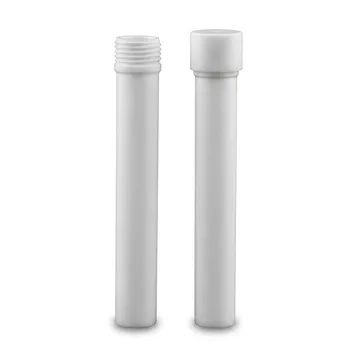
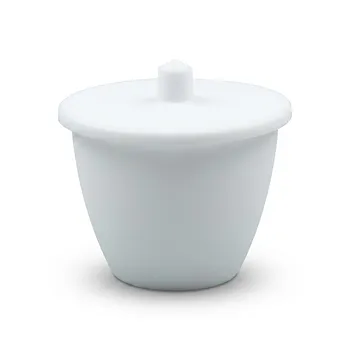
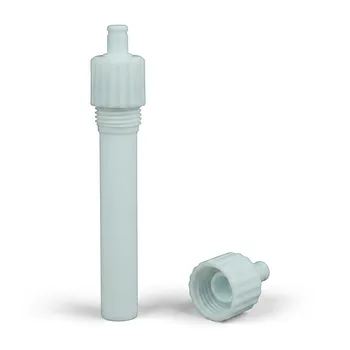
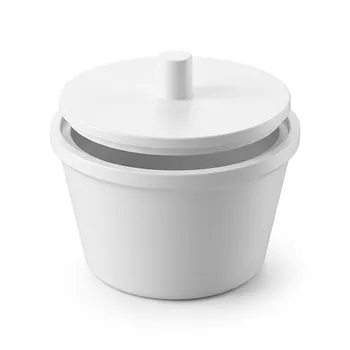
PTFE and PFA are preferred because they retain their chemical resistance and dimensional stability at temperatures where FEP approaches its practical limit. FEP is generally suitable for continuous service up to about 200°C (400°F), while PTFE and PFA can typically support continuous operation up to approximately 260°C (500–550°F), depending on grade and design. That additional thermal margin helps prevent deformation, creep, stress cracking, permeation, and chemical degradation in digestion vessels and extreme reaction equipment.
The key advantage is operating margin: PTFE and PFA combine FEP-level chemical inertness with a higher continuous-use temperature, making them more reliable for hot acid digestion, microwave vessels, hydrothermal reactions, and high-temperature fluid handling.
Why FEP Becomes Less Suitable at Extreme Temperatures
FEP has a lower continuous-use temperature
FEP is melt-processible and easier to mold than standard PTFE, but its typical continuous operating limit is around 200°C. Near or above that range, prolonged exposure can reduce mechanical strength and dimensional stability.
In a digestion vessel, this can lead to distortion, loss of sealing performance, or increased risk of liner damage when heat and pressure occur together.
Thermal margin matters during real processes
A vessel may experience temperature gradients, localized microwave heating, thermal cycling, and pressure generated by volatile or reactive samples. Operating close to a polymer’s maximum rating leaves less tolerance for these variations.
PTFE and PFA provide a higher temperature ceiling, so the material is less likely to be pushed into a range where creep, deformation, or degradation becomes significant.
Why PTFE and PFA Perform Better
Strong chemical resistance at elevated temperature
PTFE and PFA are highly resistant to concentrated acids, strong bases, and many organic solvents. Their fluorinated molecular structures provide exceptional stability because of the strength of the carbon–fluorine bonds.
This resistance is particularly important in microwave acid digestion, where hot reagents can attack less-resistant polymers or increase permeation and swelling.
Better dimensional stability under thermal load
At high temperature, polymers can gradually deform under pressure or sustained mechanical stress. This behavior is known as creep.
PTFE and PFA generally provide more useful high-temperature performance than FEP for containment applications. PFA can offer improved mechanical strength and creep resistance at elevated temperatures, although the exact performance depends on the grade, wall thickness, pressure, and temperature profile.
Lower risk of sample contamination
PTFE and PFA have very low surface adhesion and non-wetting characteristics. Samples are less likely to stick to the vessel, reducing carryover, residue, and incomplete liquid recovery.
Their low background impurity levels also make them valuable in trace analysis, where contamination from the container can affect measurements of metals such as cadmium or lead.
Resistance to thermal cycling
Digestion and reaction equipment may repeatedly transition between ambient temperature and severe heating conditions. PTFE and PFA tolerate these changes more effectively than materials with lower thermal margins.
This helps preserve the liner, seals, fittings, and vessel geometry over repeated operating cycles.
PTFE Versus PFA: The Important Difference
PTFE is the benchmark for chemical inertness
PTFE provides exceptional chemical resistance, very low friction, and a continuous service temperature commonly cited near 260°C. It is often selected when maximum inertness and resistance to aggressive reagents are the primary requirements.
However, standard PTFE cannot be processed like a conventional melt-flowing thermoplastic. Above its melting point, it forms a stiff gel rather than flowing readily, so PTFE components are commonly made through specialized molding, sintering, or machining.
PFA preserves PTFE-like performance with easier processing
PFA was developed to retain much of PTFE’s chemical and thermal performance while being melt-processible. It can therefore be extruded or injection molded into complex vessels, fittings, valves, and thin-walled components.
This processing advantage is significant when the apparatus requires intricate geometry, integrated features, high-purity surfaces, or consistent molded dimensions.
PFA is often advantageous for complex high-temperature hardware
PFA combines a continuous operating temperature of approximately 260°C with high chemical resistance, low permeability, and good mechanical performance. It is therefore particularly useful for molded digestion vessels, trace-analysis components, and complex fluid-handling assemblies.
The choice is not simply “PTFE is better than PFA.” PTFE may be preferable for maximum inertness or machined components, while PFA may be preferable when complex shapes and melt processing are important.
Why These Properties Matter in Digestion Vessels
Safe containment of aggressive reagents
Microwave digestion and similar processes combine heat, chemical attack, and pressure in a confined volume. The liner must remain chemically stable while maintaining its shape and sealing function.
PTFE and PFA reduce the likelihood that the vessel material will swell, crack, soften, or react with the sample under these conditions.
Complete reaction and liquid recovery
A chemically stable, low-adhesion liner helps the sample remain in the intended reaction environment. Low surface wetting also supports more complete recovery after digestion.
This is important when the sample contains very small quantities of analyte and even minor residue or adsorption can affect the result.
Reduced contamination and carryover
The vessel is part of the analytical system, not merely a container. If it releases impurities, adsorbs target species, or retains residues from a previous run, it can compromise accuracy.
PTFE and PFA surfaces help minimize these risks when properly cleaned, conditioned, and used within their specified operating limits.
Understanding the Trade-offs
FEP remains useful below its temperature limit
FEP is not inherently unsuitable for laboratory equipment. Its melt-processability, transparency, flexibility, and chemical resistance make it useful for tubing, liners, and components operating within its temperature range.
It becomes less attractive when continuous exposure approaches 200°C, or when the process combines high temperature with pressure, thermal cycling, and aggressive reagents.
PTFE can be difficult to manufacture into complex shapes
PTFE’s processing limitations can increase manufacturing complexity and restrict economical production of intricate molded geometries. Machining and specialized molding may also introduce design constraints.
For a complex apparatus, PFA may provide a more practical route while maintaining comparable high-temperature chemical performance.
Temperature ratings are not pressure ratings
A material’s continuous temperature rating does not by itself establish that a vessel is safe at a particular pressure. Wall thickness, geometry, seals, thermal gradients, heating method, chemical compatibility, and manufacturer specifications must all be evaluated.
Microwave and closed-vessel applications require a complete pressure and safety assessment rather than material selection alone.
Chemical compatibility remains condition-specific
PTFE and PFA are exceptionally resistant, but no fluoropolymer should be treated as universally immune to every chemical, concentration, temperature, and exposure duration. Strong oxidizers, molten alkali metals, fluorinating agents, and unusual reaction conditions require specific compatibility verification.
The relevant rating is the one for the actual chemical, temperature, pressure, and duration—not a general material label.
Choosing the Right Material for the Application
Material selection should reflect both the operating environment and how the component must be manufactured.
- If your primary focus is maximum chemical inertness: Choose PTFE or PFA rather than FEP when the process involves highly aggressive reagents or elevated temperatures.
- If your primary focus is continuous high-temperature operation: Prefer PTFE or PFA for applications approaching 260°C, while keeping FEP within its approximately 200°C continuous-use range.
- If your primary focus is complex molded geometry: Choose PFA when injection molding or extrusion is needed without giving up high-temperature chemical resistance.
- If your primary focus is trace-metal accuracy and sample recovery: Use high-purity PTFE or PFA because their low adhesion and low background contamination help protect analytical integrity.
- If your primary focus is low-temperature or moderate-temperature processing: FEP may be an effective and economical choice when its temperature and pressure limits are not approached.
For extreme digestion and reaction service, PTFE and PFA provide the thermal and chemical operating margin that FEP generally cannot.
Summary Table:
| Material | Continuous Use Temp | Chemical Resistance | Processability | Best For |
|---|---|---|---|---|
| PTFE | ~260°C | Excellent | Difficult (machining/sintering) | Maximum inertness, machined parts |
| PFA | ~260°C | Excellent | Good (melt-processible) | Complex molded geometry, high purity |
| FEP | ~200°C | Good | Good (melt-processible) | Lower temperature tubing/liners |
Ready to ensure your high-temperature digestion vessels perform reliably? At KINTEK, we specialize in manufacturing high-performance PTFE and PFA labware, from standard digestion vessels and microwave vessels to custom complex apparatus. Our end-to-end CNC machining and melting processing capabilities allow us to deliver precise, durable solutions for your most demanding applications. Contact us today to discuss your requirements and discover how our expertise can enhance your lab's efficiency and accuracy. Contact us now!
Related Products
- Custom 100ml PTFE Digestion Tube for Heavy Metal Trace Analysis and High Temperature Acid Digestion
- PTFE Lined High Pressure Digestion Vessel 50ml High Temperature Hydrothermal Synthesis Tank
- High Purity PTFE PFA Microwave Digestion Vessels Custom Acid Digestion Tanks for Laboratory Sample Preparation
- High Purity Laboratory Microwave Digestion Vessel Customizable PFA PTFE Digestion Tank for Analytical Sample Preparation Trace Metal Analysis
- Custom Thickened PTFE Beaker High Temperature Hot Plate Heating Laboratory Fluoropolymer Vessel Chemical Resistant Digestion Beaker
People Also Ask
- What are the common capacities and physical configurations available for PTFE digestion tubes? Expert Selection Guide
- How do PTFE digestion tubes minimize contamination during ultra-trace elemental analysis? Achieve high-purity results.
- What is the primary function of PTFE digestion tubes in a laboratory setting? Essential for Pure Sample Mineralization
- How do PTFE digestion tubes assist in pharmaceutical and biological sample preparation? Ensure High Recovery & Purity
- What is the primary role of a PTFE digestion tube in analytical chemistry? Ensure High Purity and Trace Accuracy