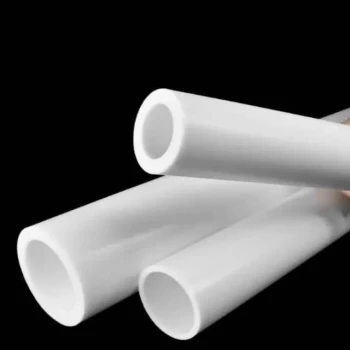
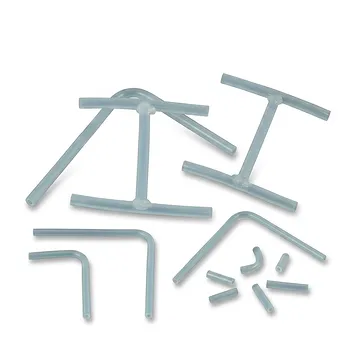
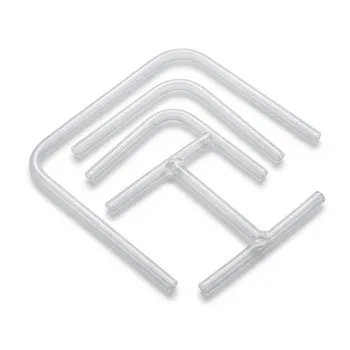
The process used is radial expansion followed by heat-shrink thermoforming. An ePTFE tube is first expanded beyond its original diameter, placed over a shaped mandrel, mold, or wire framework, and then heated under controlled conditions. As it contracts, the tube conforms tightly to the underlying geometry, creating complex three-dimensional components or reinforced tubular structures.
Radial expansion and heat contraction allow ePTFE tubing to be thermoformed directly over a three-dimensional support. This differs from conventional PTFE sheet vacuum forming or matched-die forming.
How the ePTFE Thermoforming Process Works
Radially expand the ePTFE tube
The ePTFE tube is expanded to a diameter larger than its original unexpanded size. This creates the necessary material reserve for later contraction around the component’s shaping structure.
Position the tube over the shaping geometry
The expanded tube is placed over a pre-shaped mandrel, mold, or internal wire framework. The support defines the final external geometry, including bends, branches, flanges, and other non-standard features.
Apply controlled heat
Heating causes the expanded ePTFE structure to contract. The tube shrinks tightly around the mandrel or reinforcement, conforming to its external shape with high geometric precision.
Why This Process Is Used for Complex Components
It preserves a seamless tubular structure
Because the starting material is tubing, the process can produce seamless shaped conduits rather than requiring multiple pieces to be joined. This is useful for specialized fluid-handling and reaction-apparatus components.
It accommodates three-dimensional geometries
The tube can conform to complex contours that are difficult to produce using conventional straight-tube fabrication. Typical results include flanged tubular parts, manifolds, bends, and reinforced conduits.
It integrates internal reinforcement
Wire framing or other internal scaffolding can be positioned beneath the expanded tube. Heat contraction then locks the ePTFE around the support, producing a reinforced tubular structure.
How It Differs from Conventional PTFE Thermoforming
It is not primarily a sheet-forming operation
Conventional PTFE thermoforming may heat a sheet and shape it using vacuum, pressure, a diaphragm, or matched dies. Those methods are applicable to contoured sheet components such as diaphragms, seals, and liners.
ePTFE relies on controlled recovery
For ePTFE tubing, the defining mechanism is radial expansion followed by thermally induced contraction around a physical support. The mandrel or framework supplies the shape, rather than pressure alone forcing a flat sheet into a mold.
Understanding the Trade-offs
The support geometry determines the result
The final component closely follows the mandrel, mold, or reinforcement geometry. Errors in that support will therefore be reproduced in the formed ePTFE part.
Heating must be carefully controlled
Insufficient or uneven heating can prevent full conformity or produce dimensional variation. The process requires controlled thermal conditions appropriate to the ePTFE structure.
It is specialized rather than general-purpose forming
This method is well suited to custom, low-volume, or highly specialized parts. It is not the same as standard paste extrusion, which produces continuous dense PTFE tubing, nor is it a substitute for every sheet-based thermoforming process.
How to Apply This to Your Project
- If your primary focus is complex three-dimensional tubing: Specify radial expansion and controlled heat contraction over a shaped mandrel or mold.
- If your primary focus is reinforcement: Incorporate wire framing or internal scaffolding beneath the expanded ePTFE before heating.
- If your primary focus is seamless manifolds or flanged components: Use the process to form the tube directly around the complete external geometry.
- If your primary focus is flat-sheet parts: Evaluate vacuum, pressure, diaphragm, or matched-die PTFE thermoforming instead.
For complex ePTFE tubular components, the defining fabrication method is radial expansion followed by heat contraction over a shaped support.
Summary Table:
| Aspect | Description |
|---|---|
| Process | Radial expansion followed by heat-shrink contraction over a shaped support |
| Key Steps | Expand tube, place over mandrel/mold, heat to shrink tightly |
| Advantages | Seamless structures, complex geometries, integrated reinforcement |
| Differences | Unlike sheet forming; relies on controlled recovery of expanded tube |
| Considerations | Support precision, controlled heating, specialized for custom parts |
Ready to bring your complex ePTFE components to life? At KINTEK, we specialize in high-performance fluoropolymers, offering expert custom machining and fabrication of PTFE and PFA products. Whether you need custom thermoformed tubing, reinforced structures, or advanced laboratory apparatus, our end-to-end solutions—from design to high-volume production—ensure precision and reliability. Contact us today to discuss your project and discover how we can enhance your laboratory's efficiency and performance. Get in touch now!
Related Products
- High Purity PTFE Digestion Tubes and Custom Centrifuge Tubes 100ml for Trace Analysis and Chemical Digestion
- Corrosion Resistant PTFE Digestion Tubes for Graphite Digestion Systems with Reflux Caps and Customizable Dimensions
- Custom PTFE Digestion Tube Double Sided Openable High Temperature Corrosion Resistant Low Background
- Custom High Purity PTFE Digestion Tubes and Centrifuge Tubes for Trace Metal Analysis
- Custom PTFE Condenser Tube Reflux Reaction Condensation Purification Device Semiconductor Chemical Lab Equipment
People Also Ask
- How do PTFE digestion tubes assist in pharmaceutical and biological sample preparation? Ensure High Recovery & Purity
- What is the primary function of PTFE digestion tubes in a laboratory setting? Essential for Pure Sample Mineralization
- How do PTFE digestion tubes minimize contamination during ultra-trace elemental analysis? Achieve high-purity results.
- What are the common capacities and physical configurations available for PTFE digestion tubes? Expert Selection Guide
- How do PTFE digestion tubes facilitate the analysis of food and agricultural products? Ensure High-Purity Mineralization