High-molecular-weight and porous fluoropolymers are produced primarily through emulsion-based methods, especially conventional emulsion polymerization and supercritical carbon dioxide (scCO₂) emulsion-template techniques. Other routes include electrochemical, radical, anionic, and fluorinated-peroxide-initiated polymerization, while controlled polycondensation can produce soluble resins exceeding 100,000 g/mol. Precise monomer feeding during copolymerization is necessary to control fluorine content, sequence, heat release, phase behavior, and gelation.
The synthesis method determines whether the priority is molecular weight, porosity, or composition control. Accurate feed systems are essential because fluorinated and non-fluorinated monomers must be introduced at controlled rates and positions to avoid overfluorination, phase separation, instability, and inconsistent polymer performance.
Which Synthesis Methods Are Used?
Emulsion polymerization for high molecular weight
Emulsion polymerization is a principal route for producing fluoropolymers with high molecular weight and high fluorine content.
Fluorinated monomers are hydrophobic and can diffuse rapidly across micelle membranes. This supports polymer growth within stabilized reaction domains and can produce dense polymer structures with substantial molecular weight.
scCO₂ emulsion templates for porous structures
Supercritical carbon dioxide emulsion polymerization or emulsion-template synthesis can generate controlled porous morphologies.
The emulsion acts as a temporary structural template. After polymer formation and removal or depressurization of the carbon dioxide phase, the resulting material can retain a porous architecture rather than forming only a dense bulk polymer.
Electrochemical and chain-growth routes
Electrochemical polymerization is another established approach, particularly where polymer growth can be driven at an electrode surface.
Fluoropolymers and fluorinated copolymers may also be prepared using radical polymerization, including fluorinated-peroxide initiation, as well as anionic polymerization where the monomer and reaction conditions support that mechanism.
Controlled polycondensation
For multifunctional fluorinated monomers, polycondensation can produce very high molecular weights, but it requires strict control of concentration and addition rate.
Diluted solution conditions, commonly with solid contents around 2.7–4 wt.%, combined with slow addition of multifunctional monomers, help delay macro-gelation. This can yield fully soluble fluoropolymer resins with molecular weights above 100,000 g/mol.
Why Precise Feed Control Matters
It controls copolymer composition
Fluorinated and non-fluorinated monomers do not necessarily react at identical rates or distribute uniformly without process control.
A calibrated feed system supplies the fluorinated monomer incrementally, helping maintain the intended composition throughout the reaction rather than creating fluorine-rich sections or poorly controlled composition gradients.
It prevents overfluorination
Excessive or poorly timed fluorinated-monomer addition can produce overfluorination.
According to the reference, this may contribute to undesirable phase separation, reduced stability against singlet oxygen, and degraded device performance. Feed control therefore serves as a way to keep fluorine content within the useful design window.
It controls sequence and substitution position
In copolymers, the location of fluorinated units can matter as much as their total percentage.
Controlled addition helps manage substitution positions and supports the desired backbone planarity, which can influence thermal resistance and other functional properties.
It moderates reaction heat and local concentration
Fluorinated monomers, initiators, and reaction environments can be chemically demanding. Introducing a reactive monomer too quickly can create local concentration peaks, uneven polymer growth, or excessive heat generation.
Incremental feeding distributes the reaction more evenly through the vessel and improves control over molecular weight and morphology.
It reduces the risk of gelation
Multifunctional monomers can connect growing chains into a three-dimensional network. If their concentration rises too quickly, the reaction can reach the gel point prematurely and form an insoluble macro-gel.
Slow addition under diluted conditions shifts the critical gel point toward higher conversion and improves the likelihood of obtaining a soluble, processable resin.
Why the Reaction Vessel Is Part of the Process
Fluorinated reagents can attack ordinary hardware
Fluorinated monomers, solvents, and initiator systems may be aggressive or reactive toward conventional laboratory materials.
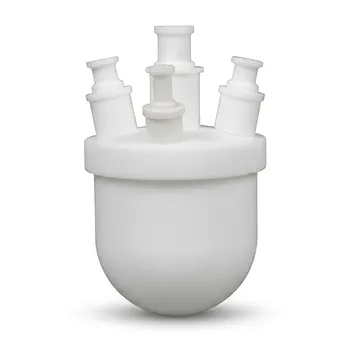
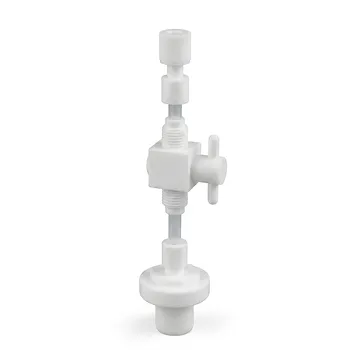
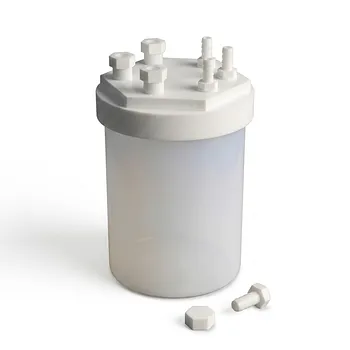
PTFE and PFA reaction vessels, transfer lines, reagent bottles, valves, and digestion containers are used to improve chemical compatibility and reduce contamination risks.
Materials compatibility protects product quality
Metallic components can introduce trace-element contamination or interact with aggressive reagents. High-purity fluoropolymer hardware helps preserve process purity, particularly during synthesis and analytical sample preparation.
The vessel must tolerate demanding conditions
Some routes involve elevated pressure, supercritical carbon dioxide, strong radicals, or high-temperature processing.
The reaction vessel and associated tubing must therefore provide appropriate chemical resistance, thermal stability, mechanical strength, and pressure compatibility for the selected synthesis route.
Understanding the Trade-offs
Emulsion methods require morphology control
Emulsion polymerization can provide high molecular weight, but particle formation, surfactant behavior, monomer diffusion, and phase stability must be managed carefully.
scCO₂ templating can create porosity, but the final pore structure depends on emulsion and processing conditions. Porosity is not automatically uniform or optimal for every application.
High fluorine content is not always better
Fluorination can improve chemical resistance and thermal performance, but excessive fluorine content or poor distribution can cause phase separation and reduce functional stability.
The objective is therefore controlled fluorination, not simply maximizing the fluorinated-monomer fraction.
Polycondensation can create insoluble networks
Multifunctional monomers offer a path to high molecular weight, but they also increase gelation risk.
Concentration, feed rate, conversion, and mixing must be controlled together. A process that produces a high molecular weight in theory may instead generate an unusable insoluble gel if these variables are poorly managed.
Specialized equipment adds complexity
PTFE and PFA hardware improves compatibility and purity, but it can increase equipment cost and impose constraints on sealing, pressure rating, heat transfer, and mechanical design.
The vessel should be selected for the actual chemistry and operating conditions rather than treated as a generic container.
How to Apply This to Your Project
The appropriate route depends on whether the main requirement is dense high molecular weight, controlled porosity, or precise copolymer composition.
- If your primary focus is high molecular weight: Use emulsion polymerization or controlled polycondensation, with dilution and slow multifunctional-monomer addition where gelation is a concern.
- If your primary focus is porosity: Use a scCO₂ emulsion-template approach and optimize the emulsion structure and post-reaction template removal.
- If your primary focus is copolymer performance: Use calibrated, incremental fluorinated-monomer feeding to control fluorine content, sequence, planarity, and phase behavior.
- If your primary focus is process purity and safety: Use compatible high-purity PTFE or PFA vessels, transfer lines, valves, and containers rated for the reaction’s chemical, thermal, and pressure conditions.
Successful fluoropolymer synthesis depends not only on selecting the right polymerization chemistry but also on controlling how, when, and where each monomer enters the reaction.
Summary Table:
| Synthesis Method | Application | Key Characteristic |
|---|---|---|
| Emulsion polymerization | High molecular weight | Efficient monomer diffusion, dense structure |
| scCO₂ emulsion templating | Porous structures | Controlled pore morphology |
| Electrochemical & chain-growth | Various polymers | Versatile, specific conditions |
| Controlled polycondensation | Soluble high MW | Dilution, slow addition to avoid gelation |
| Feed Control Reason | Impact |
|---|---|
| Composition control | Maintain intended monomer ratio |
| Prevent overfluorination | Avoid phase separation, instability |
| Manage sequence | Ensure desired backbone planarity |
| Moderate heat | Even distribution, controlled growth |
| Reduce gelation risk | Keep polymer soluble |
Optimize Your Fluoropolymer Synthesis
At KINTEK, we provide high-purity PTFE and PFA reaction vessels, tubing, valves, and custom components designed for demanding fluoropolymer chemistry. Our end-to-end CNC machining ensures precise fit and chemical resistance, supporting your polymerization control. Whether you need bespoke labware or high-volume orders, our products help maintain purity and safety.
Contact us today to discuss your specific synthesis needs and enhance your process reliability.
Related Products
- High Purity PFA Chromatography Column with Collection Bottle Corrosion Resistant Fluoropolymer Filtration System for Trace Analysis
- Custom PTFE Flask 250ml High Purity Fluoropolymer Laboratory Vessel for Chemical Research
- Custom PFA Tubing 1/4 Inch High Purity Corrosion Resistant Fluoropolymer Tube with Welding and Machining Services
- Corrosion Resistant PFA Syringe Translucent Visual Fluoropolymer Labware 10ml Chemical Handling Tool
- Custom PTFE Reaction Tank Corrosion Resistant Fluoropolymer Chemical Processing Barrel 10L 20L 30L
People Also Ask
- What are the primary functional and temperature differences between PFA and FEP when selecting melt-processible fluoropolymers for custom laboratory apparatus?
- How does PPVE modify PTFE to make melt-processable PFA? Discover key benefits and applications.
- Why is the chemical stability of polymer endgroups critical when selecting melt-processible fluoropolymers like PFA for high-purity laboratory apparatus? Choose Stable Endgroups for Reliable Performance
- What are the characteristics of PFA material? A Guide to Its High-Performance Balance
- Why is Perfluoroalkoxy alkane (PFA) preferred over glass or stainless steel in pharmaceutical process development? Pure Yield