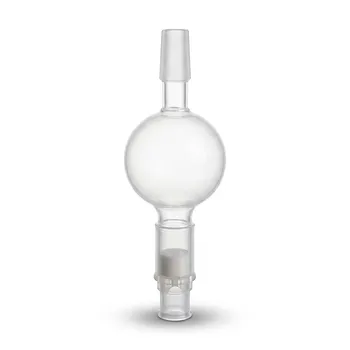
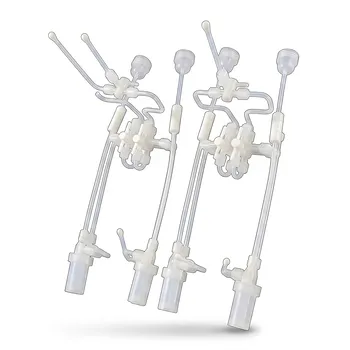
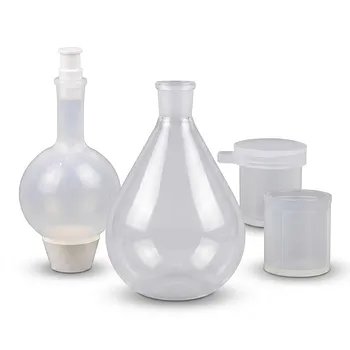
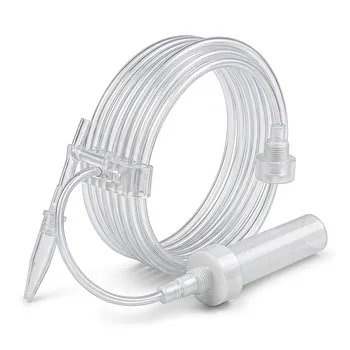
PFA is the better choice when a custom laboratory apparatus must combine melt-processible fabrication with the highest continuous-use temperature. Both PFA and FEP can be extruded, injection molded, and formed into complex tubing, fittings, vessels, and other lab components. The primary functional difference is that PFA retains mechanical integrity at substantially higher temperatures, while FEP is generally suited to moderate-temperature fluid handling and electrical insulation.
Choose PFA for continuous service up to approximately 260°C (500°F), especially in digestion vessels, thermal reaction equipment, and hot chemical transfer lines. Choose FEP when the operating temperature remains near or below 200°C (400°F) and its flexibility, processability, or electrical performance meets the application.
Why Both Materials Are Melt-Processible
Copolymer design enables conventional fabrication
PFA and FEP are perfluorinated copolymers modified to reduce the extreme melt viscosity associated with unmodified PTFE. This allows both materials to flow during processing and supports conventional extrusion, injection molding, and related fabrication methods.
That distinction matters when producing complex custom geometries, such as molded fittings, sealed fluid paths, translucent tubing, and integrated laboratory vessels.
PFA and FEP solve different fabrication requirements
Both materials provide excellent chemical resistance and high-purity performance. Their melt-processibility makes them practical for apparatus that would be difficult or costly to fabricate from conventional non-melt-processible PTFE.
However, melt-processibility does not mean the two materials have the same service limits. The processing method may be similar, but the finished component must still be selected for its operating temperature, mechanical loading, and containment requirements.
The Primary Temperature Difference
PFA supports higher continuous operating temperatures
PFA has a maximum continuous operating temperature of approximately 260°C (500°F). This is comparable to the high-temperature capability commonly associated with PTFE.
At these temperatures, PFA is better able to maintain structural stability, creep resistance, and seal integrity than FEP.
FEP is limited to approximately 200°C
FEP has a lower maximum continuous-use temperature of approximately 200°C (400°F), sometimes specified near 204°C depending on the grade and rating convention. Its mechanical properties decline more substantially as temperature increases.
FEP can therefore be an effective choice for moderate-temperature service, but it becomes less appropriate when the apparatus will operate continuously near high-temperature digestion or reaction conditions.
Melting temperatures also differ
PFA typically melts in the approximate range of 300°C to 310°C. FEP melts at a lower range, commonly reported around 250°C to 280°C, depending on grade and formulation.
Melting temperature is not the same as allowable service temperature. A component must be designed around its continuous-use limit, because mechanical softening and deformation can occur well below the polymer's melting point.
Functional Differences in Laboratory Apparatus
PFA provides greater mechanical retention at heat
PFA is generally the stronger choice when a component must resist pressure, clamping forces, thermal cycling, or sustained mechanical loads at elevated temperature. Its higher thermal threshold helps preserve dimensional stability and containment.
This is particularly important for sealed digestion vessels, thermal reaction apparatus, valves, and hot chemical transfer fittings.
FEP suits flexible, moderate-temperature components
FEP remains useful where the operating temperature is controlled below its continuous-use limit. It is well suited to flexible tubing, fluid-transfer components, molded labware, and electrical insulation in moderate-temperature environments.
Its lower temperature capability does not make it unsuitable generally; it limits where it can be used reliably.
Both offer strong chemical resistance
PFA and FEP both provide broad chemical resistance and are suitable for high-purity fluid handling. The selection should therefore be driven primarily by temperature, mechanical stress, geometry, and fabrication requirements rather than basic chemical resistance alone.
For trace-analysis or contamination-sensitive systems, both can support clean fluid paths when the correct grade and manufacturing controls are specified.
PFA can provide lower permeability
PFA generally offers lower water-vapor permeability than FEP. That can be relevant when moisture ingress, volatile retention, or long-term purity is important.
The practical significance depends on wall thickness, temperature, pressure, exposure time, and the specific chemical being handled.
FEP can offer electrical advantages
Both polymers have excellent dielectric properties. FEP may provide higher dielectric strength in some comparative data, making it attractive for applications that combine fluid handling with demanding electrical insulation.
This advantage does not compensate for exceeding FEP's thermal operating limit. Electrical requirements and thermal requirements must be evaluated together.
Processing Considerations
PFA requires higher processing temperatures
PFA generally requires higher extrusion and melt-processing temperatures than FEP. Representative profiles place PFA rear-zone temperatures near 370°C and peak melt temperatures near 395°C, compared with approximately 340°C and 385°C for FEP.
Actual settings depend on resin grade, equipment, geometry, throughput, and the manufacturer's processing guidance.
Thermal control affects component quality
Both materials require carefully controlled processing conditions. Poor temperature control can affect dimensional stability, melt draw behavior, cell-size variation, and the final mechanical performance of tubing or molded components.
For custom apparatus, the fabricator should qualify the specific resin and process rather than transfer settings directly between PFA and FEP.
Understanding the Trade-offs
PFA costs more in processing complexity
PFA's higher processing temperature can require more demanding equipment control and may increase fabrication complexity. The benefit is a substantially higher service-temperature margin.
That margin is valuable when failure would cause chemical release, loss of purity, or interruption of a high-temperature process.
FEP may be sufficient for lower-temperature systems
Selecting PFA for every fluoropolymer component can add cost without improving performance if the apparatus remains comfortably below 200°C. FEP is often the more proportionate choice for moderate-temperature tubing, fittings, and insulating components.
The correct comparison is not maximum temperature alone, but required temperature plus mechanical and chemical operating conditions.
Do not use melting point as the design limit
A common mistake is to compare the melting points and assume that operation below melting is acceptable. Polymer components can lose stiffness, creep, deform, or compromise seals well before they melt.
Use the manufacturer's continuous-use rating for the actual grade, exposure duration, pressure, and mechanical configuration.
Account for temperature excursions
Short-term spikes, thermal cycling, localized heating, and exothermic reactions can create conditions that differ from the nominal operating temperature. FEP may be unsuitable if those excursions repeatedly approach or exceed its rated limit.
PFA provides more thermal headroom, but it still requires validation against the complete duty cycle.
Making the Right Choice for Your Goal
The material decision should follow the apparatus's real operating envelope, not just its nominal fabrication method.
- If your primary focus is high-temperature digestion or thermal reaction service: Specify PFA because its approximately 260°C continuous-use capability preserves containment and mechanical integrity where FEP may soften or deform.
- If your primary focus is moderate-temperature fluid transfer: Specify FEP when the system remains near or below 200°C and its flexibility and chemical resistance satisfy the design.
- If your primary focus is high-purity chemical handling: Evaluate either material, then compare temperature margin, permeability, grade purity, and fabrication controls.
- If your primary focus is electrical insulation combined with fluid handling: Consider FEP where its electrical properties are advantageous and the thermal limit is not exceeded.
- If your primary focus is complex custom geometry at elevated temperature: Prefer PFA because it combines melt-processible fabrication with the larger thermal and mechanical operating margin.
Selecting between PFA and FEP becomes straightforward when the design is based on continuous temperature, transient exposure, mechanical loading, and the required function of the finished apparatus.
Summary Table:
| Property | PFA | FEP |
|---|---|---|
| Continuous Use Temp | ~260°C (500°F) | ~200°C (400°F) |
| Melting Point | 300-310°C | 250-280°C |
| Mechanical Stability | Higher at elevated temps | Lower at elevated temps |
| Flexibility | Good | Excellent |
| Chemical Resistance | Excellent | Excellent |
| Water Vapor Permeability | Lower | Higher |
| Electrical Strength | Good | Higher dielectric strength |
| Processability | Melt-processible | Melt-processible |
Elevate your lab's performance with KINTEK's precision-made PTFE and PFA apparatus. Whether you need high-temperature digestion vessels, custom machined components, or complete lab setups, our expertise ensures reliability and purity. Contact our specialists today to discuss your requirements and benefit from our end-to-end manufacturing capabilities — for standard or bespoke solutions, contact us now!
Related Products
- High Purity PFA Chromatography Column with Collection Bottle Corrosion Resistant Fluoropolymer Filtration System for Trace Analysis
- High Purity PFA Chromatography Columns and Collection Bottles Corrosion Resistant Fluoropolymer Filtration Systems for Trace Analysis
- PFA Sub Boiling Acid Purifier Electronic Grade Distillation System Laboratory Trace Analysis Equipment
- High Purity PFA Chromatography Column Double Layer Constant Pressure Filtration System with Sieve Plate for Strong Acid Resistance
- High Purity PFA Chromatography Column and Collection Bottle System Corrosion Resistant Filter Column with Sieve Plate Glass Alternative
People Also Ask
- Why is the chemical stability of polymer endgroups critical when selecting melt-processible fluoropolymers like PFA for high-purity laboratory apparatus? Choose Stable Endgroups for Reliable Performance
- What are the characteristics of PFA material? A Guide to Its High-Performance Balance
- Why is Perfluoroalkoxy alkane (PFA) preferred over glass or stainless steel in pharmaceutical process development? Pure Yield
- Why is PFA superior for cleaning and preventing cross-contamination? The Gold Standard for Ultra-Trace Lab Hygiene
- What are the key properties of PFA (PerFluoroAlkoxy)? A Guide to Extreme Chemical and Thermal Resistance