PTFE and PFA resist chemical attack because their carbon backbones are completely shielded by fluorine atoms and protected by exceptionally strong carbon–fluorine bonds. The fluorine sheath makes the polymer difficult for acids, bases, oxidizers, and organic solvents to penetrate or react with, giving both materials broad resistance in laboratory fluid handling. The main exceptions are highly reactive fluorinating or reducing environments, molten alkali metals, and certain concentrated bases at elevated temperatures.
Core takeaway: PTFE and PFA are chemically inert because a dense, electronegative fluorine layer protects the carbon chain. Their resistance is extensive but not unlimited: extreme fluorination, molten alkali metals, and hot concentrated alkalis can overcome that protection.
Why PTFE and PFA Are Chemically Inert
A fully fluorinated carbon backbone
PTFE is built from repeating tetrafluoroethylene units, while PFA is a perfluorinated copolymer with a small amount of alkoxy comonomer. In both materials, the polymer structure is dominated by carbon–carbon and carbon–fluorine bonds, with very little chemically vulnerable hydrogen present.
This distinguishes them from partially fluorinated plastics, whose remaining carbon–hydrogen bonds can provide more accessible sites for chemical attack.
Strong carbon–fluorine bonds
The carbon–fluorine bond is exceptionally strong, with a commonly cited bond energy of approximately 116 kcal/mol. Its strength makes it difficult for ordinary laboratory reagents to break the fluorinated polymer structure.
The high electronegativity of fluorine also gives the C–F bond a stable, tightly bound character, reducing the tendency of the polymer to participate in ordinary chemical reactions.
Fluorine forms a protective sheath
Fluorine atoms closely surround the carbon backbone, creating a dense molecular shield. This sheath limits direct access to the underlying carbon chain, including the carbon–carbon bonds that would otherwise be more exposed to chemical attack.
The result is similar to a cable covered by an insulating jacket: reagents may contact the outer surface, but they have difficulty reaching the chemically important structure underneath.
Low surface energy reduces interaction with fluids
The fluorinated surface has very low surface energy, which contributes to PTFE’s and PFA’s non-wetting and non-stick behavior. Laboratory fluids are less likely to adhere strongly, swell the material, or become absorbed into it.
This is especially valuable in tubing, bottles, digestion vessels, tanks, and trace-analysis components where contamination and sample carryover must be minimized.
What This Means for Laboratory Fluid Handling
Broad resistance to acids and alkalis
PTFE and PFA generally tolerate a wide range of concentrated mineral acids and many alkaline reagents. They are therefore commonly selected for aggressive digestion, reagent storage, fluid transfer, and process-contact applications.
Their resistance applies to the polymer itself; seals, fittings, pigments, fillers, and other connected materials may have much narrower compatibility limits.
Resistance to organic solvents
The strong, shielded molecular structure makes PTFE and PFA essentially insoluble in ordinary laboratory organic solvents. They also resist the chemical swelling and degradation that can affect less fluorinated polymers.
This does not mean that every solvent has no effect under every condition. Temperature, pressure, exposure time, mechanical stress, and the presence of additives can change practical performance.
Thermal resistance supports chemical resistance
PTFE and PFA retain useful chemical resistance at elevated temperatures, with typical continuous-use limits commonly around 260 °C, depending on the grade, design, load, and application.
Temperature is important because some reagents that are harmless at room temperature become substantially more aggressive near the material’s service limit.
Chemical Environments That Represent Exceptions
Molten alkali metals
Molten sodium and potassium can attack PTFE and PFA by removing fluorine from the polymer chain. This is a fundamentally different mechanism from ordinary acid or solvent exposure: the metal can chemically reduce and defluorinate the perfluoropolymer.
Contact with molten alkali metals should therefore be treated as incompatible unless a specific material and process evaluation demonstrates otherwise.
Highly reactive fluorinating agents
Elemental fluorine can attack fluoropolymers, particularly under severe conditions. Other powerful fluorinating agents, including chlorine trifluoride (ClF₃) and oxygen difluoride (OF₂), can also overcome the normal protective effect of the fluorine sheath.
High temperature and pressure increase the hazard and can accelerate fluorination or decomposition reactions. These substances require compatibility data specific to concentration, temperature, pressure, and exposure time.
Hot concentrated sodium or potassium hydroxide
Very concentrated sodium hydroxide or potassium hydroxide—such as approximately 80% solutions—can attack PTFE and PFA when used at or near the upper continuous service-temperature range.
The important distinction is the combination of high concentration and high temperature. Dilute or room-temperature caustic solutions are generally far less concerning than hot, concentrated alkali.
Strong Lewis bases and metal hydrides
Strong Lewis bases, including certain metal hydrides, can react with or degrade perfluoropolymer surfaces under sufficiently severe conditions. These reagents should not be grouped automatically with ordinary laboratory bases.
Compatibility must be assessed for the exact reagent and operating conditions rather than inferred from the general resistance of PTFE or PFA to common aqueous alkalis.
Understanding the Trade-offs
“Chemically inert” is not the same as universally compatible
PTFE and PFA resist most conventional laboratory chemicals, but no polymer should be considered immune to all chemical environments. Extreme fluorination, reduction, temperature, and pressure can change the outcome.
A compatibility chart is a starting point, not a substitute for process-specific evaluation.
Temperature can determine the result
A reagent may be compatible at room temperature but unsuitable near the material’s upper operating limit. Thermal exposure can increase reaction rates, diffusion, stress, and the consequences of any chemical attack.
Evaluate the combined condition of reagent, concentration, temperature, pressure, contact time, and mechanical load.
The complete fluid-handling assembly matters
The fluoropolymer may be resistant while an attached valve, gasket, adhesive, fitting, or reinforcement is not. The weakest component often determines the actual compatibility of the assembly.
For high-consequence applications, assess every wetted material, not only the PTFE or PFA tubing and vessel.
Mechanical and thermal limitations remain
Chemical resistance does not eliminate issues such as creep, deformation, permeation, or loss of mechanical strength at elevated temperature. PFA’s melt-processability can make it advantageous for tubing and complex components, while PTFE is often preferred where maximum chemical inertness and low friction are primary concerns.
Material selection must therefore consider both chemical compatibility and mechanical design.
Making the Right Choice for Your Goal
PTFE and PFA are strong default choices for aggressive laboratory fluids, provided the operating envelope is clearly defined.
- If your primary focus is broad acid, base, and solvent resistance: PTFE or PFA will generally provide excellent protection against chemical attack in conventional laboratory service.
- If your primary focus is elevated-temperature fluid handling: Verify the exact continuous-use temperature, pressure, mechanical load, and reagent concentration rather than relying on room-temperature compatibility.
- If your primary focus is handling fluorinating agents or molten alkali metals: Treat PTFE and PFA as potentially incompatible and obtain reagent-specific data before use.
- If your primary focus is system reliability: Evaluate all wetted components, including seals, valves, fittings, and reinforcements, because the assembly is only as resistant as its least-compatible part.
Use the fluorinated polymer structure as a powerful compatibility advantage, but define the chemical and thermal limits before treating PTFE or PFA as inert for a specific process.
Summary Table:
| Feature | Contribution to Chemical Inertness |
|---|---|
| Fully fluorinated carbon backbone | Minimal vulnerable hydrogen, stable structure |
| Strong C-F bonds | High bond energy (~116 kcal/mol) resists attack |
| Protective fluorine sheath | Shields carbon chain from reagents |
| Low surface energy | Reduces wetting, swelling, and absorption |
| Environment | Exception Status |
|---|---|
| Molten alkali metals | Incompatible (defluorination) |
| Highly reactive fluorinating agents (e.g., ClF₃, OF₂) | Incompatible under severe conditions |
| Hot concentrated NaOH/KOH (~80%) | Potential attack at high temp |
| Strong Lewis bases/metal hydrides | Potential degradation |
Ensure your lab's fluid handling systems withstand extreme conditions. Contact KINTEK today to explore our high-performance PTFE and PFA labware, including custom CNC machined parts, backed by our expertise in chemical resistance. Our solutions are designed to meet your exact needs, ensuring reliability and safety.
Related Products
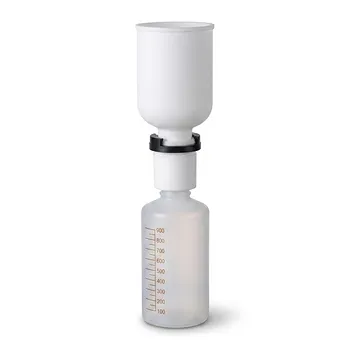
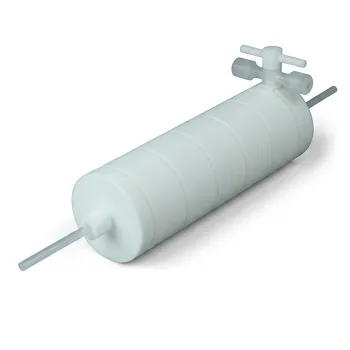
- PTFE PFA Vacuum Filtration System Corrosion Resistant Customizable Shatterproof Laboratory Device
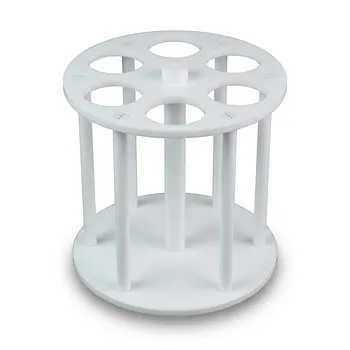
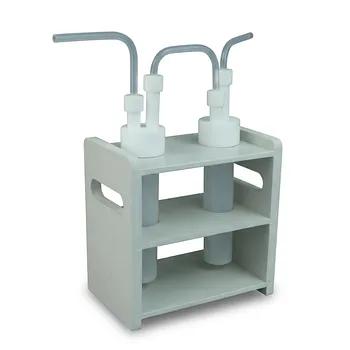
- Custom PFA Separatory Funnel Rack PTFE Machined Laboratory Support Stand Corrosion Resistant Low Background Fluoropolymer Fixture
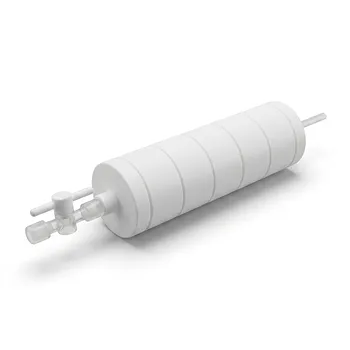
- PTFE Corrosion Resistant Filter with PFA Valve Connections and Integrated Sieve Plate
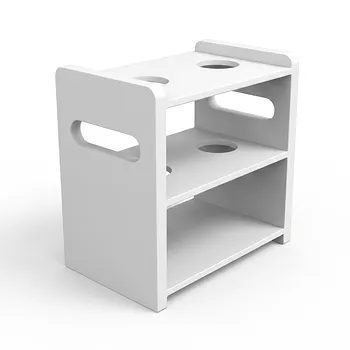
- Custom PTFE Acid Resistant Support Rack for PFA Hydrogen Absorption Systems Multi Hole Configurations
- Corrosion Resistant PTFE Polytetrafluoroethylene Valve and Customizable Laboratory Fluid Dispensing Faucet for Aggressive Chemical Handling in Industrial Storage Tanks and Plastic Drums
People Also Ask
- What makes PTFE filtration systems advantageous for industrial and scientific use? Unmatched Chemical & Thermal Stability
- How does the hydrophobicity of PTFE filters benefit their use? Ensure Uninterrupted Gas Flow and Solvent Filtration
- What temperature resistance do PTFE filters offer? Unmatched Thermal Stability from -200°C to +260°C
- Which chemicals are fully compatible with PTFE filters? Discover Unmatched Chemical Resistance
- What sizes and pore options are available for PTFE filters? Choose the Right Filter for Your Application