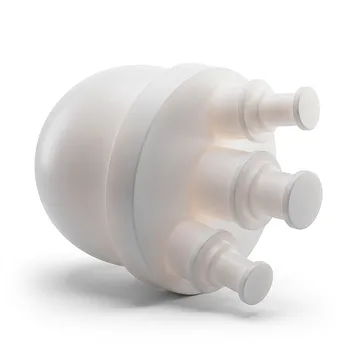
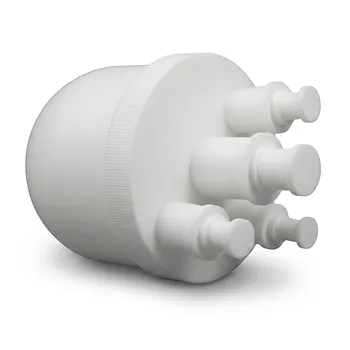
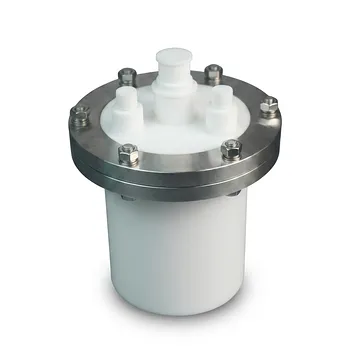
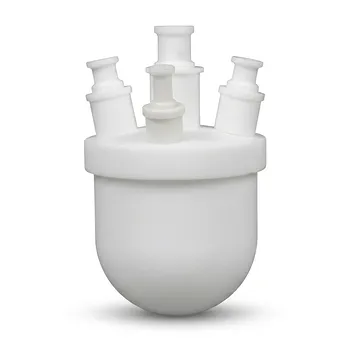
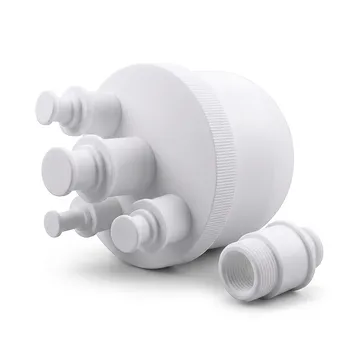
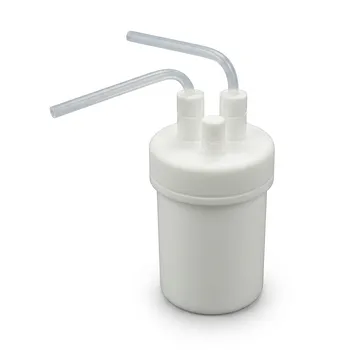
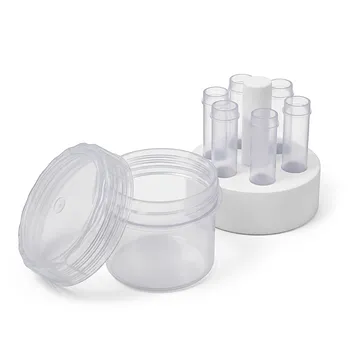
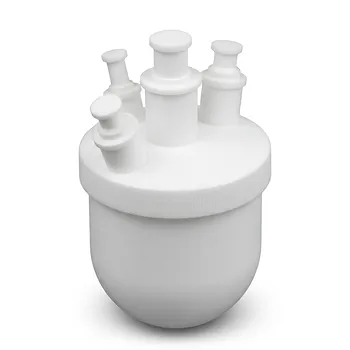
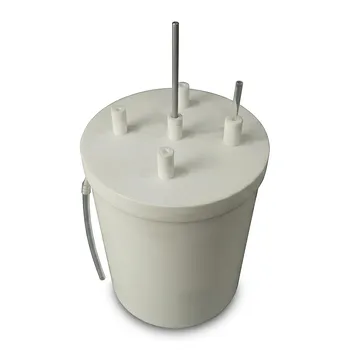
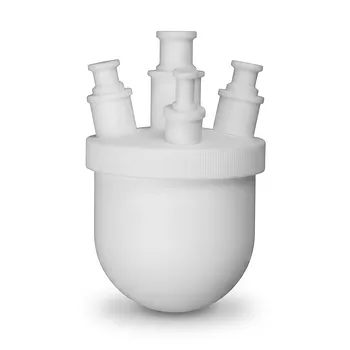
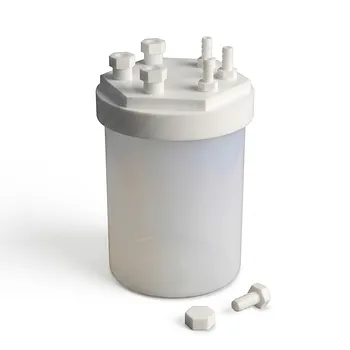
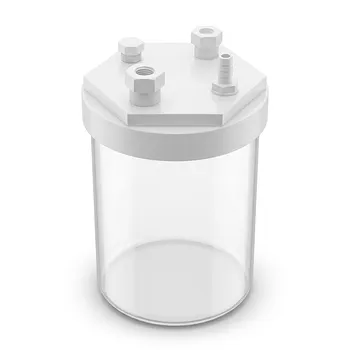
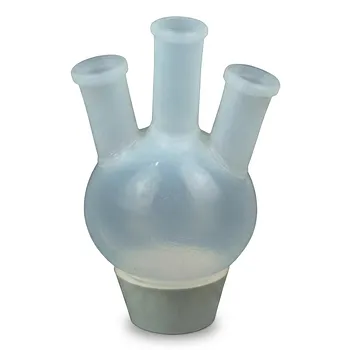
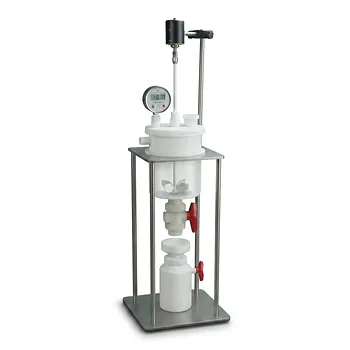
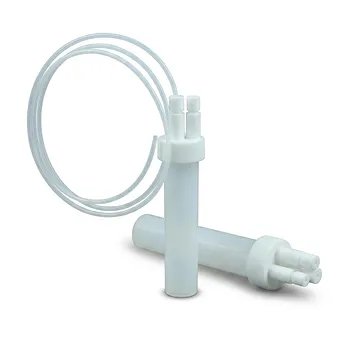
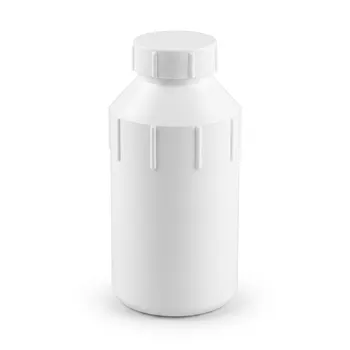
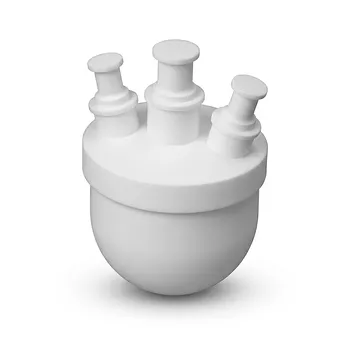
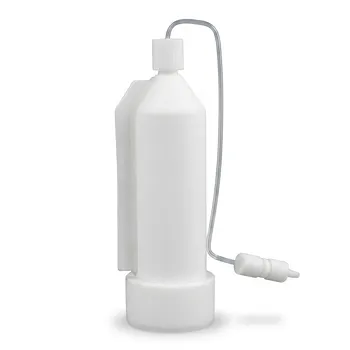
Low-surface-energy fluoropolymer reaction vessels reduce fouling by making it difficult for polymer particles and coagulated latex to attach to reactor walls. PTFE and PFA provide hydrophobic, non-stick interfaces with weak intermolecular attraction, limiting wetting, particle deposition, and buildup during particle synthesis and heterophase emulsion polymerization. They do not eliminate the root causes of fouling, such as local overheating or latex coagulation, but they substantially reduce the tendency of those materials to remain attached once they contact the vessel.
PTFE and PFA vessels act as a passive fouling-control barrier: they weaken particle-surface adhesion, help preserve reactor-wall cleanliness, support more consistent particle formation, and simplify post-reaction cleaning.
Why Fouling Develops During Polymerization
Local overheating accelerates wall deposits
Heterophase emulsion polymerizations can develop localized temperature increases near reactor surfaces or poorly mixed regions. These conditions may destabilize the latex and cause polymer particles to coagulate.
Once coagulated material contacts a conventional glass, metal, or untreated polymer surface, it can form a persistent deposit. As the deposit grows, it may further disrupt mixing and heat transfer.
Particle adhesion creates a feedback loop
Initial particle attachment is often the beginning of progressive wall fouling. Deposited polymer can act as a rough, chemically compatible surface that captures additional particles and latex.
This produces thicker buildup, less predictable reactor conditions, and greater risk of batch-to-batch variation.
How Low Surface Energy Limits Fouling
Weakens adhesive interactions
Fluoropolymers have exceptionally low surface energy because fluorine creates a surface with low polarizability and weak intermolecular attraction. Polymer particles, liquid residues, and coagulated latex therefore have less driving force to spread across and remain bonded to the vessel wall.
The result is not simply “slipperiness.” The surface is difficult to wet and provides fewer favorable interactions for deposited material.
Reduces wetting and residue retention
PTFE and PFA are both hydrophobic and oleophobic. Reaction liquids and polymer-rich residues are less likely to form persistent films or retain droplets across the surface.
Reduced wetting helps prevent small deposits from becoming broad, continuous layers that are difficult to remove.
Supports detachment during agitation and rinsing
A weakly adhered particle may be removed by normal stirring, fluid movement, rinsing, or cleaning. This is especially useful when the process involves suspended nanoparticles or latex particles that repeatedly contact the vessel wall.
Fluoropolymer components can therefore reduce the residence time of contaminants at the surface, even when some deposition still occurs.
Why Vessel Design Matters in Particle Synthesis
Helps preserve particle morphology
Wall deposits can alter local mixing, heat flow, and particle-surface interactions. By minimizing buildup on the vessel and stirrer, PTFE or PFA equipment helps maintain more uniform reaction conditions.
That consistency supports tighter control of particle size, morphology, and dispersion stability.
Maintains effective reactor operation
A clean reactor wall provides more predictable contact between the reaction mixture and the vessel boundary. Preventing an insulating polymer layer from accumulating can help preserve the reactor's intended thermal behavior.
However, fluoropolymers themselves are not highly thermally conductive. Their contribution is primarily fouling prevention, not enhanced material-level heat conduction.
Reduces contamination between batches
Residual polymer on vessel walls can be released into a later reaction or serve as a nucleation and aggregation site. Low-adhesion surfaces reduce retained material and make complete removal more practical.
This is valuable when working with sensitive nanoparticle formulations or when small changes in residual material can affect the next batch.
Why PTFE and PFA Are Common Choices
PTFE provides a highly non-stick interface
PTFE is widely used where minimal adhesion and strong chemical resistance are required. Its low surface energy makes it effective for vessels, stirrers, liners, tubing, and other components that contact polymerizing mixtures.
Its low friction also reduces the likelihood that moving particles or polymer-rich fluids will remain attached to contacted surfaces.
PFA combines non-stick behavior with fabrication flexibility
PFA offers similar fluoropolymer surface characteristics while being useful for molded or custom laboratory components. PFA vessels and labware can be selected when transparent or more readily fabricated fluoropolymer equipment is advantageous.
The specific choice should account for temperature, mechanical requirements, transparency, dimensional stability, and compatibility with the reactor system.
Matching all wetted components improves results
Using a fluoropolymer vessel while leaving a conventional stirrer, probe, fitting, or insert exposed can preserve a significant fouling site. Fouling control is more effective when the relevant wetted surfaces, including stirrers and custom labware, share compatible low-adhesion properties.
Understanding the Trade-offs
Low surface energy does not prevent coagulation
PTFE and PFA do not correct poor temperature control, inadequate mixing, excessive initiator concentration, or latex instability. If the process generates substantial coagulated polymer, even a low-energy surface can accumulate deposits.
Process control remains the first line of defense; fluoropolymer equipment reduces the consequences of unavoidable wall contact.
Thermal transfer can be a limitation
Fluoropolymers generally transfer heat less effectively than metals and some glass reactor configurations. A fluoropolymer vessel may therefore require careful external heating or cooling design to avoid temperature gradients.
The key benefit is that preventing deposit layers can preserve heat-transfer performance relative to a fouled surface, not that PTFE or PFA inherently improves heat transfer.
Mechanical and dimensional limits matter
Fluoropolymers can be softer than glass or metal and may deform, creep, or scratch under unsuitable mechanical or thermal conditions. Abrasion from aggressive stirring or particulate formulations can damage the surface and create sites where deposits are easier to anchor.
Equipment selection should therefore consider operating temperature, stirrer design, pressure, cleaning method, and mechanical loading.
Surface treatment can change the behavior
Fluoropolymer surfaces that are etched, damaged, coated, or contaminated may no longer exhibit their original low-adhesion performance. Cleaning procedures should remove residues without introducing scratches or persistent contamination.
A low-surface-energy material is most effective when its surface remains intact and the reactor geometry supports good circulation.
How to Apply This to Your Project
Fluoropolymer vessels are most effective as part of a broader fouling-control strategy that combines material selection with stable polymerization conditions.
- If your primary focus is minimizing wall fouling: Use PTFE or PFA for the vessel and other wetted components, while controlling local overheating, mixing, and latex stability.
- If your primary focus is particle morphology: Use low-adhesion labware to reduce wall deposits that can disturb heat flow, mixing, and particle-surface interactions.
- If your primary focus is batch reproducibility: Select fluoropolymer equipment that minimizes retained polymer and establish a cleaning process that preserves the surface.
- If your primary focus is thermal control: Treat PTFE and PFA as fouling-resistant materials, not high-conductivity reactor materials, and design the external heating or cooling system accordingly.
- If your primary focus is contamination control: Use low-retention fluoropolymer components throughout the wetted path and inspect surfaces for scratches, residues, or damaged areas.
The most reliable approach is to pair low-surface-energy fluoropolymer equipment with disciplined thermal, mixing, and formulation control.
Summary Table:
| Mechanism | Benefit |
|---|---|
| Low surface energy | Reduces particle adhesion and wetting |
| Hydrophobic/oleophobic | Minimizes residue retention |
| Weak intermolecular forces | Limits deposit buildup |
| Easy detachment | Simplifies cleaning and rinsing |
Optimize your polymerization with KINTEK's PTFE and PFA labware, designed to minimize fouling and enhance product consistency. Explore our range of custom vessels and components—contact us today for tailored solutions for your particle synthesis needs!
Related Products
- High Purity Custom PTFE Large Volume 15L Flask Corrosion Resistant Low Trace Background Fluoropolymer Reaction Vessel
- Laboratory PTFE Three Neck Reaction Flask Corrosion Resistant 2000ml Low Background Fluoropolymer Vessel
- Custom PTFE Reaction Kettle 2L Flanged Fluoropolymer Reactor Tank Acid and Alkali Resistant Polytetrafluoroethylene Vessel
- Custom PTFE Flask 250ml High Purity Fluoropolymer Laboratory Vessel for Chemical Research
- Large Capacity PTFE Reaction Flask 20L Custom Multi Neck Laboratory Boiling Flask Fluoropolymer Chemical Processing Vessel
People Also Ask
- Why are high-purity PTFE or PFA reaction vessels recommended for the synthesis of PANI-TiC hybrid materials? - Guide
- How do perfluorinated solvent environments influence the selection of reaction vessels and fluid handling components in nonaqueous emulsion polymerizations? Choose fluoropolymer materials.
- What reaction vessel and fluid handling considerations are necessary for living cationic polymerization of fluorinated monomers involving Lewis acid catalysts? Key design and safety tips
- Ion Activation Reaction Vessel Requirements: Why PTFE is Critical for Membrane Performance
- Why are fluoroplastic (PTFE) reaction vessels recommended for Methylene Blue (MB) adsorption kinetic experiments?