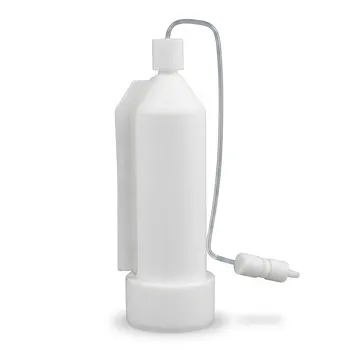
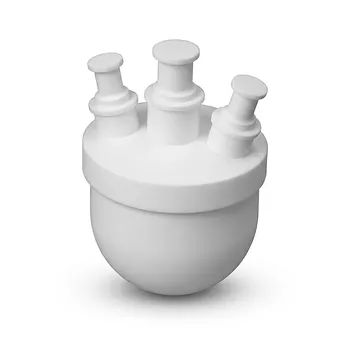
For direct gas fluorination, material compatibility and containment integrity are inseparable. Reaction vessels, tubing, fittings, valves, and seals must resist elemental fluorine, maintain leak-tight performance under vacuum and pressure, and avoid contaminating the polymer substrate. High-purity PTFE and PFA are generally preferred for wetted or exposed components, but the complete system must also account for temperature, pressure, mechanical strength, permeability, fabrication, and fluorine-service validation.
The correct selection is not simply “use fluoropolymer.” Choose high-purity, fully fluorinated materials for chemical contact and low-contamination performance, while engineering the surrounding system for pressure containment, controlled gas delivery, thermal management, reliable sealing, and safe handling of highly reactive fluorine.
What the Fluorination System Must Withstand
Extreme chemical reactivity
Elemental fluorine is substantially more aggressive than ordinary process gases. It can rapidly attack conventional plastics, elastomers, adhesives, lubricants, and contaminated or poorly prepared metal surfaces.
Materials exposed directly to the gas should therefore have a proven compatibility basis for the specific fluorine concentration, pressure, temperature, exposure duration, and moisture level used in the process.
Vacuum and pressure cycling
Direct fluorination commonly requires pre-evacuation, controlled gas introduction, and pressure containment. Components may experience repeated transitions between vacuum and positive pressure.
This places demands on both the material and the design. A chemically resistant polymer that deforms, creeps, permeates excessively, or loses compression under cycling can still produce leaks or unstable process conditions.
Diffusion-controlled exposure
The objective is often controlled surface modification rather than uncontrolled bulk reaction. The vessel and transfer path must therefore support a stable and reproducible fluorine concentration and pressure gradient around the substrate.
Dead volumes, adsorption, leaks, and poorly positioned inlets can alter the local gas environment and reduce treatment uniformity.
Material Requirements for Reaction Vessels
High-purity PTFE and PFA for exposed surfaces
PTFE and PFA provide highly fluorinated carbon backbones, low surface energy, low volatility, and strong resistance to many aggressive chemical environments. These properties help reduce surface reaction, sample retention, and trace contamination.
PFA is often attractive where a more processable fluoropolymer or clearer vessel construction is useful. PTFE is widely used for machined vessels, liners, seals, and valve components.
Neither material should be treated as universally inert under every fluorination condition. Compatibility must be confirmed using the actual gas composition and operating envelope, particularly at elevated temperature or prolonged exposure.
Low contamination and non-wetting behavior
The vessel interior should not leach metals, plasticizers, processing residues, or other extractables into the substrate or process stream. A low-energy fluoropolymer surface also reduces wetting and retained residues.
This is important when the system is used for multiple substrates or when surface chemistry must be characterized accurately after treatment.
Adequate thermal performance
The vessel must tolerate the process temperature without excessive softening, creep, dimensional change, or seal-load loss. PTFE and PFA have broad useful temperature ranges, but their mechanical strength and dimensional stability decline as temperature increases.
Temperature compatibility must therefore be assessed separately from chemical compatibility. A material may resist fluorine chemically while being unsuitable as a pressure-retaining structure at the intended temperature.
Pressure-rated construction
A fluoropolymer reaction vessel should not automatically be assumed to be a pressure vessel. Fluoropolymers are relatively soft and can deform under sustained load, especially at elevated temperature.
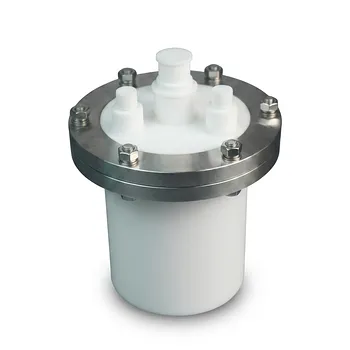
For higher-pressure service, a common engineering approach is to use a suitable metal pressure boundary with a fluoropolymer liner or exposed internal components, provided the metal and surface treatment are compatible with the fluorine environment. Where stainless steel is used, high-grade material, careful passivation, and contamination control are important.
Requirements for Fluid Transfer Components
Tubing, fittings, and valves
Transfer tubing, fittings, valve seats, and internal wetted parts should use high-purity PTFE, PFA, or another material specifically qualified for fluorine service.
The selection must consider more than chemical resistance:
- Pressure and vacuum rating
- Permeation and leak-tightness
- Temperature and thermal cycling
- Connection geometry and dead volume
- Mechanical creep and compression
- Cleanability and particle generation
- Availability of fluorine-service qualification
Small fittings and valve seats can become the most failure-prone parts of the system because they combine thin sections, compression loads, moving interfaces, and repeated cycling.
Seals and gaskets
Conventional elastomer seals are a major contamination and failure risk. They may swell, embrittle, decompose, or lose elasticity when exposed to fluorine or fluorine-containing process streams.
Use high-purity fluoropolymer seals where practical, and select the seal design according to the pressure, temperature, compression, and cycling requirements. A chemically resistant seal is not sufficient if it cannot maintain contact force throughout the operating cycle.
Minimize dead volume
Dead legs and oversized cavities can retain residual gas, slow evacuation, and create delayed release during pressure changes. They can also make cleaning and decontamination more difficult.
Compact flow paths with smooth, cleanable interiors improve gas replacement and help maintain the intended exposure conditions.
Operational Challenges That Affect Material Selection
Leak prevention is a process-control issue
A leak is not only a personnel hazard; it can also change the fluorine concentration and invalidate the treatment profile. The system must maintain integrity during evacuation, gas admission, reaction, and purge or recovery operations.
Leak testing, compatible instrumentation, controlled assembly, and inspection of seals are therefore part of process qualification—not merely maintenance activities.
Fluorine purity and moisture control
Moisture and contaminants can react with fluorine and alter the gas chemistry. Residues from machining, cleaning agents, lubricants, or previous experiments can introduce unpredictable reactions or compromise surface treatment.
Components should be cleaned, dried, and handled using a defined high-purity protocol. Interior surfaces should be protected from contamination during assembly and storage.
Thermal expansion and material mismatch
PTFE, PFA, metals, and glass expand at different rates. Repeated heating and cooling can loosen joints, distort seals, or create stress at lined interfaces.
Designs should accommodate differential expansion rather than relying on rigidly constrained polymer parts. The worst-case temperature should be evaluated together with vacuum and pressure loads.
Gas distribution and treatment uniformity
The reaction vessel should provide consistent gas access to the substrate without creating stagnant regions or excessive local concentration. Inlet placement, substrate orientation, vessel geometry, and flow-path resistance all influence repeatability.
Material selection cannot compensate for poor gas distribution. The vessel and fluid-transfer design must be treated as one system.
Safety interlocks and pressure relief
Fluorine systems require engineered controls for abnormal pressure, blocked outlets, valve malfunction, and loss of containment. Pressure relief must be compatible with the gas and protected against fouling or obstruction.
Where a rupture disc or similar device is used, it requires appropriate inspection and maintenance. Deposits or fluoropolymer buildup that obstruct venting can defeat the protection system.
Understanding the Trade-offs
Chemical resistance versus mechanical strength
PTFE and PFA offer excellent chemical resistance but are not equivalent to metals in stiffness, load-bearing capacity, or resistance to creep. They are often best used for liners, tubing, seals, and wetted components rather than as the sole structural pressure boundary.
A metal outer vessel can provide strength, but the selected metal, passivation state, surface finish, and exposed-area design must be verified for the fluorine environment.
Purity versus durability
High-purity fluoropolymer components reduce contamination, but they can be more vulnerable to scratching, deformation, particle generation from mechanical damage, or dimensional change under load.
Handling and assembly procedures must prevent gouging, excessive tightening, and uncontrolled compression of polymer seals.
Inertness versus permeation
Low surface reactivity does not mean zero gas permeation. Fluorine can migrate through or diffuse into some polymer components depending on thickness, pressure, temperature, and exposure time.
For long hold times or high-pressure operation, use sufficiently robust component geometries and validate the actual assembly rather than relying only on a material datasheet.
Broad temperature capability versus high-temperature performance
Fluoropolymers can tolerate substantial temperature ranges, but their useful pressure and dimensional limits are narrower than their chemical-use limits. The relevant question is not whether the polymer survives the temperature, but whether it retains the required seal load, geometry, and pressure rating at that temperature.
“Fluoropolymer” is not a complete specification
Different grades, fillers, processing histories, and surface finishes can produce different purity and compatibility outcomes. Avoid assuming that every PTFE or PFA product is suitable for direct fluorine service.
Require traceability, cleanliness information, pressure and temperature ratings, and—where possible—service-specific compatibility evidence.
Making the Right Choice for Your Goal
Select materials and designs according to the dominant risk in your process:
- If your primary focus is chemical compatibility: Use high-purity PTFE or PFA for exposed wetted components, and verify compatibility against the actual fluorine concentration, temperature, pressure, and exposure duration.
- If your primary focus is pressure containment: Use a properly engineered pressure boundary, potentially with fluoropolymer liners or internal components, rather than relying on an unsupported fluoropolymer vessel.
- If your primary focus is treatment uniformity: Minimize dead volume, control inlet and outlet geometry, and validate evacuation, gas distribution, and exposure stability.
- If your primary focus is contamination control: Specify low-extractable materials, controlled cleaning and drying, non-wetting internal surfaces, and fluoropolymer seals without conventional elastomer or lubricant exposure.
- If your primary focus is operational safety: Design for leak detection, compatible pressure relief, safe isolation, seal inspection, and controlled response to blocked or overpressurized flow paths.
A reliable direct gas fluorination system results from matching fluoropolymer chemistry with pressure engineering, contamination control, and disciplined operating procedures.
Summary Table:
| Material Requirement | Key Considerations |
|---|---|
| Chemical Compatibility | Verify resistance to F2 at specific concentration, temperature, and pressure. |
| Mechanical Strength | PTFE/PFA are soft; use metal outer vessel with polymer liner for high pressure. |
| Temperature Performance | Ensure seal load and dimensional stability at process temperature. |
| Sealing & Permeation | Minimize dead volume and use high-purity fluoropolymer seals; account for gas permeation. |
| Operational Challenge | Mitigation Strategy |
|---|---|
| Leak Prevention | Use leak testing, compatible seals, and controlled assembly. |
| Purity & Moisture Control | Implement strict cleaning and handling protocols. |
| Thermal Expansion | Design for differential expansion to prevent joint loosening. |
| Gas Distribution | Optimize vessel geometry and inlet/outlet placement. |
Ensure the safety and efficiency of your direct gas fluorination system with our high-performance PTFE and PFA components. Whether you need custom reaction vessels, leak-tight fittings, or comprehensive fluid transfer assemblies, our experts are ready to support your project from concept to production. Contact us today to discuss your specific requirements and benefit from our advanced polymer solutions.
Related Products
- High Purity Custom PTFE Large Volume 15L Flask Corrosion Resistant Low Trace Background Fluoropolymer Reaction Vessel
- Laboratory PTFE Three Neck Reaction Flask Corrosion Resistant 2000ml Low Background Fluoropolymer Vessel
- Custom PTFE Continuous Reaction Bottles Virgin Fluoropolymer High Purity Low Background Synthesis Vessels
- Custom PTFE Reaction Kettle 2L Flanged Fluoropolymer Reactor Tank Acid and Alkali Resistant Polytetrafluoroethylene Vessel
- Large Capacity PTFE Reaction Bottle 2L Wide Mouth Fluoropolymer Extraction Vessel Compatible with Rotary Agitators
People Also Ask
- What toxicological hazards and safe handling protocols must be established when PTFE fluoropolymer reaction vessels are subjected to pyrolysis temperatures? Learn essential safety measures now.
- Why are high-purity PTFE or PFA reaction vessels recommended for the synthesis of PANI-TiC hybrid materials? - Guide
- How do perfluorinated solvent environments influence the selection of reaction vessels and fluid handling components in nonaqueous emulsion polymerizations? Choose fluoropolymer materials.
- What reaction vessel and fluid handling considerations are necessary for living cationic polymerization of fluorinated monomers involving Lewis acid catalysts? Key design and safety tips
- Ion Activation Reaction Vessel Requirements: Why PTFE is Critical for Membrane Performance