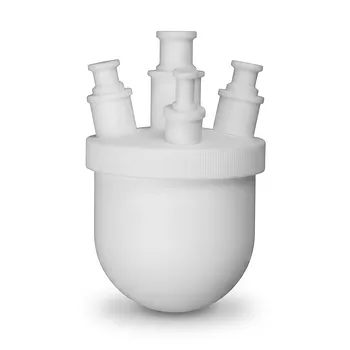
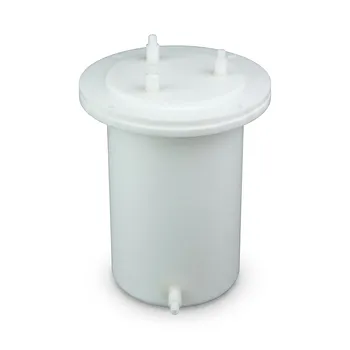
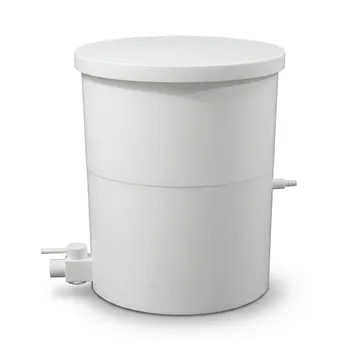
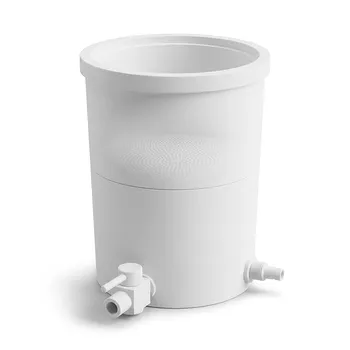
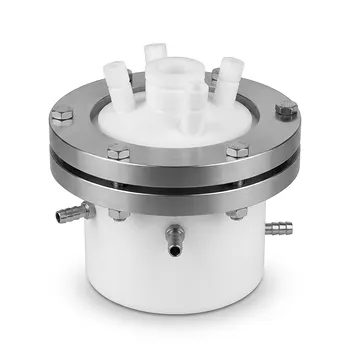
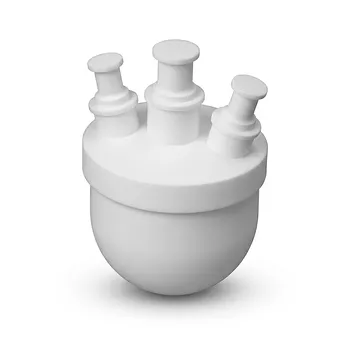
Industrial-scale hydrothermal synthesis utilizes specialized batch processing to bridge the gap between laboratory research and high-volume production. Large-scale reactors allow for the simultaneous treatment of multiple 3D-printed components, while internal Teflon racks ensure these components remain fully submerged and correctly positioned during chemical exposure. This controlled environment is critical for the uniform deposition of active substances within the complex internal geometries of 3D-printed hardware.
The primary purpose of this setup is to ensure process scalability and structural uniformity. By utilizing large-scale vessels and precision racking, manufacturers can produce high-quality, functionalized 3D-printed reactors in bulk without sacrificing the integrity of their internal flow channels.
The Role of Large-Scale Reactors in Industrial Scaling
Transitioning from Lab to Production
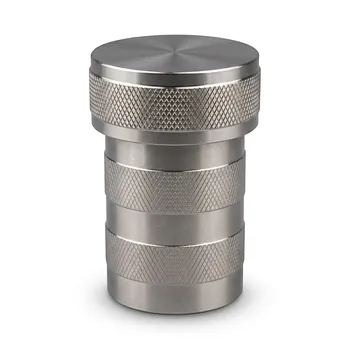
Large-scale hydrothermal reactors are the cornerstone of moving 3D-printed technology from proof-of-concept to industrial application. They provide the necessary volume to treat larger individual units or multiple smaller reactors in a single cycle.
Efficiency through Batch Processing
Processing components in large batches significantly reduces the time-to-market and energy costs per unit. This simultaneous treatment ensures that an entire production run is exposed to identical pressure and temperature conditions, promoting batch-to-batch consistency.
The Critical Function of Internal Teflon Racks
Precision Positioning and Total Submersion
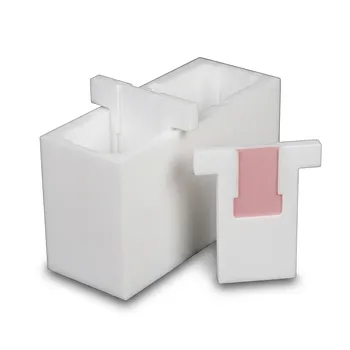
Teflon racks serve as a structural guide to precisely secure the position of 3D-printed reactors within the larger vessel. This stability ensures that every part of the reactor is completely submerged in corrosive solutions, such as sodium hydroxide (NaOH), which is necessary for chemical activation.
Protecting Complex Flow Channels
3D-printed reactors often feature intricate internal flow channels that are easily compromised by improper handling. The racks prevent preparation defects by ensuring that reactors do not stack on top of one another or come into direct contact with the vessel walls.
Ensuring Uniform Growth
By maintaining a fixed orientation, the racks allow the hydrothermal solution to circulate freely through all internal voids. This results in the uniform growth of active substances on the internal walls, which is vital for the functional performance of the reactor.
Understanding the Trade-offs and Limitations
Thermal Gradients in Large Volumes
While large-scale reactors increase throughput, they can also introduce thermal gradients where the center of the vessel heats slower than the edges. If not managed, this can lead to slight variations in the crystalline growth of the active substances across the batch.
Material Compatibility and Wear
Teflon is chosen for its chemical inertness, but it is a relatively soft material that can degrade or deform over hundreds of high-pressure cycles. Regular inspection of the racks is required to ensure they continue to hold the 3D-printed components with the necessary precision.
How to Apply This to Your Project
When implementing large-scale hydrothermal synthesis for 3D-printed components, your approach should depend on your specific production requirements.
- If your primary focus is maximizing throughput: Prioritize large-capacity reactors with custom-designed Teflon racks that maximize the "packing density" of your components without allowing them to touch.
- If your primary focus is coating uniformity: Focus on the orientation of the components within the racks to ensure that the internal flow channels are aligned with natural convection currents within the vessel.
- If your primary focus is chemical durability: Ensure that both the 3D-printing filament and the rack material are fully compatible with concentrated NaOH at elevated temperatures to prevent structural failure during synthesis.
By carefully balancing vessel volume with precision internal racking, you can successfully scale the functionalization of 3D-printed reactors for industrial use.
Summary Table:
| Component | Primary Function | Industrial Benefit |
|---|---|---|
| Large-Scale Reactor | Simultaneous treatment of multiple units | High throughput and batch-to-batch consistency |
| Internal Teflon Racks | Precision positioning and component submersion | Uniform growth and protection of complex flow channels |
| NaOH Solution | Chemical activation and functionalization | Prepares surfaces for active substance deposition |
| Custom CNC Racking | Optimized packing density | Maximizes production efficiency while preventing defects |
Scale Your Hydrothermal Production with KINTEK Precision
Transitioning from lab-scale research to high-volume industrial production requires equipment that never compromises on chemical purity or structural integrity. KINTEK specializes in high-performance fluoropolymer solutions designed for the most demanding environments.
Whether you need everyday basic labware like beakers, crucibles, and reagent bottles, or advanced reaction apparatus such as hydrothermal synthesis liners, microwave digestion vessels, and custom electrochemical cells, we have you covered. Our expertise extends to the precise fabrication of internal Teflon racks, fittings, and complex fluid transfer components that ensure your 3D-printed reactors achieve perfect uniformity during every batch.
Why choose KINTEK?
- End-to-End Customization: Benefit from our specialized CNC fabrication for non-standard machined parts and bespoke laboratory setups.
- Material Excellence: We maintain an absolute focus on high-performance PTFE and PFA for maximum chemical inertness.
- Scalable Solutions: From individual custom components to high-volume orders, we deliver what your facility needs to grow.
Ready to optimize your hydrothermal synthesis workflow? Contact our technical team today to discuss your custom project requirements!
References
- Hyojin Kim, Hiromi Yamashita. Layered Na2Ti3O7-supported Ru catalyst for ambient CO2 methanation. DOI: 10.1038/s41467-025-57954-9
This article is also based on technical information from Kintek Knowledge Base .
Related Products
- High Temperature Corrosion Resistant Hydrothermal Synthesis Reactor with TFM Inner Liner and Straight Cylinder Design
- Customizable Polytetrafluoroethylene PTFE Reactor and Corrosion Resistant Teflon Flask
- High Temperature Teflon Continuous Reaction System and HF Resistant Three Neck Flask for Petrochemical Processing
- High Purity Custom PTFE Laboratory Reaction Tank with Baffles for Low Background Trace Analysis
- PTFE Flat Bottom Flask Continuous Reaction System Hydrofluoric Acid Resistant with Dropping Funnel
People Also Ask
- What is the role of a corrosion-resistant reactor in the synthesis of lignin-based carbon dots? Ensure Maximum Purity
- What are the technical advantages of using hydrothermal synthesis reactors for advanced electronic & optical nanomaterials?
- How does a hydrothermal synthesis reactor facilitate the production of crystalline materials with tailored morphologies? Precision Crystal Growth
- Why is the sealing reliability of a hydrothermal synthesis reactor critical for 24-hour cycles? Ensure Nano-Precision
- What role do hydrothermal synthesis reactors play in CQD preparation? Achieve High-Purity Nanomaterial Synthesis