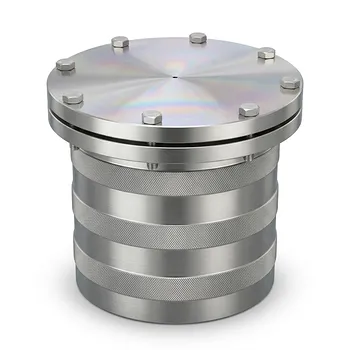
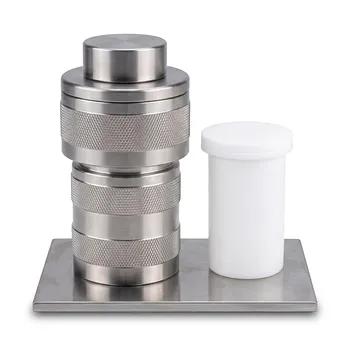
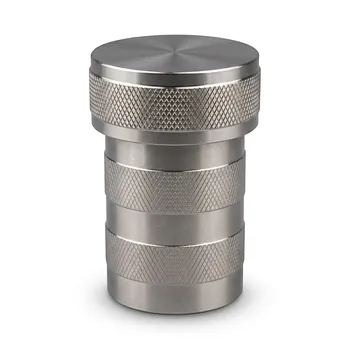
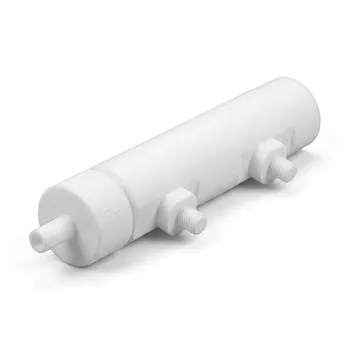
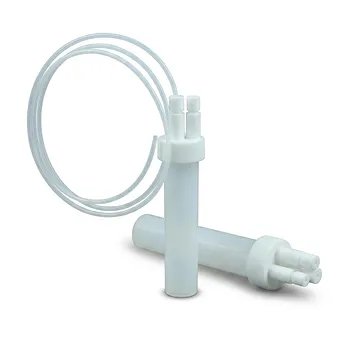
The primary purpose of a high-pressure autoclave in lithium-mediated ammonia electrosynthesis is to overcome the inherent low solubility of nitrogen gas in organic electrolytes. By operating at pressures up to 20 bar, the cell forces a higher concentration of nitrogen into the liquid phase, directly addressing mass transfer bottlenecks and significantly boosting the overall ammonia production rate.
Using high-pressure reaction cells is a strategic engineering choice to bypass the physical limitations of nitrogen transport in non-aqueous solvents. By increasing reactant availability at the electrode surface, these systems shift the process from being diffusion-limited to being kinetically productive.
Overcoming Solubility Constraints in Non-Aqueous Systems
The Challenge of Nitrogen Dissolution
Nitrogen ($N_2$) is a non-polar molecule that possesses very low natural solubility in the non-aqueous solvents typically used for lithium-mediated reactions. At standard atmospheric pressure, the concentration of available $N_2$ in the electrolyte is often too low to sustain high reaction rates.
Leveraging Pressure to Drive Concentration
The autoclave functions by maintaining a high-pressure nitrogen environment (up to 20 bar) above the electrolyte. According to the principles of gas solubility, increasing the partial pressure of the gas directly increases its concentration within the liquid medium.
Enhancing Reactant Availability
By forcing more nitrogen into the solvent, the autoclave ensures that the lithium-mediated pathway has a constant supply of "building blocks." This high concentration is essential for the lithium metal to effectively react with nitrogen to form lithium nitride, the critical intermediate in this process.
Solving Mass Transfer Limitations
Eliminating the Diffusion Bottleneck
In electrochemical systems, "mass transfer" refers to how quickly reactants move through the fluid to reach the electrode surface. Low nitrogen solubility creates a mass transfer limitation, where the reaction consumes nitrogen faster than it can be replaced by simple diffusion.
Boosting Production Efficiency
The high-pressure environment mitigates these transport issues by creating a steeper concentration gradient. This allows the system to achieve a much higher ammonia production efficiency, as the electrode is no longer "starved" for nitrogen during the electrolysis cycle.
Optimizing the Lithium-Mediated Pathway
Lithium-mediated synthesis is unique because it relies on the continuous cycling of lithium ions to metallic lithium and back. The autoclave ensures that once metallic lithium is formed, it immediately finds a nitrogen molecule to react with, preventing side reactions or efficiency losses.
Understanding the Trade-offs
Engineering and Safety Complexity
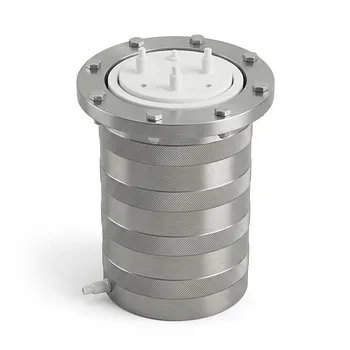
Utilizing a high-pressure autoclave introduces significant mechanical complexity to the experimental setup. The system must be rated for high-pressure safety, requiring specialized seals, valves, and heavy-duty reaction vessels that increase the initial capital cost.
Energy Demands of Compression
While the high pressure improves chemical efficiency, it introduces an energetic cost associated with gas compression. In a full-scale industrial context, the energy required to maintain 20 bar of pressure must be balanced against the gains in ammonia yield to ensure the process remains economically viable.
System Scalability
Scaling an autoclave-based process from a laboratory "batch" cell to a continuous industrial flow is technically challenging. High-pressure systems are harder to integrate into continuous-flow architectures compared to systems operating at ambient pressure.
How to Apply This to Your Project
Making the Right Choice for Your Goal
- If your primary focus is maximizing ammonia yield: You should prioritize the use of a high-pressure autoclave to ensure nitrogen availability never becomes the limiting factor for your reaction rate.
- If your primary focus is fundamental mechanistic study: Operating at varied pressures within an autoclave can help you determine exactly when your system transitions from being mass-transfer limited to being kinetically limited.
- If your primary focus is low-cost, decentralized production: You may need to explore alternative catalysts or solvent additives that increase nitrogen affinity at lower pressures to avoid the costs of high-pressure hardware.
By utilizing high-pressure environments, researchers can effectively bridge the gap between theoretical reaction potential and practical ammonia output.
Summary Table:
| Feature | Primary Function | Technical Impact |
|---|---|---|
| Pressure (up to 20 bar) | Increases $N_2$ partial pressure | Forces higher $N_2$ concentration into organic electrolytes |
| Mass Transfer | Eliminates diffusion bottlenecks | Ensures the electrode surface is never starved of reactants |
| Reaction Kinetics | Optimizes Li-mediated pathway | Rapid conversion of metallic lithium to lithium nitride |
| Engineering | Specialized containment | Maintains system integrity under high-pressure conditions |
Optimize Your Synthesis with KINTEK’s High-Performance Fluoropolymer Solutions
To achieve breakthrough results in lithium-mediated ammonia synthesis, you need equipment that withstands both high pressure and aggressive chemical environments. KINTEK specializes in high-performance fluoropolymer materials, offering an unparalleled range of laboratory supplies and custom-engineered components.
From everyday essentials—like PTFE beakers, reagent bottles, and centrifuge tubes—to advanced custom electrochemical cells, battery testing fixtures, and microwave digestion vessels, our products are designed for the most demanding trace analysis and reaction processes. Whether you require standard consumables such as O-rings and gaskets or complex bespoke laboratory setups crafted through our end-to-end custom CNC fabrication, we deliver precision and purity every time.
Ready to enhance your lab's efficiency with specialized PFA and PTFE hardware? Contact us today to discuss your custom project!
References
- Anna Mangini, Federico Bella. Multivariate Approaches Boosting Lithium‐Mediated Ammonia Electrosynthesis in Different Electrolytes. DOI: 10.1002/anie.202416027
This article is also based on technical information from Kintek Knowledge Base .
Related Products
- Custom TFM Reaction Vessel with Stainless Steel Jacket and PTFE Inner Cup for High Corrosion Resistance
- PTFE Lined High Pressure Digestion Vessel 50ml High Temperature Hydrothermal Synthesis Tank
- High Temperature Corrosion Resistant Hydrothermal Synthesis Reactor with TFM Inner Liner and Straight Cylinder Design
- High Purity Custom PTFE Reaction Cell Electrolytic Tank for Semiconductor and Polysilicon Industrial Applications
- Custom PTFE Corrosion Resistant Insulating Electrophoresis Reaction Cell with Septum and Valves for Low Background Trace Analysis
People Also Ask
- Why are high-performance pressure-resistant reaction vessels required for oxygen-assisted hydrothermal conversion at 150 °C?
- Why are PTFE-lined reaction vessels necessary for forced degradation studies? Ensure high-purity results and accuracy.
- Why are high-quality fluoropolymer-lined reaction vessels required for alk-Ti3C2Tx MXene? Ensure Purity & HF Resistance
- How do magnetic stirring and reaction vessels impact MOF-derived carbon quality? Optimize Your Composite Performance
- Why is a high-purity PTFE lined reaction vessel required for the acidic etching of MXenes? Ensure Material Purity.