The key is a fluorine-protected carbon backbone. Fluoropolymers combine strong carbon–carbon (C–C) backbone bonds, approximately 340 kJ/mol, with exceptionally strong carbon–fluorine (C–F) bonds, approximately 485–490 kJ/mol. Replacing hydrogen with fluorine creates a chemically shielded, low-polarizability structure that resists thermal bond cleavage, combustion, and attack by aggressive laboratory chemicals.
Fluoropolymer performance comes primarily from the strength and arrangement of C–F bonds. Fluorine atoms form a tightly bound protective sheath around the carbon backbone, making materials such as PTFE and PFA unusually stable at high temperatures and resistant to chemical degradation.
Why the Molecular Structure Is So Stable
Strong bonds resist thermal breakdown
The polymer backbone is held together by strong C–C bonds, while the attached fluorine atoms are connected through even stronger C–F bonds. The C–F bond is substantially stronger than a typical C–H bond, which is approximately 420 kJ/mol.
Breaking these bonds requires significant energy. As a result, fluoropolymers resist the molecular-chain scission and chemical decomposition that commonly limit less stable plastics at elevated temperatures.
Fluorine shields the carbon backbone
In highly fluorinated polymers, fluorine atoms surround much of the carbon backbone. This arrangement acts like a protective molecular shell, making it difficult for acids, bases, solvents, oxygen, and other reactive species to reach and attack the carbon chain.
This shielding effect is especially important in perfluoropolymers, such as PTFE and PFA, where hydrogen has been extensively or completely replaced by fluorine.
Fluorine holds its electrons tightly
Fluorine is highly electronegative and has low polarizability. Its electrons are therefore held tightly rather than being easily distorted or transferred during chemical reactions.
That reduced tendency to participate in reactions helps explain the broad chemical inertness of fluoropolymer laboratory components.
How These Bonds Produce Thermal Resistance
High bond energy delays degradation
Thermal degradation begins when enough heat is available to break chemical bonds or initiate chain reactions. The high energy required to disrupt C–F bonds gives fluoropolymers strong resistance to these processes.
This allows fluoropolymer vessels, digestion tubes, tubing, seals, and fittings to retain their chemical integrity under substantial thermal stress.
Structural integrity matters in laboratory apparatus
For laboratory equipment, thermal resistance is not merely a matter of surviving a high temperature briefly. The material must also avoid embrittlement, decomposition, chemical attack, and contamination during repeated exposure.
The stable molecular structure of fluoropolymers supports reliable use in applications involving heated reagents, digestion procedures, and high-purity fluid handling. The exact allowable temperature still depends on the specific fluoropolymer, its design, mechanical loading, and exposure time.
Thermal resistance is not unlimited
Strong C–F bonds do not make fluoropolymers immune to heat. At sufficiently high temperatures, the polymer can decompose, and excessive heat can also cause dimensional changes or loss of mechanical performance before chemical decomposition becomes obvious.
Therefore, chemical compatibility charts and manufacturer temperature limits remain necessary for apparatus selection.
Why Fluoropolymers Are Less Flammable
Fluorine substitution reduces combustible hydrogen content
Many common polymers contain substantial hydrogen and carbon, providing chemical fuel for combustion. Fluoropolymers replace much of that hydrogen with fluorine, reducing the availability of easily oxidized C–H-rich structures.
Their strong C–F bonds also make thermal breakdown and ignition more difficult than in many conventional organic polymers.
The fluorine-rich surface suppresses reactivity
The fluorine sheath gives the material a relatively unreactive surface. It reduces the ease with which oxygen and other reactants can initiate decomposition at the polymer interface.
This contributes to low flammability and flame resistance, although it should not be interpreted as absolute noncombustibility. Severe heat or direct flame can still cause fluoropolymers to decompose and may generate hazardous fumes.
Why They Resist Chemical Attack
Aggressive reagents have difficulty reaching the backbone
Chemical attack generally requires a reagent to approach a reactive site and break or transform a bond. In fluoropolymers, the carbon backbone is protected by tightly bound fluorine atoms, while the highly stable C–F bonds offer few accessible reaction pathways.
This is why PTFE, PFA, and related materials can handle many concentrated acids, strong bases, organic solvents, and other aggressive reagents without rapid degradation.
Low polarizability limits chemical interactions
Because fluorine’s electrons are tightly bound and not easily distorted, fluoropolymer surfaces have very low surface energy. They interact weakly with many other substances rather than readily forming strong adhesive or reactive interactions.
In laboratory apparatus, this can reduce sample adhesion, adsorption, and residue retention. It also supports clean fluid transfer and helps minimize contamination in trace-analysis work.
Chemical inertness protects sample purity
A vessel or tubing material can compromise an experiment by reacting with the sample, leaching additives, or retaining material from a previous operation. High-purity fluoropolymers minimize these risks because their stable molecular structure is resistant to dissolution and chemical attack.
This makes them valuable for digestion vessels, sample containers, tubing, valves, seals, and fittings used with corrosive or contamination-sensitive materials.
Understanding the Trade-offs
Chemical inertness does not equal universal compatibility
Fluoropolymers resist a broad range of laboratory chemicals, but compatibility remains application-specific. Temperature, exposure duration, pressure, concentration, mechanical stress, and the presence of unusual reactive species can change performance.
A material that is stable in one reagent at room temperature may behave differently under heated, pressurized, or chemically extreme conditions.
Mechanical properties can limit use
The same low surface energy and molecular characteristics that provide chemical resistance can also create practical challenges, including difficult bonding, lower stiffness than some engineering plastics, and potential deformation under sustained load or elevated temperature.
For apparatus design, chemical resistance must therefore be evaluated alongside strength, dimensional stability, sealing performance, and fabrication requirements.
Decomposition products require attention
Fluoropolymers are highly resistant during normal service, but overheating can produce decomposition products. Laboratory systems should prevent exposure to uncontrolled flame or temperatures beyond the manufacturer’s specified limits.
Good ventilation and appropriate thermal controls are essential whenever fluoropolymer equipment may be overheated.
How to Apply This to Laboratory Equipment
The molecular features explain the performance, but the correct choice depends on the operating conditions and the consequences of failure.
- If your primary focus is thermal resistance: Choose a fluoropolymer suited to the actual temperature, duration, mechanical load, and thermal cycling requirements—not solely its nominal maximum temperature.
- If your primary focus is chemical inertness: Select PTFE, PFA, or another compatible grade after checking the specific reagent, concentration, temperature, and exposure time.
- If your primary focus is low contamination: Favor high-purity fluoropolymer components with low surface energy and low extractables, while controlling cleaning and handling procedures.
- If your primary focus is fire safety: Treat fluoropolymers as low-flammability materials rather than completely noncombustible materials, and prevent exposure to direct flame or uncontrolled overheating.
The fundamental principle is simple: strong C–F bonds plus fluorine-based shielding give fluoropolymers their unusual combination of thermal stability, low flammability, and chemical inertness.
Summary Table:
| Bond Type | Bond Energy (kJ/mol) | Role in Fluoropolymer Properties |
|---|---|---|
| C-C (backbone) | ~340 | Provides structural integrity; strong bond resists thermal breakdown |
| C-F | ~485-490 | Extremely strong bond; high energy required to break, contributing to thermal stability and chemical inertness |
| C-H (comparison) | ~420 | Weaker than C-F; polymers with C-H are more flammable and reactive |
Enhance your lab's performance with high-purity PTFE and PFA apparatus from KINTEK. Our fluoropolymer products are designed to withstand extreme temperatures, resist chemical attack, and minimize contamination, ensuring reliable results in your most demanding applications. From digestion vessels and sample containers to custom machined parts, we deliver precision and durability. Contact us today to discuss your requirements and experience the KINTEK advantage. Get in touch now!
Related Products
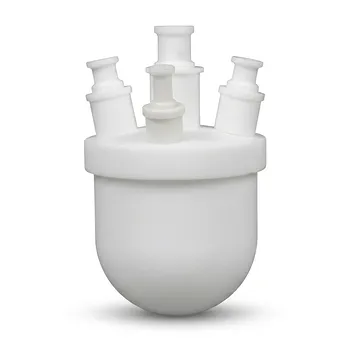
- Custom PTFE Flask 250ml High Purity Fluoropolymer Laboratory Vessel for Chemical Research
- Custom PTFE Insulating Gaskets and Corrosion Resistant Fluoropolymer Seals for Industrial Electrical Applications
- High Temperature Resistant PTFE Thermal Insulation Board Corrosion Resistant Metal Free Fluoropolymer Stand for Ultra Clean Laboratories
- Custom PFA Tubing 1/4 Inch High Purity Corrosion Resistant Fluoropolymer Tube with Welding and Machining Services
- Custom PTFE Teflon Balls for Advanced Industrial Applications
People Also Ask
- What are the key steps for structural integrity in molded PTFE lab reaction vessels? Master fine powder processing.
- When synthesizing TFVE monomers involving reactive organometallic reagents and aggressive polar solvents, what material performance characteristics are required? Ensure purity with PTFE/PFA.
- Why Are High-Purity Fluoropolymer Vessels and Tubing Critical for Trace Analysis? Prevent Contamination Reliably
- Why do PTFE fluoropolymer laboratory vessels and containers exhibit superior chemical resistance against harsh solvents and corrosive acids compared to standard plastic labware? Discover the molecular secrets
- How do choice of solvent and chain transfer activity affect molecular weight during vinylidene fluoride (VDF) radical polymerization? Learn Key Factors for High-MW PVDF