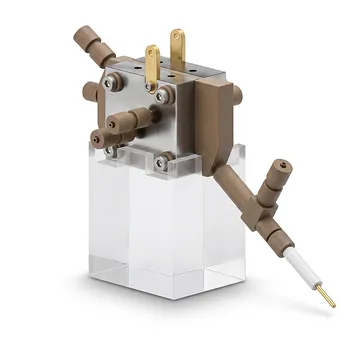
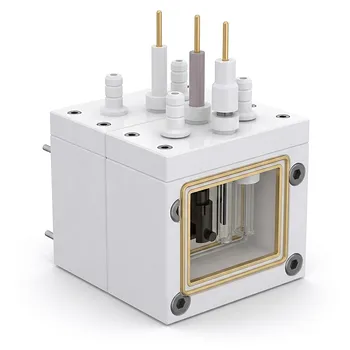
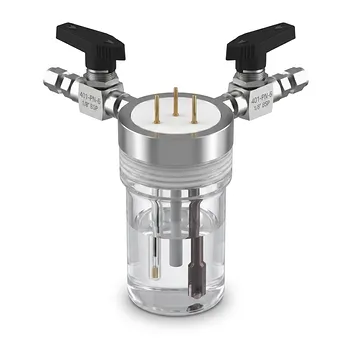
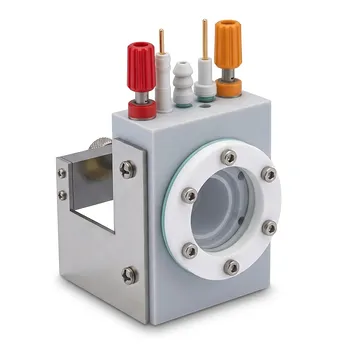
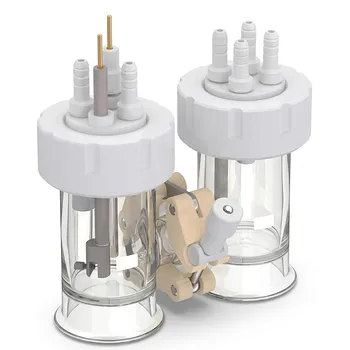
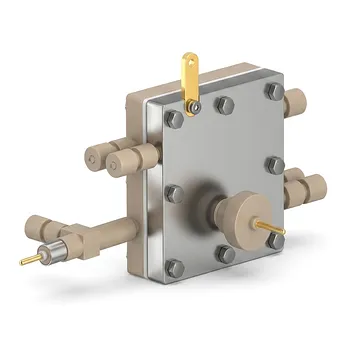
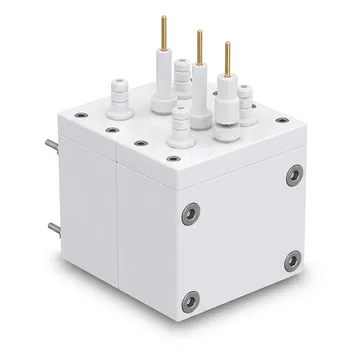
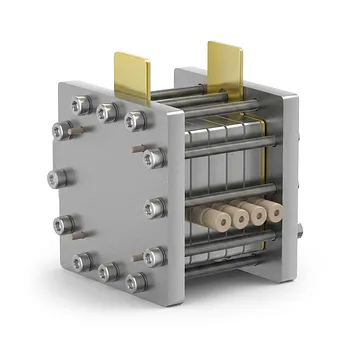
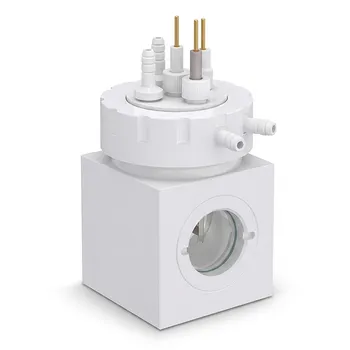
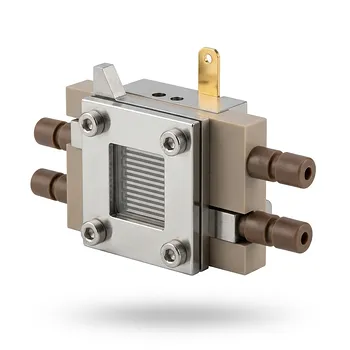
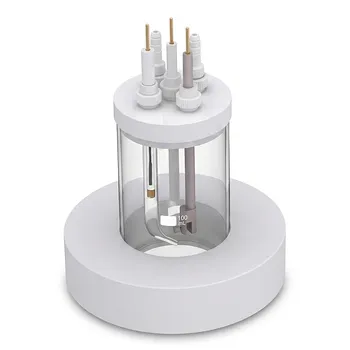
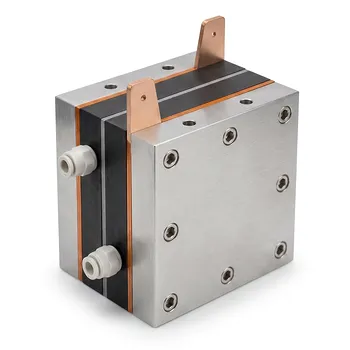
Electrochemical fluorination (ECF) takes place in anhydrous, highly corrosive liquid hydrofluoric acid, while fluoropolymer materials provide the chemically inert cell environment needed to contain it. Hydrocarbon substrates dissolved in anhydrous liquid HF are electrolyzed so that carbon-bound hydrogen is replaced by fluorine, producing perfluorinated compounds. The cell may also contain electrochemically generated elemental fluorine and reactive fluorinated intermediates, creating a severe chemical and materials challenge.
ECF combines anhydrous HF, fluorinated reactive species, electrical potential, and often significant heat release. High-purity PTFE and PFA are therefore used for wetted cell bodies, vessels, tubing, seals, and related fluid-handling components because they resist corrosion, prevent metal contamination, and maintain containment under demanding conditions.
What Chemical Conditions Exist During ECF?
Anhydrous Liquid Hydrofluoric Acid
The electrolyte is typically anhydrous liquid HF, which acts both as the reaction medium and as the source of fluorine for the electrochemical process. The absence of water is important because moisture changes HF chemistry, can alter conductivity and reaction behavior, and may introduce unwanted side reactions.
HF is highly corrosive and hazardous. Its ability to attack conventional materials is a primary reason ECF equipment requires specialized construction.
Hydrocarbon Feedstocks and Perfluorinated Products
Linear or branched hydrocarbons are dissolved in the HF electrolyte and exposed to electrochemical conditions. Hydrogen atoms in the feedstock are progressively replaced by fluorine, producing partially fluorinated intermediates and ultimately perfluorinated compounds.
The reaction mixture can therefore contain the original hydrocarbon, intermediate fluorinated species, product compounds, dissolved HF, and gases or volatile materials generated during electrolysis.
Elemental Fluorine and Reactive Intermediates
At the anode, electrochemical oxidation can generate highly reactive fluorinating species, including elemental fluorine or surface-associated fluorine intermediates. These species drive substitution and fluorination reactions but are also aggressive toward many construction materials.
The exact composition depends on the substrate, electrode arrangement, operating conditions, and degree of conversion. It is more accurate to describe ECF as a chemically complex fluorinating environment than as a simple HF solution.
Strong Electrical and Thermal Conditions
ECF combines an aggressive electrolyte with substantial electrical potentials and current flow. Joule heating and the exothermic nature of fluorination can create temperature gradients, making thermal management part of the cell design.
Cooling jackets or other controlled heat-removal features may be required to keep the electrolyte, electrodes, seals, and fluoropolymer components within their intended operating range.
Why Conventional Cell Materials Present Problems
Glass Is Vulnerable to HF
Glass and other silica-containing materials are unsuitable for direct exposure to anhydrous HF because HF attacks silicate structures. A glass cell may therefore suffer chemical degradation, loss of mechanical integrity, or contamination of the reaction mixture.
This distinguishes ECF from many ordinary aqueous electrochemical experiments, where glass is commonly used for laboratory vessels.
Metals Can Corrode or Contaminate the Process
Many conventional metals are vulnerable to HF, fluorine, or the combined effect of chemical attack and electrochemical potential. Corrosion can release metal ions into the reaction stream and can change the composition of the product or interfere with downstream purification.
Metallic contamination is particularly problematic when product purity, reaction selectivity, or mechanistic measurement is important.
Electrodes Require Separate Materials Considerations
The statement that metals are unsuitable should not be interpreted as meaning that every metal must be excluded from an ECF cell. Electrode materials are selected separately because they must conduct current and tolerate the local anodic or cathodic environment; nickel and related materials have historically been used in electrochemical fluorination equipment because of their behavior under appropriate fluorinating conditions.
The non-electrode wetted components still commonly rely on fluoropolymers. Material selection must account for both chemical compatibility and the electrical function of each component.
How Fluoropolymers Shape Cell Design
PTFE and PFA Form the Chemical Barrier
PTFE and PFA are used for components that contact HF, fluorinated intermediates, products, or aggressive gases. Typical applications include cell bodies, reaction vessels, storage containers, transfer tubing, fittings, valves, gaskets, and gas-separation features.
Their chemical resistance reduces corrosion and helps preserve the intended composition of the electrolyte and product stream.
The Cell Body Must Support Containment
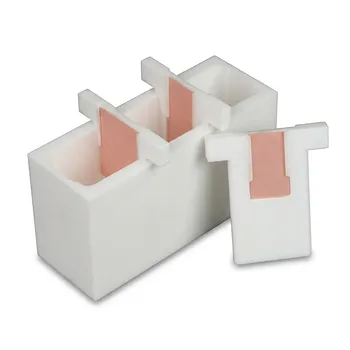
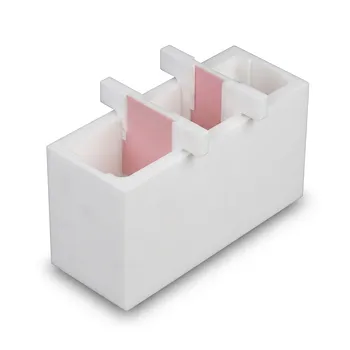
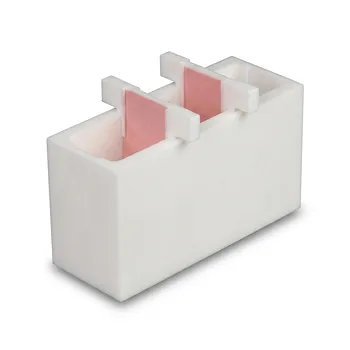
A fluoropolymer cell body provides an electrically insulating and chemically resistant enclosure around the reaction zone. It can isolate the electrolyte from external structural materials and reduce the number of exposed metallic interfaces.
The design still has to address mechanical strength, clamping, thermal expansion, pressure relief, and compatibility with the selected electrodes. Chemical inertness alone does not make a cell safe or mechanically adequate.
Tubing and Seals Protect the Closed-Loop System
ECF systems often require controlled circulation or transfer of HF and fluorinated products. PTFE/PFA tubing, fittings, and valves help prevent corrosion and reduce the risk that metal ions or degraded seal materials will enter the process.
Seals and connection points deserve particular attention because leakage and permeation can become failure modes even when the main vessel remains intact.
Gas Management Requires Dedicated Paths
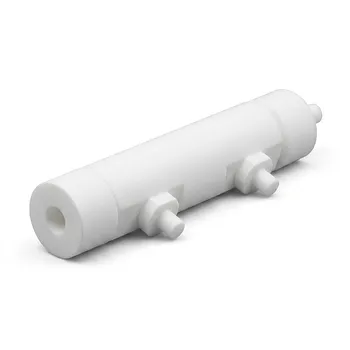
Electrolysis can produce or handle fluorinated gases and other volatile species. Dedicated HF and gas inlets and outlets help separate gas-phase flows from liquid circulation and support controlled venting, recovery, or downstream treatment.
Fluoropolymer gas-separation skirts and related barriers can limit unintended mixing while maintaining chemical resistance around the electrodes.
Cooling Features Control Reaction Conditions
A cooling jacket or comparable heat-transfer arrangement can stabilize electrolyte temperature and reduce thermal stress. This is important because temperature affects reaction rates, HF vapor pressure, fluoropolymer dimensions, and the behavior of seals and joints.
PFA may be useful where greater transparency or fabrication flexibility is needed, while PTFE is often selected for robust chemical resistance and insulating structural parts. The appropriate choice depends on temperature, mechanical loading, permeability, fabrication method, and the specific chemicals present.
Understanding the Trade-offs
Fluoropolymers Are Chemically Strong but Mechanically Limited
PTFE has excellent chemical resistance and electrical insulation, but it has relatively high creep and thermal expansion compared with many engineering metals. Under clamping force, pressure, or elevated temperature, dimensions and sealing loads can change.
Designers may therefore use support structures, controlled compression, thicker sections, or compatible secondary materials while keeping the fluoropolymer as the primary wetted barrier.
Chemical Compatibility Is Not Universal
Fluoropolymers are highly resistant to HF and many fluorinated chemicals, but compatibility must be evaluated for the complete operating envelope. Temperature, pressure, radiation, electrical potential, mechanical stress, and exposure time can change material performance.
A compatibility decision based only on room-temperature immersion data may not represent actual ECF service.
Fluoropolymer Construction Does Not Remove Process Hazards
PTFE and PFA reduce equipment corrosion and contamination; they do not eliminate the hazards of anhydrous HF, fluorine, toxic products, electrical energy, or pressure. The system still requires suitable containment, monitoring, cooling, interlocks, ventilation, emergency response, and waste treatment.
The cell material is one part of the safety strategy, not a substitute for process engineering controls.
Permeation and Fabrication Quality Matter
Fluoropolymers can permit some gas permeation, and poorly designed joints can leak despite the material’s chemical resistance. Welds, machined surfaces, threaded connections, valve seats, and gasket compression must be evaluated as part of the complete system.
High-purity grades and appropriate fabrication practices also help prevent extractables, ionic leaching, and particulate contamination.
Electrical Insulation Must Be Managed Deliberately
The insulating nature of PTFE and PFA is valuable for preventing unintended current paths. However, it also means that electrodes, electrical feedthroughs, and conductive supports must be integrated carefully.
The design must expose the intended electrode surfaces to the electrolyte while preventing stray currents, short circuits, and corrosion at feedthrough interfaces.
How to Apply This to Your Project
The correct design depends on whether the priority is product purity, long-term operation, temperature control, or experimental measurement.
- If your primary focus is chemical containment: Use high-purity PTFE or PFA for the cell body, wetted tubing, fittings, valves, gaskets, and gas-management components, with compatibility verified for the full HF and fluorinated process stream.
- If your primary focus is product purity: Minimize exposed conventional metals, select low-extractable fluoropolymer grades, and prevent corrosion products or ionic leachables from entering the electrolyte.
- If your primary focus is electrochemical performance: Treat electrode selection separately from vessel construction, and design fluoropolymer insulation and feedthroughs to maintain the intended current distribution.
- If your primary focus is thermal stability: Include controlled cooling and account for fluoropolymer thermal expansion, creep, seal compression, and HF vapor behavior across the operating range.
- If your primary focus is reliable continuous operation: Design the entire closed-loop path, including storage, transfer, gas separation, joints, and maintenance access, around the same corrosion and contamination requirements as the reaction cell.
A successful ECF cell treats materials compatibility, electrochemical function, thermal control, gas handling, and containment as one integrated design problem.
Summary Table:
| Factor | Description |
|---|---|
| Electrolyte | Anhydrous, highly corrosive liquid hydrogen fluoride (HF) |
| Reactants | Hydrocarbon feedstocks dissolved in HF |
| Reactive Species | Electrochemically generated elemental fluorine and fluorinated intermediates |
| Products | Perfluorinated compounds, partially fluorinated intermediates, gases |
| Thermal Conditions | Significant heat generation, requiring cooling management |
| Electrical Conditions | High electrical potential and current flow |
| Key Materials | Fluoropolymers (PTFE, PFA) for wetted components, nickel for electrodes |
Design robust ECF cells with KINTEK's high-purity PTFE and PFA components. Our corrosion-resistant labware, tubing, and custom-machined parts ensure chemical containment and product purity in demanding fluorination processes. Contact us today to optimize your ECF system — get in touch!
Related Products
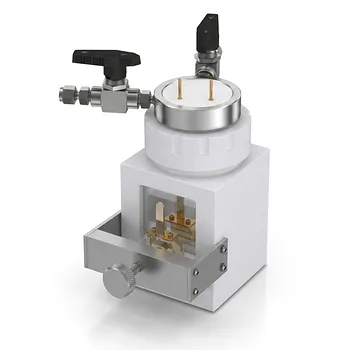
- White PTFE Electrolytic Cell with Movable Slider and Insulated Lid for Fluorine Corrosion Resistance
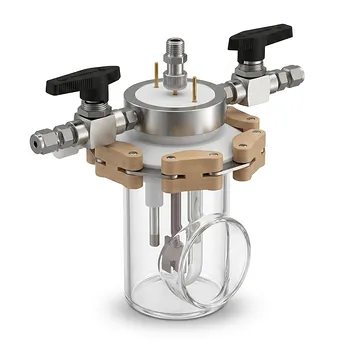
- Corrosion Resistant PTFE Electrochemical Cell for New Energy Research Inert Insulating Customizable Lab Reaction Vessel
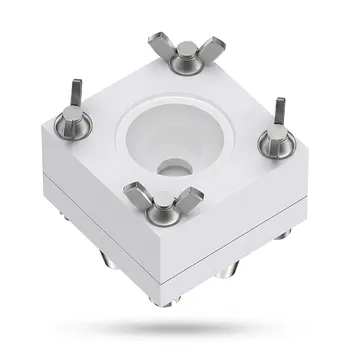
- Square PTFE Electrochemical Cell for Silicon Wafer Processing and Hydrofluoric Acid Resistance in Semiconductor and New Energy Research
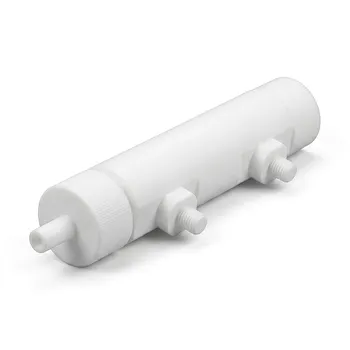
- Custom PTFE Electrolytic Cell Corrosion Resistant Low Background Reaction Vessel with Inlet Outlet Ports
- PTFE Flat Plate Working Electrode Electrochemical Cell for Sheet Samples Corrosion Testing and SEM Sample Preparation
People Also Ask
- What makes PTFE an ideal construction material for custom electrochemical cells and electronic analytical instrumentation housings? Discover superior chemical resistance and electrical insulation
- How do custom PTFE electrochemical cells improve the accuracy of stability testing for alkaline catalysts compared to glass cells?
- What parameters govern the electrochemical decomposition of perfluorooctanoic acid (PFOA) in aqueous solutions, and why are custom PTFE electrochemical cells preferred? Key factors include anode material, current density, electrolyte, and cell design.
- How does the hydrophobicity of PTFE benefit electrochemical measurements? Enhance Stability and Precision in Your Lab
- How are electrolytic cells utilized in the Hall-Héroult process? Optimizing Purity and Energy Efficiency