The more fluorinated a polymer is, the less compatible it becomes with ordinary organic solvents—but the more compatible it can become with fluorinated media. Low-fluorine polymers may dissolve in solvents such as toluene, chloroform, THF, and acetone, while highly fluorinated polymers resist those solvents and may dissolve only in perfluorinated solvents or selected hydrochlorofluorocarbons (HCFCs). This is a balance between fluorine-driven chemical resistance and fluorine–fluorine solvent affinity, not simply a steady increase in universal insolubility.
Fluorination shifts a polymer’s solvent preference from conventional organic media toward fluorinated media. Increasing fluorine content generally reduces swelling, dissolution, and chemical attack by non-fluorinated solvents, although the most highly fluorinated commercial polymers—such as PTFE and PFA—are typically selected for their exceptional insolubility and inertness rather than routine solution processing.
How Fluorination Changes Solvent Compatibility
Low fluorine content preserves conventional solvent compatibility
Polymers with relatively low fluorine content retain more of the chemical character of their non-fluorinated backbone or side groups.
As a result, materials such as poly(5FVE) can remain soluble in common organic solvents, including toluene, chloroform, THF, and acetone. These solvents can interact sufficiently with the polymer to separate and solvate its chains.
Such polymers may be easier to solution-process, but their solvent resistance is correspondingly limited. Exposure can produce dissolution, swelling, or loss of dimensional stability.
Moderate fluorination creates solvent- and temperature-dependent behavior
At intermediate fluorine levels, the polymer may no longer behave as a straightforward soluble resin.
Poly(9FVE), for example, can exhibit upper critical solution temperature (UCST) behavior in organic solvents. Below or above a particular temperature range, polymer–solvent interactions change enough to cause phase separation or mixing.
This means compatibility cannot be judged only by whether a polymer dissolves at room temperature. Temperature, concentration, solvent identity, and polymer architecture may all determine whether the system is homogeneous.
High fluorine content suppresses ordinary organic-solvent dissolution
Highly fluorinated polymers have a low surface energy and strong, tightly shielded carbon–fluorine structures. These features make it difficult for conventional organic solvents to penetrate, swell, and separate the polymer chains.
Poly(13FVE) illustrates this transition: it is reported to be completely insoluble in standard non-fluorinated organic solvents but soluble in selected perfluorinated liquids, such as perfluorohexanes and perfluorodecalin, as well as certain HCFCs.
The practical trend is therefore clear: increasing fluorine density generally decreases compatibility with conventional organic solvents while increasing compatibility with suitably fluorinated media.
Why Perfluorinated Media Behave Differently
Solvent compatibility depends on chemical similarity
A useful approximation is that materials dissolve when the solvent can adequately replace the cohesive interactions holding the polymer chains together.
Non-fluorinated solvents such as ketones, aromatics, chlorinated hydrocarbons, and polar aprotic solvents are often effective against polymers with accessible hydrocarbon or polar functionality. They are much less effective when the polymer surface and backbone are dominated by fluorinated groups.
Perfluorinated solvents present a different interaction environment. Their fluorinated structure can provide better fluorophilic compatibility with highly fluorinated polymer segments than ordinary hydrocarbons can.
Fluorophilic compatibility is not the same as chemical attack
A perfluorinated solvent may dissolve or swell a highly fluorinated specialty polymer because of favorable segment–solvent interactions. That does not mean the solvent is chemically degrading the polymer.
Dissolution is primarily a physical compatibility process. Chemical resistance concerns whether the polymer undergoes bond cleavage, oxidation, substitution, or another irreversible reaction.
Commercial perfluoropolymers are a special case
The behavior of soluble fluorinated model polymers should not be generalized directly to PTFE or PFA.
PTFE and PFA are highly crystalline or semi-crystalline, high-molecular-weight perfluoropolymers with exceptionally strong cohesive structure. They are generally regarded as effectively insoluble under ordinary processing and laboratory conditions, including in most perfluorinated liquids.
Selected fluorinated media may dissolve or process specialized fluorinated polymers, but PTFE and PFA are normally chosen precisely because they resist dissolution and retain dimensional integrity.
Fluorination Reduces Swelling as Well as Dissolution
Higher fluorine density limits solvent penetration
A polymer does not need to dissolve completely to become unsuitable. Solvent uptake can cause swelling, softening, stress cracking, seal failure, and dimensional change.
Higher fluorine content reduces solvent penetration and usually improves resistance to volumetric swelling. One cited comparison shows that increasing fluorine content from approximately 65% to 71% reduced swelling in benzene from about 20% to 3%.
This distinction matters in tubing, fittings, vessels, and seals, where even modest swelling can alter clearances or compromise joints.
Full fluorination improves resistance to polar aprotic solvents
Partially fluorinated polymers may remain vulnerable to aggressive polar solvents.
For example, PVDF can swell in ketones and esters and dissolve in solvents such as DMF, DMAc, and NMP. It can also be attacked by hot amines and concentrated alkalis.
Fully fluorinated materials such as PFA and PTFE provide substantially broader resistance, including strong performance in demanding solvent-handling environments. However, compatibility should still be checked against temperature, exposure time, stress, and the specific grade.
Molecular Architecture Matters Alongside Fluorine Content
Fluorinated side groups can preserve processability
Fluorine content is important, but it is not the only design variable.
Short fluorinated side groups, such as trifluoroethoxy units, can allow solubility in selected solvents including THF, acetone, and methyl ethyl ketone. This can make the polymer suitable for solution coating or other processing methods.
Longer perfluoroalkyl groups usually reduce solubility
Adding more CF₂ units or bulky fluorinated aryloxy groups generally increases fluorine-rich character and reduces compatibility with conventional organic solvents.
This architecture can produce strong solvent-barrier behavior, but it may also make the polymer difficult or impossible to process from solution.
Crystallinity can dominate observed resistance
Two polymers with similar fluorine content may show different solvent resistance if their crystallinity differs.
More crystalline structures pack chains more densely, restricting solvent diffusion and reducing swelling. Therefore, fluorine content and crystallinity must be evaluated together, particularly for molded laboratory and fluid-handling components.
Understanding the Trade-offs
Higher resistance can mean lower processability
Highly fluorinated polymers are difficult to dissolve, coat, bond, or rework using ordinary solvent techniques.
This is an advantage during chemical exposure but a disadvantage during fabrication. Low- and moderately fluorinated polymers may offer a more practical balance when solution processing is essential.
Solubility in fluorinated media does not imply universal compatibility
A polymer that dissolves in perfluorohexane or perfluorodecalin is not necessarily compatible with every fluorinated solvent.
Fluorinated solvents differ in molecular size, fluorine content, polarity, and cohesive energy. Compatibility must therefore be tested with the exact solvent, temperature, concentration, and polymer grade.
Side-chain fluorination can reduce thermal limits
Bulky perfluoroalkyl side groups can provide excellent resistance to common organic solvents, but side-chain degradation may lower the polymer’s thermal decomposition threshold.
Some such materials show breakdown onset near 294 °C, whereas fully fluorinated engineering polymers such as PTFE and PFA are generally preferred when maximum thermal and chemical endurance are required.
Chemical resistance is not determined by fluorine alone
Temperature, crystallinity, mechanical stress, exposure duration, molecular weight, additives, and processing history all affect performance.
A compatibility chart is useful for screening, but critical applications should include immersion, swelling, tensile-retention, and permeation testing under actual operating conditions.
How to Apply This to Your Project
Fluorination should be selected according to whether the priority is conventional solvent processing, fluorinated-media compatibility, or maximum chemical inertness.
- If your primary focus is solution processing in ordinary organic solvents: Choose a low- or moderately fluorinated polymer whose architecture retains compatibility with solvents such as THF, acetone, toluene, or chloroform.
- If your primary focus is controlled phase behavior: Evaluate moderately fluorinated polymers for temperature-dependent behavior such as UCST transitions rather than assuming room-temperature solubility predicts all conditions.
- If your primary focus is dissolution in perfluorinated media: Select a fluorinated polymer designed for fluorophilic solvent compatibility and verify performance in the specific perfluorinated liquid.
- If your primary focus is resistance to aggressive non-fluorinated solvents: Prefer a high-fluorine, highly crystalline material and assess swelling as well as complete dissolution.
- If your primary focus is maximum laboratory chemical inertness: Use PTFE or PFA for vessels, tubing, fittings, and fluid-contact parts, recognizing that these materials are normally not solution-processable or readily soluble.
The right fluoropolymer is the one whose fluorine content, architecture, and crystallinity match the solvent environment and the required processing method.
Summary Table:
| Fluorination Level | Solubility in Non-Fluorinated Solvents | Solubility in Perfluorinated Media | Key Characteristics |
|---|---|---|---|
| Low (e.g., poly(5FVE)) | Soluble in toluene, chloroform, THF, acetone | Limited or not tested | Easier solution processing; lower solvent resistance |
| Moderate (e.g., poly(9FVE)) | UCST behavior, temperature-dependent | Variable | Phase separation possible; compatibility depends on conditions |
| High (e.g., poly(13FVE)) | Insoluble | Soluble in perfluorohexanes, perfluorodecalin, selected HCFCs | Strong resistance to organic solvents; fluorophilic compatibility |
| Very High (e.g., PTFE, PFA) | Insoluble | Practically insoluble | Exceptional chemical inertness, high crystallinity; not solution-processable |
Need help selecting the right fluoropolymer for your lab? Our experts at KINTEK specialize in high-performance PTFE and PFA products, from basic labware to custom machined parts. Contact us today for a tailored solution that meets your chemical compatibility and processing needs. Contact KINTEK to discuss your application and benefit from our end-to-end fluoropolymer expertise.
Related Products
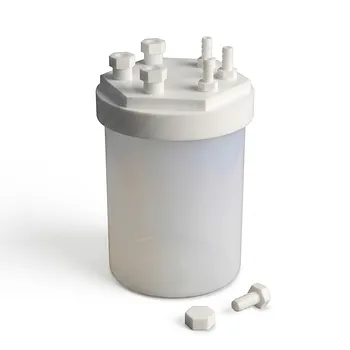
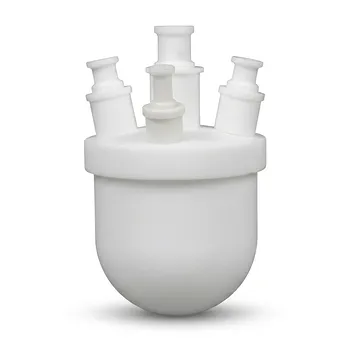
- PFA Chemical Reaction Tank with Customizable Fittings for Corrosive Solvent Synthesis and High Purity Lab Applications
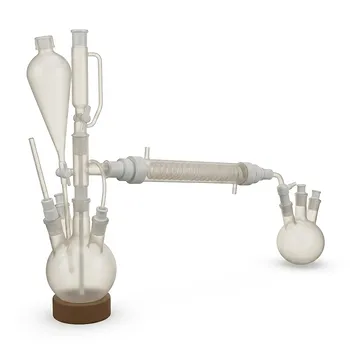
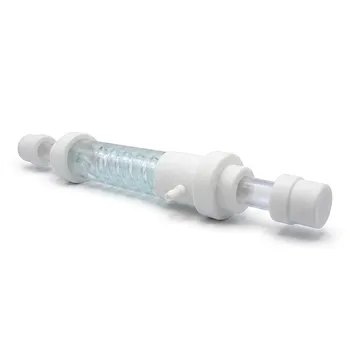
- PTFE Distillation Condensation Apparatus High Temperature Hydrofluoric Acid Resistant Fluorination Reaction Flask
- High Purity PFA Chromatography Column with Collection Bottle Corrosion Resistant Fluoropolymer Filtration System for Trace Analysis
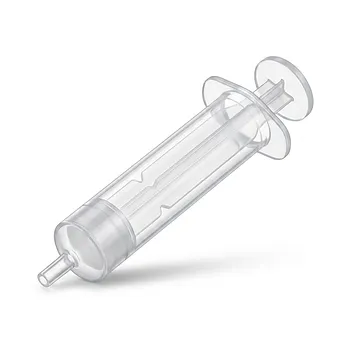
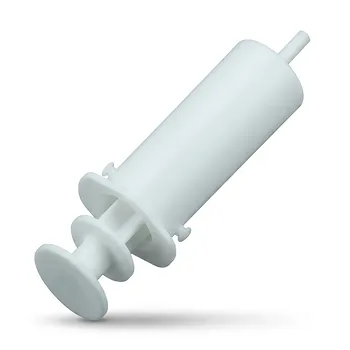
- Corrosion Resistant PFA Syringe Translucent Visual Fluoropolymer Labware 10ml Chemical Handling Tool
- Custom PTFE Condenser Tube 100ml Serpentine and Straight Fluoropolymer Laboratory Heat Exchanger with Flask Adapters
People Also Ask
- How do choice of solvent and chain transfer activity affect molecular weight during vinylidene fluoride (VDF) radical polymerization? Learn Key Factors for High-MW PVDF
- Why are fluoropolymer reaction vessels essential for SnO2/rGO synthesis? The Key to High-Performance Composites
- What synthesis methods are used for fluoropolymers like vinylidene fluoride copolymers, and how do high-purity fluoropolymer reaction vessels and labware support these processes?
- Why use PFA or PTFE for WO3-x acidification? Ensure high-purity nanocrystals and prevent metallic contamination.
- What role does a high-pressure reaction vessel with a fluoropolymer liner play in MoS2/Cu2S synthesis? Expert Guide