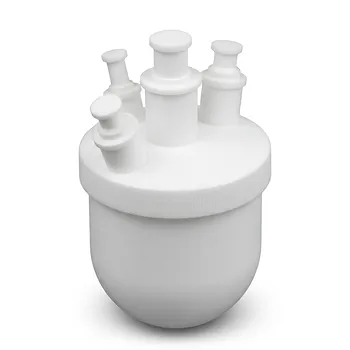
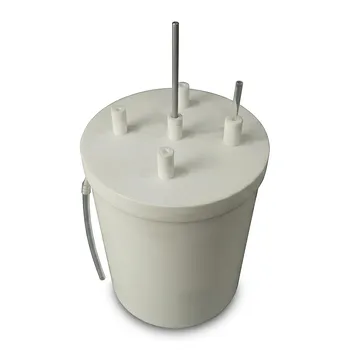
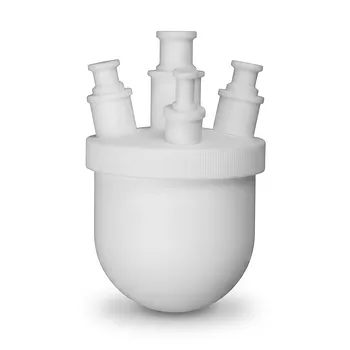
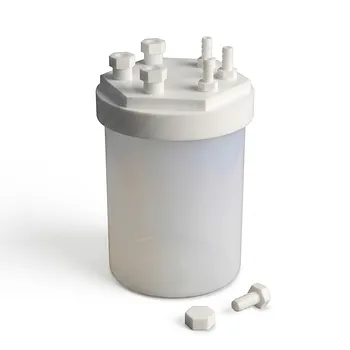
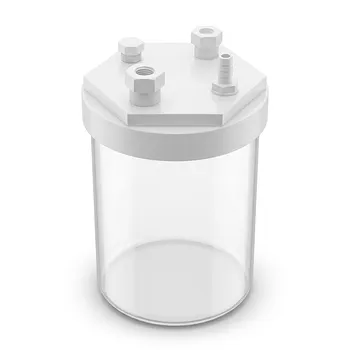
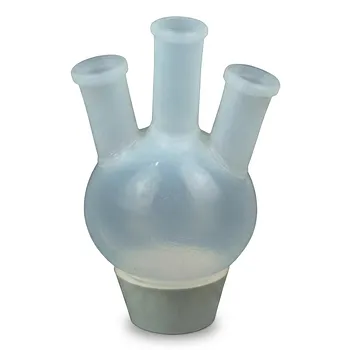
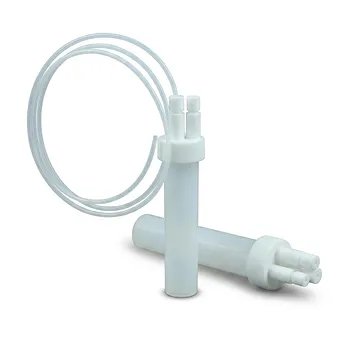
Solvent choice and chain-transfer activity are major determinants of molecular weight in VDF radical polymerization. DMF, DMAc, and NMP can strongly transfer to growing PVDF radicals, creating new radical species and terminating polymer chains early; the result is often very low number-average molecular weight, around 500–1,000 g/mol. Acetonitrile (ACN), by contrast, promotes heterogeneous precipitation polymerization with minimal solvent transfer, allowing much higher molecular weights, often above 17,000 g/mol. Chemically inert PTFE or PFA vessels are required because aggressive polar solvents, volatile fluorinated monomers, radicals, and initiators can otherwise extract, swell, or degrade ordinary vessel materials and alter the polymerization chemistry.
The practical rule is simple: solvents that readily donate atoms or otherwise transfer to growing VDF radicals suppress molecular weight, while low-transfer conditions preserve chain growth. PTFE and PFA equipment protects those conditions by preventing vessel-derived contamination and chemical interference.
How Solvent Choice Controls VDF Molecular Weight
Chain transfer competes with propagation
In radical polymerization, a growing PVDF radical can either add another VDF molecule or undergo a chain-transfer reaction. Transfer terminates the original growing chain and generates a new radical capable of reinitiating polymerization.
When transfer occurs frequently, many chains are formed but each chain has fewer repeat units. The number-average molecular weight, (M_n) therefore decreases.
DMF, DMAc, and NMP strongly suppress (M_n)
DMF, DMAc, and NMP are useful polar solvents for PVDF processing and solution chemistry, but they are poor choices when the objective is high molecular weight through homogeneous VDF polymerization. Their strong chain-transfer activity interrupts chain growth and can reduce (M_n) to approximately 500–1,000 g/mol.
This behavior explains why a solvent that dissolves the monomer and polymer well is not automatically a good polymerization medium. Solubility can improve reaction uniformity while the solvent simultaneously limits achievable chain length.
ACN favors higher molecular weight
Acetonitrile exhibits much lower chain-transfer activity under the referenced VDF polymerization conditions. Polymer formation occurs as a heterogeneous precipitation process, so the growing PVDF becomes less dependent on a strongly interacting homogeneous solvent environment.
With fewer transfer events, propagation remains effective for longer periods, and polymers with (M_n) values above 17,000 g/mol can form.
High molecular weight and homogeneous solution polymerization are difficult to combine
Typical polar solvents offer the convenience of homogeneous processing but can participate in chain transfer. ACN offers better molecular-weight preservation but does so through precipitation rather than a fully homogeneous solution.
The underlying challenge is therefore not simply selecting a solvent with the best dissolving power. It is finding a medium that provides adequate monomer transport and thermal control without becoming an active source of chain termination.
How Chain-Transfer Activity Sets Chain Length
A transfer agent caps one chain and starts another
A chain-transfer agent (CTA) reacts with a growing polymer radical, commonly through abstraction of a labile atom such as hydrogen. The original polymer radical is capped, while the CTA-derived radical may reinitiate polymerization.
This mechanism provides a direct way to regulate molecular weight. More effective transfer generally produces shorter chains and a lower (M_n), provided the new radical can continue the desired polymerization.
CTA concentration changes the molecular-weight target
Increasing the concentration of an effective CTA increases the number of transfer events relative to propagation. This typically lowers the average chain length and can narrow or reshape the molecular-weight distribution, depending on the kinetics of reinitiation and termination.
The important variable is not merely the nominal amount of CTA added. It is the effective transfer rate under the specific solvent, temperature, initiator, monomer concentration, and pressure conditions.
CTA functionality affects control
Difunctional agents such as 1,4-diiodoperfluorobutane can provide stronger molar-mass control than monofunctional CTAs at equivalent molar amounts. Their two reactive iodine-containing ends can influence the number and architecture of polymer chains more substantially.
Monofunctional perfluoroalkyl iodides also differ in activity. The referenced comparison identifies shorter-chain C4F9I as more active and better suited to linear molar-mass control than longer-chain C6F13I under lower-CTA-concentration conditions.
Perfluoroalkyl iodides provide functional chain ends
Perfluoroalkyl iodides are not used only to reduce molecular weight. They can also generate iodine-terminated fluoropolymer chains that are useful for later block-copolymer formation or post-polymerization modification.
Their efficient transfer behavior can also suppress head-to-head propagation defects and hydrogen-transfer termination, preserving useful chain-end functionality while controlling molar mass.
Why Reaction Vessel Materials Matter
Ordinary materials can change the reaction
A vessel is not chemically irrelevant in a sensitive radical polymerization. Aggressive polar solvents may extract additives, cause swelling, or degrade polymeric and elastomeric components; reactive fluorinated species and radicals can further complicate compatibility.
Any species released from the vessel can act as an unintended chain-transfer agent, radical quencher, catalyst poison, or analytical contaminant. That can change the measured molecular weight and make the intended solvent or CTA effects impossible to interpret reliably.
PTFE and PFA minimize chemical interference
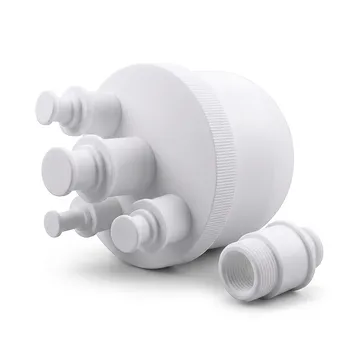
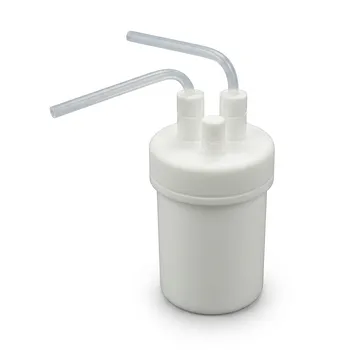
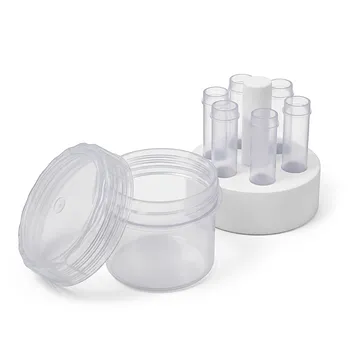
PTFE and PFA provide high chemical resistance to the polar solvents, fluorinated monomers, initiators, and radical intermediates used in VDF polymerization. They are therefore appropriate for reaction vessels, digestion containers, tubing, fittings, storage containers, and other wetted components.
Their purpose is not to increase molecular weight directly. Their purpose is to ensure that the molecular weight is governed by the selected polymerization chemistry rather than by uncontrolled interaction with the equipment.
Containment is especially important for gaseous VDF
VDF is a volatile gaseous monomer with a boiling point near −84 °C, so polymerization commonly involves pressure-rated equipment and carefully controlled fluid handling. The combination of volatile monomer, organic solvent, initiator, and elevated pressure increases the consequences of leaks, contamination, and material incompatibility.
Fluoropolymer components support reliable containment and help maintain chemical and thermal stability throughout the process. Pressure-rated design remains essential: PTFE or PFA chemical resistance does not by itself make an apparatus suitable for high-pressure operation.
Understanding the Trade-offs
A high-transfer solvent may improve handling but reduce (M_n)
DMF, DMAc, and NMP can provide good solvent compatibility and homogeneous reaction mixtures, but their transfer activity can dominate the molecular-weight outcome. They are therefore useful when solubility or processing is more important than maximizing chain length, but risky when high-(M_n) PVDF is the primary objective.
Precipitation can improve molecular weight while complicating processing
ACN can support higher molecular weight because it minimizes transfer, but precipitation introduces mass-transfer, mixing, particle-growth, and heat-removal considerations. The process may be less convenient than a homogeneous solution polymerization and may produce a polymer morphology that requires additional control.
More CTA is not automatically better control
An effective CTA can reduce excessive molecular weight and introduce valuable chain-end functionality. Excessive or poorly matched transfer activity, however, can drive (M_n) too low, reduce conversion, or produce inconsistent reinitiation behavior.
CTA selection must therefore consider functionality, chain length, concentration, and compatibility with the radical system, rather than relying only on the total molar amount.
Chemical resistance does not replace process validation
PTFE and PFA reduce leaching and contamination risks, but they do not eliminate the need to validate pressure rating, seals, fittings, temperature limits, cleaning procedures, and monomer compatibility. In particular, fluoropolymer labware should be integrated with equipment designed for the pressure and volatility of VDF.
How to Apply This to Your Project
Begin by defining whether the priority is maximum molecular weight, precise molar-mass control, functional chain ends, homogeneous processing, or analytical purity.
- If your primary focus is high molecular weight: Favor low-transfer conditions such as ACN-based precipitation polymerization and avoid strongly transferring solvents such as DMF, DMAc, and NMP.
- If your primary focus is controlled molecular weight: Select a CTA based on its transfer activity, functionality, and chain length, then adjust its concentration relative to the expected propagation rate.
- If your primary focus is functional fluoropolymer chains: Consider efficient perfluoroalkyl iodide CTAs that provide iodine-terminated chains for subsequent block-copolymer synthesis or derivatization.
- If your primary focus is reproducible kinetics and product purity: Use PTFE or PFA for wetted reaction and fluid-handling components, while separately verifying pressure, temperature, sealing, and cleaning requirements.
- If your primary focus is homogeneous processing: Recognize that typical polar solvents may force a trade-off with molecular weight because their chain-transfer activity can overwhelm the benefits of polymer and monomer solubility.
In VDF radical polymerization, molecular weight is controlled by the balance between propagation and transfer, while inert fluoropolymer equipment ensures that the balance is determined by design rather than by the reaction vessel.
Summary Table:
| Factor | Effect on Molecular Weight | Key Details |
|---|---|---|
| Solvent (DMF, DMAc, NMP) | Strong chain transfer, low Mn (500-1,000 g/mol) | Homogeneous but terminates chains early. |
| Solvent (Acetonitrile) | Low chain transfer, high Mn (>17,000 g/mol) | Heterogeneous precipitation, preserves growth. |
| Chain Transfer Agent (CTA) | Reduces Mn by capping chains | Perfluoroalkyl iodides like C4F9I effective. |
| CTA Concentration | Lower Mn with higher concentration | More transfer events vs propagation. |
| Vessel Material (PTFE/PFA) | Protects purity and consistency | Prevents contamination and leaching. |
For reliable VDF polymerization with precise molecular weight control, choose KINTEK as your partner. Our high-purity PTFE and PFA labware—including reactors, tubing, fittings, and custom parts—ensure inert conditions that safeguard your kinetics. Whether you are developing high-MW PVDF or optimizing CTA strategies, our expertise and end-to-end machining capabilities support your research from concept to production. Contact us today to discuss your fluoropolymer needs and benefit from our tailored solutions for high-performance applications.
Related Products
- High Purity Custom PTFE Large Volume 15L Flask Corrosion Resistant Low Trace Background Fluoropolymer Reaction Vessel
- Laboratory PTFE Three Neck Reaction Flask Corrosion Resistant 2000ml Low Background Fluoropolymer Vessel
- Custom PTFE Reaction Kettle 2L Flanged Fluoropolymer Reactor Tank Acid and Alkali Resistant Polytetrafluoroethylene Vessel
- Custom PTFE Flask 250ml High Purity Fluoropolymer Laboratory Vessel for Chemical Research
- Large Capacity PTFE Reaction Flask 20L Custom Multi Neck Laboratory Boiling Flask Fluoropolymer Chemical Processing Vessel
People Also Ask
- Why are high-purity PTFE or PFA reaction vessels recommended for the synthesis of PANI-TiC hybrid materials? - Guide
- How do perfluorinated solvent environments influence the selection of reaction vessels and fluid handling components in nonaqueous emulsion polymerizations? Choose fluoropolymer materials.
- What reaction vessel and fluid handling considerations are necessary for living cationic polymerization of fluorinated monomers involving Lewis acid catalysts? Key design and safety tips
- Ion Activation Reaction Vessel Requirements: Why PTFE is Critical for Membrane Performance
- Why are fluoroplastic (PTFE) reaction vessels recommended for Methylene Blue (MB) adsorption kinetic experiments?