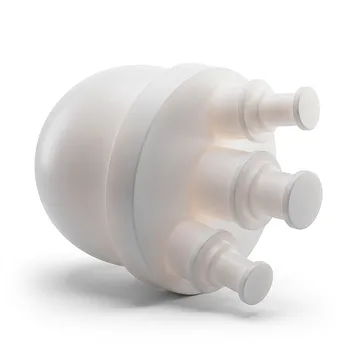
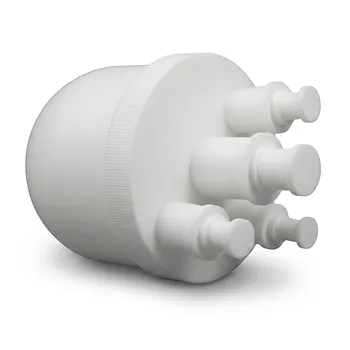
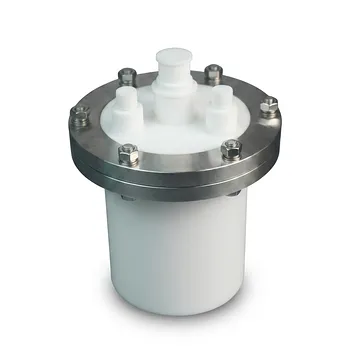
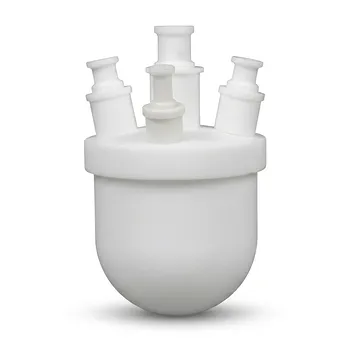
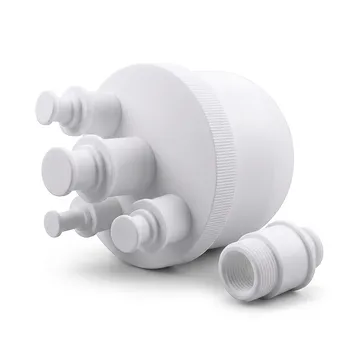
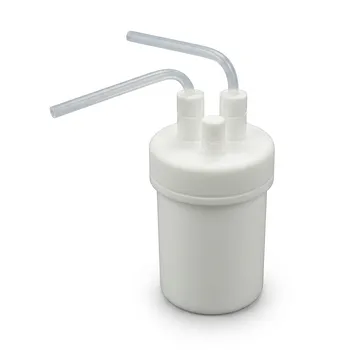
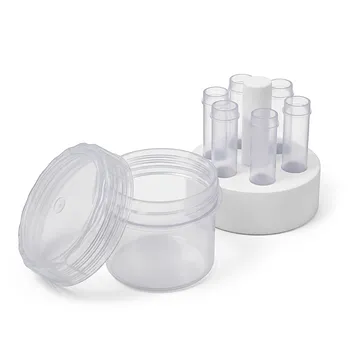
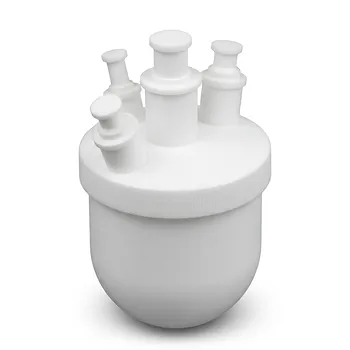
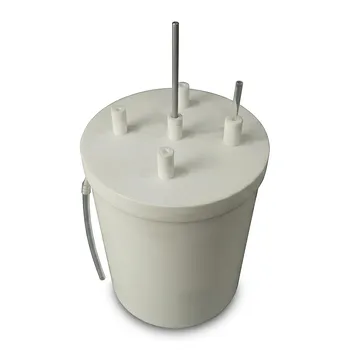
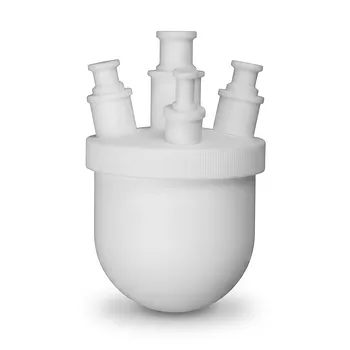
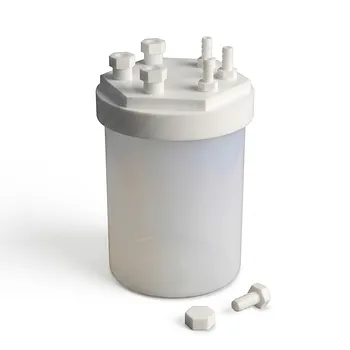
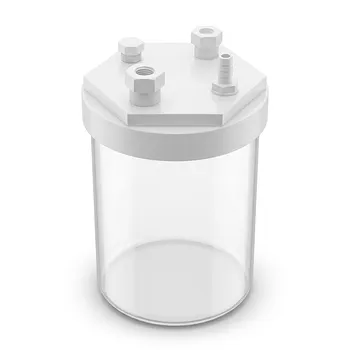
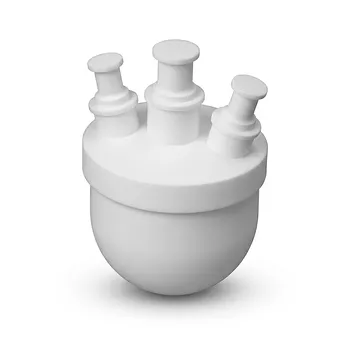
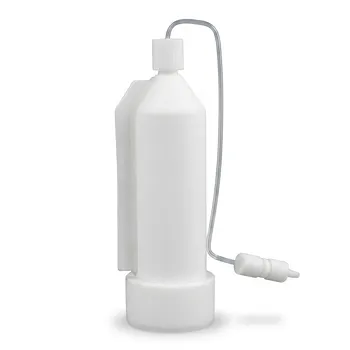
Fluoropolymer reaction vessels are the critical enabler for $SnO_2/rGO$ synthesis due to their unique combination of electromagnetic transparency and extreme chemical resilience. These vessels allow microwave energy to penetrate directly into the reaction mixture, facilitating the rapid, uniform nucleation of $SnO_2$ crystals at high temperatures, typically around 160°C. Simultaneously, they provide the necessary structural integrity to withstand high internal pressures and the corrosive nature of reducing agents like hydrazine hydrate during the one-pot process.
The essential nature of fluoropolymer vessels lies in their ability to facilitate "volumetric heating" while remaining chemically inert under high-pressure conditions. This synergy ensures that $SnO_2$ nanoparticles are loaded onto graphene oxide uniformly without the vessel interfering with the chemical reaction or failing under stress.
The Role of Microwave Transparency in Material Growth
Achieving Rapid Volumetric Heating
Unlike traditional glassware or metallic containers, fluoropolymers like PTFE and PFA are transparent to microwave radiation. This allows electromagnetic waves to pass through the vessel walls and heat the reaction solution directly.
This phenomenon, known as volumetric heating, ensures that the energy is distributed throughout the entire volume of the liquid simultaneously. This eliminates the temperature gradients common in conventional heating, where the liquid near the vessel wall is hotter than the center.
Ensuring Uniform $SnO_2$ Nucleation
The rapid, uniform heating provided by microwave-transparent vessels is vital for the formation of $SnO_2$ crystal nuclei. By reaching temperatures such as 160°C almost instantaneously, the system promotes simultaneous nucleation.
This consistency results in a narrower particle size distribution and precise control over the nanomorphology of the metal oxides. This is a primary reason why microwave-assisted methods are preferred over traditional hydrothermal synthesis for binary metal oxide composites.
Maintaining Integrity Under Extreme Reaction Conditions
Resistance to Chemical Aggression
The synthesis of $SnO_2/rGO$ often involves aggressive reducing agents like hydrazine hydrate or strong alkaline media. Fluoropolymers offer extreme chemical inertness, meaning they do not react with these reagents or degrade over time.
This inertness prevents the container walls from participating in side reactions. It also ensures that no plasticizers or impurities leach into the composite, maintaining the high purity required for electronic or energy storage applications.
Managing High Internal Pressure
One-pot synthesis typically occurs in a sealed environment to facilitate the simultaneous reduction of graphene and loading of nanoparticles. This process generates significant internal pressure as the temperature rises.
High-performance fluoropolymer liners are designed to maintain their structural integrity and sealing performance under these conditions. They prevent the leakage of hazardous vapors and ensure the reaction proceeds safely at stable pressures.
Enhancing Composite Purity and Yield
Preventing Side Reactions and Impurities
In precision chemical synthesis, the vessel must be a passive observer. Fluoropolymers ensure that the reaction chamber walls do not catalyze unwanted side reactions or introduce trace metal contaminants.
This is particularly important when detecting trace elements or ensuring the specific electrical properties of the $SnO_2/rGO$ composite. The anti-fouling properties of PFA and PTFE also prevent nanoparticles from sticking to the walls, which increases the overall yield.
Optimal Fluid Dynamics
The low friction coefficient of fluoropolymer surfaces facilitates smoother fluid flow during the stirring or mixing phases of the synthesis. This reduces pressure fluctuations within the system and ensures a more homogenous reaction environment.
Understanding the Trade-offs and Limitations
Temperature and Pressure Thresholds
While fluoropolymers are resilient, they have absolute thermal ceilings. For example, while some can withstand up to 280°C, exceeding these limits can lead to material deformation or the release of toxic fumes.
Thermal Expansion and Sealing
Fluoropolymers have different thermal expansion rates than the stainless steel jackets often used to reinforce them. If the heating profile is too aggressive, it can lead to sealing failures or "cold flow" where the plastic deforms permanently under pressure.
Microwave Absorption Limits
Fluoropolymers are transparent, but the solvents used (like water or ethylene glycol) are highly absorptive. If the reaction mixture absorbs energy too quickly, it can cause localized overheating if the vessel design does not allow for efficient pressure venting.
How to Apply This to Your Project
Making the Right Choice for Your Goal
- If your primary focus is Maximum Purity: Utilize high-grade PFA vessels, as they offer the highest level of chemical inertness and the lowest risk of trace element leaching.
- If your primary focus is High-Temperature Synthesis: Ensure your PTFE liners are housed in high-strength stainless steel autoclaves to manage the mechanical stress of temperatures exceeding 200°C.
- If your primary focus is Scalability and Yield: Select vessels with anti-fouling surfaces to minimize material loss on the container walls and facilitate easier cleaning between batches.
By leveraging the unique electromagnetic and chemical properties of fluoropolymers, researchers can safely achieve the precise thermal conditions necessary for high-performance composite synthesis.
Summary Table:
| Feature | Benefit for SnO2/rGO Synthesis | Material Example |
|---|---|---|
| Microwave Transparency | Enables rapid volumetric heating & uniform SnO2 nucleation | PTFE / PFA |
| Chemical Inertness | Resists aggressive reducing agents like hydrazine hydrate | PFA |
| Structural Integrity | Manages high internal pressures during one-pot synthesis | Reinforced PTFE |
| Anti-fouling Surface | Prevents nanoparticle sticking; increases composite yield | PFA / PTFE |
| High Purity | Prevents trace element leaching for electronic applications | High-grade PFA |
Elevate Your Material Synthesis with KINTEK’s Fluoropolymer Expertise
Precise control over $SnO_2/rGO$ composite morphology requires laboratory tools that never compromise on purity or performance. KINTEK specializes in high-performance fluoropolymer solutions tailored for the most demanding microwave and hydrothermal applications.
From everyday basic labware like beakers, crucibles, and reagent bottles to specialized microwave digestion vessels and hydrothermal synthesis liners, we provide the absolute resilience your research demands. Our comprehensive range includes:
- Fluid Transfer: High-purity tubing, fittings, and valves.
- Sample Prep: Separatory funnels, filters, pipettes, and tweezers.
- Custom Engineering: End-to-end custom CNC fabrication for complex non-standard machined parts and bespoke laboratory setups.
Whether you need high-volume consumables like stirring bars and O-rings or advanced reaction apparatus like electrochemical cells, KINTEK delivers precision-crafted PTFE and PFA products designed to withstand aggressive chemicals and high pressures.
Ready to optimize your synthesis workflow? Contact us today to discuss your standard or custom laboratory requirements!
References
- Zhenjie Tang. Research on a Review of Derivative Methods of Classical Hydrothermal/Solvothermal Synthesis Methods, Taking SnO₂/r-GO Gas-sensitive Composite Materials as Examples. DOI: 10.62051/ijepes.v4n2.06
This article is also based on technical information from Kintek Knowledge Base .
Related Products
- High Purity Custom PTFE Large Volume 15L Flask Corrosion Resistant Low Trace Background Fluoropolymer Reaction Vessel
- Laboratory PTFE Three Neck Reaction Flask Corrosion Resistant 2000ml Low Background Fluoropolymer Vessel
- Custom PTFE Reaction Kettle 2L Flanged Fluoropolymer Reactor Tank Acid and Alkali Resistant Polytetrafluoroethylene Vessel
- Custom PTFE Flask 250ml High Purity Fluoropolymer Laboratory Vessel for Chemical Research
- Large Capacity PTFE Reaction Flask 20L Custom Multi Neck Laboratory Boiling Flask Fluoropolymer Chemical Processing Vessel
People Also Ask
- Why are high-purity PTFE or PFA reaction vessels recommended for the synthesis of PANI-TiC hybrid materials? - Guide
- How do perfluorinated solvent environments influence the selection of reaction vessels and fluid handling components in nonaqueous emulsion polymerizations? Choose fluoropolymer materials.
- What reaction vessel and fluid handling considerations are necessary for living cationic polymerization of fluorinated monomers involving Lewis acid catalysts? Key design and safety tips
- Ion Activation Reaction Vessel Requirements: Why PTFE is Critical for Membrane Performance
- Why are fluoroplastic (PTFE) reaction vessels recommended for Methylene Blue (MB) adsorption kinetic experiments?