The C–F bond is the molecular foundation of fluoropolymer durability. Its very high dissociation energy—approximately 490 kJ/mol (116 kcal/mol)—makes carbon–fluorine bonds difficult to break through heat, chemical attack, or oxidation. In fluoropolymers, this strength is reinforced by fluorine atoms shielding the carbon backbone, enabling materials such as PTFE and PFA to resist aggressive chemicals and retain structural integrity at elevated temperatures.
Core takeaway: C–F bond strength raises the energy required for molecular degradation, while dense fluorine shielding limits access to the polymer backbone. Together, these features explain fluoropolymers’ exceptional chemical resistance and thermal stability, although actual service limits depend on the specific polymer, temperature, stress, and exposure conditions.
Why the C–F Bond Is So Effective
High bond dissociation energy
A C–F bond requires substantially more energy to break than many common organic bonds. Its dissociation energy is approximately 490 kJ/mol, compared with roughly 414 kJ/mol for C–H and 351 kJ/mol for C–O bonds.
This high energy barrier makes thermally or chemically initiated chain scission less likely. The polymer therefore remains intact under conditions that would degrade many hydrocarbon-based materials.
Short, compact bonding structure
The C–F bond is also unusually short, typically around 1.3–1.4 Å. Fluorine’s small atomic size and high electronegativity produce a compact, strongly bound molecular arrangement.
This compact structure contributes to the rigidity of fluorinated segments and makes it more difficult for reactive species to disrupt the polymer chain.
Low polarizability and strong electron retention
Fluorine holds its nonbonding electrons tightly and is relatively difficult to polarize. As a result, fluorinated groups are less susceptible to interactions that promote chemical reactions, oxidation, or solvent-driven swelling.
This does not mean that fluoropolymers are chemically unreactive under every possible condition. It means that many common attack mechanisms are energetically unfavorable.
How the Bond Produces Chemical Resistance
Fluorine shields the polymer backbone
In polymers such as PTFE, fluorine atoms densely surround the carbon backbone. This creates a protective sheath that limits direct access by acids, solvents, oxidants, and other reactive molecules.
The C–F bond therefore contributes in two ways: it is difficult to break itself, and it helps position fluorine atoms as a barrier around more vulnerable parts of the chain.
Reduced solvent interaction and swelling
Perfluorinated structures generally have low surface energy and weak attractive interactions with many liquids. This produces non-wetting and non-stick behavior while reducing liquid absorption and solvent-induced swelling.
That characteristic is important in tubing, vessels, fittings, and high-purity containers because dimensional stability and low absorption help prevent both material damage and sample contamination.
Resistance to aggressive reagents
The combination of strong bonding and backbone shielding allows high-performance fluoropolymers to withstand many strong acids, organic solvents, and oxidative environments with minimal degradation.
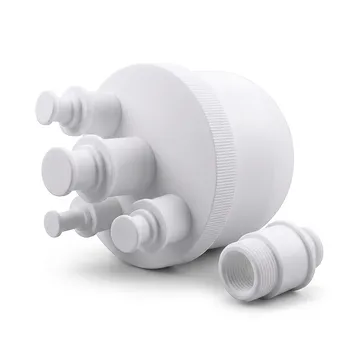
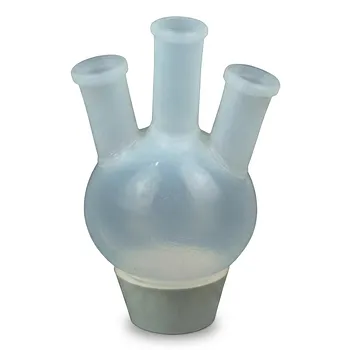
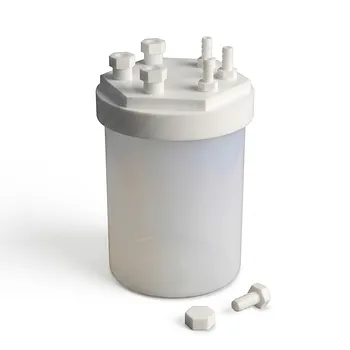
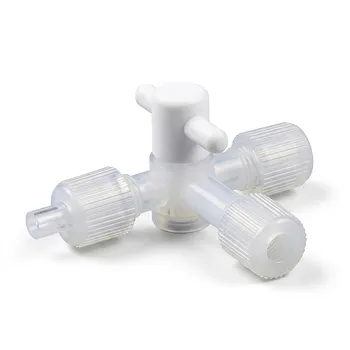
This is why PTFE, PFA, and related materials are widely used in reaction vessels, digestion equipment, fluid-transfer systems, and trace-analysis labware.
How the Bond Produces Thermal Stability
More energy is required for degradation
Thermal degradation commonly begins when polymer bonds undergo scission, rearrangement, or reaction with oxygen and other species. Strong C–F bonds raise the energy required for these processes.
Fluorinated polymers can therefore remain stable at temperatures where polymers containing weaker or more chemically accessible bonds would soften, oxidize, or decompose.
The polymer architecture matters
C–F bond strength is essential, but it is not the only factor controlling thermal performance. Strong carbon–carbon bonds, fluorine shielding, chain structure, crystallinity, molecular weight, and the presence of defects all influence the degradation pathway.
Bulky groups such as trifluoromethyl or perfluoroalkyl groups can further protect reactive sites and retard thermal attack.
Decomposition temperature is not operating temperature
Some fluoropolymer architectures have thermal decomposition onset temperatures approaching or exceeding 500–550 °C under particular test conditions. That value should not be interpreted as a universal continuous-use temperature.
Actual service limits are normally lower and depend on the grade, mechanical load, exposure time, atmosphere, and application design. For many laboratory components, continuous operating temperatures are commonly specified around 260 °C, even though measurable decomposition occurs at substantially higher temperatures.
Why Fluorine Content and Structure Matter
Perfluoropolymers maximize resistance
Fully fluorinated polymers generally provide the highest combination of chemical inertness, solvent resistance, thermal stability, flame resistance, and low friction.
They are preferred when maximum resistance is more important than ease of processing, solubility, or mechanical flexibility.
Partially fluorinated polymers balance properties
Partially fluorinated materials can retain much of fluorine’s chemical protection while offering improved mechanical strength, rigidity, processability, or adhesion.
The trade-off is that exposed nonfluorinated segments may provide more sites for chemical interaction than a fully fluorinated structure.
Molecular symmetry affects polarity
Individual C–F bonds are strongly polar, but in highly fluorinated and symmetrical structures, local dipoles can partially cancel. The resulting material can have low overall polarizability and strong hydrophobicity.
Semifluorinated polymers may retain some local polarity, so their surface and solvent behavior depends on the exact architecture rather than fluorine content alone.
Understanding the Trade-offs
High thermal stability does not eliminate all temperature limits
Fluoropolymers may resist chemical decomposition at high temperatures but still experience softening, creep, loss of stiffness, or dimensional change before chemical breakdown begins.
Designers must therefore distinguish chemical stability, mechanical temperature rating, and decomposition onset.
Chemical resistance is not universal
Fluoropolymers resist a very broad range of laboratory chemicals, but extreme conditions can still cause damage. Molten alkali metals, certain highly reactive fluorinating systems, plasma environments, and unusual high-temperature combinations may attack or degrade them.
Compatibility should be evaluated against the specific chemical, concentration, temperature, pressure, and exposure duration.
More fluorination can reduce mechanical practicality
Increasing fluorine content generally improves chemical and thermal resistance but can reduce mechanical strength, increase processing difficulty, and decrease solubility.
The best material is therefore not always the most highly fluorinated one. The correct choice balances chemical exposure against load-bearing and manufacturing requirements.
Contamination control still requires good design
Fluoropolymers are well suited to high-purity applications because they resist leaching and chemical interaction. However, contamination can still arise from manufacturing residues, additives, surface damage, seals, fittings, or improper cleaning.
Material selection should therefore include the complete fluid-contact system, not just the primary polymer.
How to Apply This to Your Project
The C–F bond provides the molecular basis, but the polymer grade and operating conditions determine practical performance.
- If your primary focus is chemical resistance: Choose a highly fluorinated architecture such as PTFE or PFA and verify compatibility with the specific reagents, concentrations, and temperatures involved.
- If your primary focus is high-temperature operation: Use the manufacturer’s continuous-use and mechanical-temperature ratings rather than relying only on decomposition onset data.
- If your primary focus is trace analysis or purity: Select a fluoropolymer with controlled manufacturing and low extractables, and evaluate every wetted component for possible contamination.
- If your primary focus is mechanical strength: Consider a partially fluorinated or reinforced material if its chemical resistance remains adequate for the application.
- If your primary focus is fluid handling: Use fluoropolymers to reduce swelling, wetting, adsorption, and chemical interaction, while checking pressure, creep, and dimensional stability limits.
Strong C–F bonds make fluoropolymers exceptionally resistant, but reliable performance comes from matching the molecular advantages to the real operating environment.
Summary Table:
| Factor | Impact | Example |
|---|---|---|
| High bond dissociation energy | Requires more energy to break, preventing degradation | C-F ~490 kJ/mol vs C-H ~414 kJ/mol |
| Fluorine shielding | Protects backbone from chemical attack | PTFE's dense fluorine sheath |
| Reduced solvent interaction | Minimizes swelling and absorption | Non-wetting, non-stick behavior |
| Thermal stability | Withstands high temperatures | Continuous use up to 260°C for PTFE |
Maximize the durability of your lab equipment with KINTEK's high-performance PTFE and PFA products. From beakers to custom CNC machined parts, our fluoropolymer components are designed to withstand harsh chemicals and high temperatures. Contact us today to find the perfect solution for your application – Get in touch with our experts!
Related Products
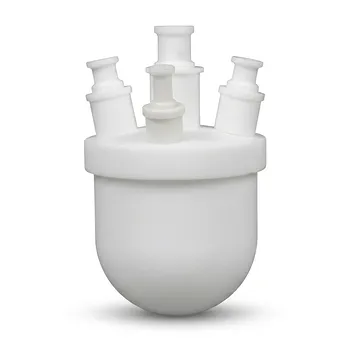
- Custom PTFE Flask 250ml High Purity Fluoropolymer Laboratory Vessel for Chemical Research
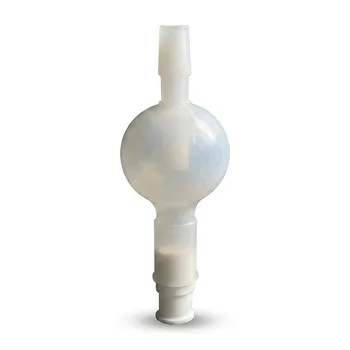
- High Purity PFA Chromatography Column with Collection Bottle Corrosion Resistant Fluoropolymer Filtration System for Trace Analysis
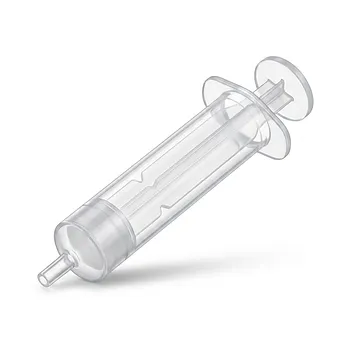
- Corrosion Resistant PFA Syringe Translucent Visual Fluoropolymer Labware 10ml Chemical Handling Tool
- Custom PTFE Reaction Tank Corrosion Resistant Fluoropolymer Chemical Processing Barrel 10L 20L 30L
- Custom PFA Tubing 1/4 Inch High Purity Corrosion Resistant Fluoropolymer Tube with Welding and Machining Services
People Also Ask
- What are the key steps for structural integrity in molded PTFE lab reaction vessels? Master fine powder processing.
- When synthesizing TFVE monomers involving reactive organometallic reagents and aggressive polar solvents, what material performance characteristics are required? Ensure purity with PTFE/PFA.
- Why Are High-Purity Fluoropolymer Vessels and Tubing Critical for Trace Analysis? Prevent Contamination Reliably
- Why do PTFE fluoropolymer laboratory vessels and containers exhibit superior chemical resistance against harsh solvents and corrosive acids compared to standard plastic labware? Discover the molecular secrets
- How do choice of solvent and chain transfer activity affect molecular weight during vinylidene fluoride (VDF) radical polymerization? Learn Key Factors for High-MW PVDF