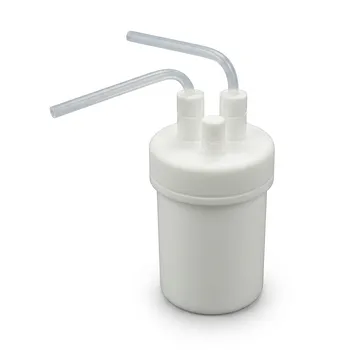
High-pressure reaction vessels directly improve lithium-mediated nitrogen reduction (Li-NRR) by overcoming the poor solubility of nitrogen in organic electrolytes. By increasing the partial pressure of nitrogen (often up to 15 bar or higher), these vessels ensure a higher concentration of reactant at the electrode interface, accelerating the formation of the key intermediate, lithium nitride ($Li_3N$), and boosting both Faradaic efficiency and ammonia yield.
The core advantage of high-pressure vessels is their ability to shift the reaction kinetics in favor of nitrogen fixation by ensuring that gas supply is not the rate-limiting step. This environment stabilizes the desired chemical pathway, making the synthesis of ammonia more efficient and productive compared to ambient pressure conditions.
Enhancing Mass Transport and Reactant Availability
Overcoming the Solubility Barrier
Nitrogen is naturally poorly soluble in the organic solvents typically used in Li-NRR systems. High-pressure reactors leverage physical principles to force a higher concentration of $N_2$ molecules into the liquid electrolyte, significantly increasing the "chemical push" toward the electrode.
Saturating the Electrode Interface
At ambient pressure, the area immediately surrounding the electrode often becomes depleted of nitrogen during the reaction. High-pressure vessels minimize this concentration polarization, maintaining a steady flux of nitrogen molecules to the catalyst surface even at high current densities.
Accelerating the Formation of Critical Intermediates
Promoting Lithium Nitride ($Li_3N$) Synthesis
The lithium-mediated pathway relies on the reaction of metallic lithium with nitrogen to form lithium nitride ($Li_3N$). Increased nitrogen partial pressure directly promotes this step, which is the essential precursor that eventually reacts with a proton source to produce ammonia.
Improving Faradaic Efficiency
By making nitrogen more available, the vessel ensures that the active lithium species are consumed by the desired nitrogen reduction reaction. This effectively suppresses side reactions, such as the decomposition of the electrolyte or the unnecessary buildup of solid-electrolyte interphase (SEI) components, leading to higher efficiency.
Understanding the Trade-offs and Constraints
Mechanical and Safety Requirements
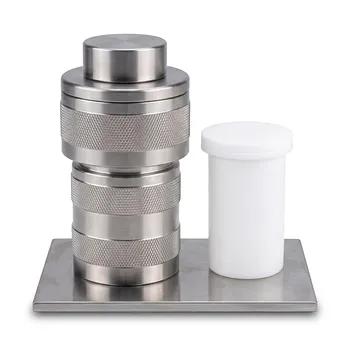
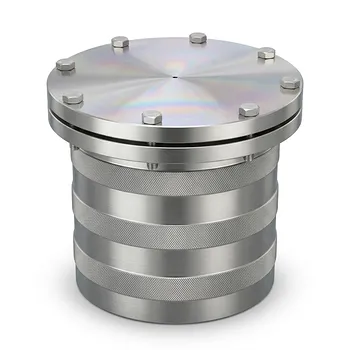
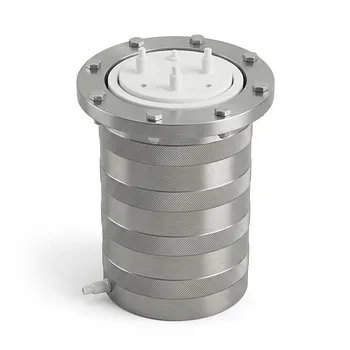
Operating at pressures such as 15 bar requires specialized stainless steel reactors and robust sealing mechanisms to prevent hazardous leaks. This adds significant cost and complexity to the experimental setup compared to standard glassware or low-pressure cells.
System Complexity and Monitoring
High-pressure environments make real-time monitoring of the reaction more difficult. Traditional analytical ports may require specialized high-pressure fittings, and ensuring consistent gas-liquid mixing under pressure demands more sophisticated stirring or flow-control hardware.
How to Apply Pressure Control to Your Project
Making the Right Choice for Your Goal
Depending on your specific research or production objectives, the use of a high-pressure vessel should be tailored to address the following priorities:
- If your primary focus is maximizing ammonia yield: Utilize high-pressure stainless steel reactors (10–15 bar) to push the system beyond the mass-transport limits inherent in nitrogen gas.
- If your primary focus is fundamental mechanistic study: Use variable pressure settings to map the relationship between $N_2$ concentration and $Li_3N$ formation rates, identifying the exact point where the reaction transitions from diffusion-controlled to kinetically controlled.
- If your primary focus is industrial scalability: Perform a cost-benefit analysis to determine if the energy required for gas compression is justified by the resulting gains in Faradaic efficiency and production rate.
High-pressure vessels transform Li-NRR from a diffusion-limited process into a high-performance chemical synthesis route, providing the necessary environment to unlock the full potential of nitrogen fixation.
Summary Table:
| Parameter | Impact of High Pressure | Key Benefit |
|---|---|---|
| Nitrogen Solubility | Increases $N_2$ concentration in organic electrolytes | Overcomes mass-transport barriers |
| Reaction Kinetics | Accelerates formation of Lithium Nitride ($Li_3N$) | Faster ammonia synthesis rates |
| Faradaic Efficiency | Suppresses electrolyte decomposition/SEI side reactions | Higher electrical energy utilization |
| System Stability | Maintains steady $N_2$ flux at high current densities | Consistent performance at scale |
Elevate Your Electrochemical Research with KINTEK Precision
To achieve peak performance in lithium-mediated nitrogen reduction, your setup requires materials that withstand demanding chemical environments. KINTEK specializes in high-performance fluoropolymer solutions and custom-engineered laboratory equipment designed for precision and durability.
From everyday basic labware like beakers, crucibles, and reagent bottles to advanced electrochemical cells, battery testing fixtures, and microwave digestion vessels, we manufacture a comprehensive range of supplies crafted from premium PTFE and PFA. Whether you need standard tubing, fittings, and filters or bespoke non-standard machined parts via our end-to-end custom CNC fabrication, KINTEK is your absolute partner for high-performance fluoropolymer materials.
Ready to optimize your lab's efficiency with custom-tailored solutions?
Contact us today to discuss your project requirements!
References
- Ngoc‐Trung Nguyen, Alexandr N. Simonov. Nitrogen electroreduction to ammonia with phosphonium proton shuttles: Mass-transport vs. electrode surface chemistry effects. DOI: 10.1016/j.chempr.2024.07.029
This article is also based on technical information from Kintek Knowledge Base .
Related Products
- PTFE Lined High Pressure Digestion Vessel 50ml High Temperature Hydrothermal Synthesis Tank
- Custom TFM Reaction Vessel with Stainless Steel Jacket and PTFE Inner Cup for High Corrosion Resistance
- High Pressure Custom TFM Reactor Stainless Steel Outer Vessel PTFE Inner Cup for Corrosive Synthesis
- High Purity PFA Constant Pressure Condensation Reaction System Acid Resistant High Temperature Customizable Teflon Labware
- Custom High Purity TFM Microwave Digestion Vessel 100ml for Analytical Laboratory Sample Preparation
People Also Ask
- What are the benefits of using a PTFE-lined vessel for carbon-sulfur cathode treatment? Maximize Purity & Performance
- Why are PTFE-lined pressure digestion vessels required for the preparation of Ag/CeO2 catalysts? Purity & Performance
- What safety features are typically incorporated into high-pressure PTFE digestion vessel designs? Ensure Lab Safety
- What is the function of PTFE lined high-pressure vessels in g-C3N4 synthesis? Achieve High-Purity Material Growth
- Role of High-Pressure Digestion Tanks in Perovskite Synthesis: Achieve Superior Stability and Latent Heat