Structural design and polymerization conditions determine how a fluoropolymer behaves in service. Chain architecture, fluorine content, comonomer selection, molecular weight, and crystallinity influence melting temperature, strength, chemical resistance, permeability, friction, and processability. Polymerization pressure and initiator concentration further affect molecular weight and melt viscosity, while surface and chain-end functionalization can address fluoropolymers' inherently low surface energy and limited adhesion.
The most useful fluoropolymer is not necessarily the most highly fluorinated or crystalline one. Performance depends on matching molecular architecture and processing conditions to the required balance of chemical durability, flexibility, transparency, permeability, mechanical strength, and manufacturability.
How Chain Architecture Controls Physical Behavior
Polymerization Sequence Affects Crystallinity
Fluoropolymer chains with a high proportion of regular head-to-tail linkages generally pack more efficiently than chains containing head-to-head or tail-to-tail units. This packing difference influences crystallinity, melting behavior, dimensional stability, and resistance to chemical permeation.
More ordered structures typically produce higher crystallinity and stronger resistance to aggressive chemicals. Less regular architectures disrupt packing, producing more amorphous material with different flexibility and processing characteristics.
Fluorine Content Changes Multiple Properties
Increasing fluorine content generally improves chemical resistance, thermal stability, flame resistance, weathering resistance, and electrical resistivity. It also lowers surface energy, friction coefficient, dielectric constant, and dissipation factor.
This combination explains the utility of highly fluorinated materials such as PTFE and PFA in tubing, labware, seals, and components exposed to acids, solvents, and elevated temperatures. Their low surface energy also provides non-stick behavior, although it makes bonding, coating, and printing more difficult.
Comonomers Interrupt Regular Packing
Bulky comonomers such as hexafluoropropylene can interrupt the regular packing of a fluoropolymer backbone. In systems based on materials such as PVDF or PTFE, this can suppress or eliminate crystalline domains and create a more amorphous copolymer.
The resulting material generally has a lower melting temperature, weaker polymer-polymer cohesive interactions, and improved compatibility with fluids. These changes can enable processing or dissolution at lower temperatures and pressures than would be practical for a highly crystalline homopolymer.
Molecular Weight Governs Melt and Mechanical Performance
Molecular weight is strongly connected to melt viscosity and mechanical durability. In aqueous FEP polymerization, for example, lower initiator concentration and higher polymerization pressure can increase resin molecular weight.
Higher-molecular-weight FEP has higher melt viscosity and substantially better flex endurance. Reported MIT flex life can increase from approximately 1,800 cycles to more than 30,000 cycles, depending on the formulation and process conditions.
How Crystallinity Shapes Component Performance
Crystalline Regions Improve Chemical Durability
Crystallinity restricts chain motion and reduces the pathways available for chemical penetration. Highly crystalline fluoropolymers therefore tend to show lower permeation, reduced swelling, and greater resistance to concentrated acids and organic solvents than highly amorphous forms.
This distinction matters in chemical storage, sample digestion, high-purity fluid transfer, and laboratory apparatus. A component selected only for ease of processing may not provide adequate long-term resistance in aggressive service.
Amorphous Regions Improve Processability
Amorphous fluoropolymer structures usually offer greater chain mobility and easier melt processing. They can also improve fluid compatibility and, depending on the material, support transparency or flexibility.
The trade-off is that excessive amorphous content can reduce chemical resistance and increase permeation or swelling. Component design must therefore balance processing convenience against exposure conditions.
Drawing Can Refine the Internal Morphology
High-temperature drawing changes the lamellar structure of a semicrystalline fluoropolymer. It can reduce the inter-lamellar long period while increasing lamellar thickness and densifying the remaining amorphous regions.
A denser amorphous matrix scatters less light, which can significantly improve optical transparency. Combined with surface-functionalized nanofillers that promote heterogeneous nucleation, drawing can produce transparent components with refined crystalline morphology, mechanical strength, chemical inertness, and thermal stability.
How Polymerization Conditions Influence Utility
Initiator Concentration Affects Molecular Weight
The initiator determines how readily polymer chains begin to grow and can influence the resulting molecular-weight distribution. In the cited FEP system, reducing initiator concentration favors higher molecular weight.
The practical effects include higher melt viscosity and improved resistance to repeated flexing. However, a resin that is mechanically robust in service may require more demanding processing conditions.
Pressure Influences Chain Growth
Increasing polymerization pressure can also raise molecular weight in aqueous FEP polymerization. This creates a direct connection between reactor conditions and the performance of the finished component.
The effect is important for applications where the polymer must survive repeated bending, pressure cycling, or mechanical handling. High molecular weight can also affect extrusion behavior, molding windows, and the ability to produce complex geometries.
Copolymerization Enables Tough, Stable Membranes
Perfluorinated vinyl ether monomers generally have low homopolymerization rates. Copolymerizing them with tetrafluoroethylene allows the formation of high-molecular-weight materials with a dense fluorocarbon backbone.
These polymers can combine mechanical toughness, structural integrity, chemical inertness, and ion-exchange functionality. That balance is useful in membranes and custom reaction components exposed to high temperatures, aggressive solvents, and mechanical stress.
Electrical Performance Depends on Resin Quality
Properly polymerized FEP provides strong electrical insulation, with dielectric breakdown strengths reported between approximately 40 and 60 kV/mm. This makes synthesis-property control relevant to compact electrical insulation and high-power energy-storage components.
Electrical performance should be evaluated alongside thickness, defects, processing history, and service environment. Resin chemistry alone does not determine the final breakdown strength of a manufactured part.
How Surface and Chain-End Modification Expand Applications
Functionalization Addresses Low Surface Energy
Low surface energy supports non-stick and low-friction behavior, but it also limits adhesion and surface compatibility. Functionalizing chain ends or modifying the surface can introduce sites for bonding, coating, printing, or interaction with other materials.
This approach preserves much of the fluoropolymer's bulk chemical and thermal performance while improving the properties needed at interfaces. It is particularly valuable in assemblies where fluoropolymer components must join metals, adhesives, membranes, or other polymers.
Nanofillers Can Control Optical Morphology
Surface-functionalized nanofillers provide nucleation sites for epitaxial crystal growth. This can increase crystallization temperature and degree of crystallinity while reducing spherulitic grain size.
When followed by controlled high-temperature drawing, the resulting morphology can improve clarity without sacrificing the chemical inertness and thermal stability expected from fluoropolymer labware. The modification is therefore a way to tune both appearance and structural performance.
Fluorine-Driven Free Volume Supports Transport
Fluorination increases the fraction of free volume in a polymer structure. Greater free volume can enhance gas permeability while maintaining structural stability and broad chemical resistance.
This balance is useful in tubing, membranes, labware, and custom components requiring consistent gas or fluid transport. The correct permeability level remains application-specific, since low permeation is desirable for chemical containment while higher permeability may be useful in controlled transport applications.
Understanding the Trade-offs
Maximum Fluorination Is Not Always Optimal
Higher fluorination improves chemical inertness, thermal stability, and non-stick performance, but it can slightly reduce mechanical properties such as cut-through resistance. This matters in load-bearing or wear-intensive laboratory apparatus.
Material selection should consider contact stresses, abrasion, cutting hazards, and deformation, not only chemical exposure and temperature.
High Crystallinity Can Reduce Processing Flexibility
Highly crystalline fluoropolymers usually provide strong chemical resistance and dimensional stability. They can also require higher processing temperatures, greater forming pressures, or more specialized manufacturing methods.
Amorphous or partially amorphous copolymers may be easier to process and more compatible with fluids, but they can have higher permeation, swelling, or chemical attack under severe conditions.
Higher Molecular Weight Raises Processing Demands
High molecular weight improves melt strength and flex endurance, but it also increases melt viscosity. This can narrow the processing window and make extrusion, molding, or fine-feature fabrication more difficult.
The best resin is therefore the one that provides sufficient mechanical life without creating unnecessary manufacturing complexity.
Optical Clarity Requires Controlled Processing
Nanofiller modification and drawing can improve transparency, but filler dispersion, nucleation behavior, and thermal history must be controlled. Poor morphology control can introduce defects or scattering rather than clarity.
Transparent components should be evaluated for both optical performance and retention of mechanical and chemical properties after fabrication.
Choosing the Right Structure for the Application
Fluoropolymer selection should begin with the dominant service requirement and then account for processing and secondary properties.
- If your primary focus is chemical containment: Choose a highly crystalline, highly fluorinated structure where possible, because lower permeation, reduced swelling, and strong resistance to acids and solvents are the governing requirements.
- If your primary focus is repeated flexing: Favor a high-molecular-weight resin and polymerization formulation that provides high melt viscosity and strong flex endurance.
- If your primary focus is easy processing: Consider a copolymer with disrupted crystallinity, provided its chemical resistance and permeation behavior remain adequate for the service environment.
- If your primary focus is optical clarity: Combine controlled nucleation with high-temperature drawing to refine crystalline morphology and densify amorphous regions.
- If your primary focus is bonding or coating: Use chain-end functionalization or surface treatment to compensate for low surface energy.
- If your primary focus is electrical insulation: Select a properly polymerized resin with appropriate dielectric strength, while controlling part thickness, defects, and manufacturing quality.
- If your primary focus is controlled gas or fluid transport: Use fluorinated structures with suitable free volume and verify that permeability remains compatible with containment and durability requirements.
The right fluoropolymer component is created by designing its molecular structure and processing history around the demands of its final environment.
Summary Table:
| Factor | Effect on Physical Behavior | Effect on Utility |
|---|---|---|
| Chain regularity (head-to-tail) | Higher crystallinity, stronger packing | Improved chemical resistance, dimensional stability |
| Fluorine content | Lower surface energy, higher thermal stability | Enhanced chemical inertness, non-stick, electrical insulation |
| Comonomers (e.g., HFP) | Disrupt crystallinity, lower melting point | Easier processing, better fluid compatibility |
| Molecular weight | Higher melt viscosity, better flex endurance | Improved mechanical durability, but harder processing |
| Polymerization pressure & initiator | Influence molecular weight | Tune mechanical strength and processability |
| Crystallinity | Crystalline: low permeation; Amorphous: easy processing | Balance chemical resistance vs. manufacturability |
| Drawing & nanofillers | Refine morphology, improve transparency | Optical clarity without losing chemical/temperature resistance |
| Surface functionalization | Adds adhesion sites | Enables bonding, coating, printing |
| Free volume | Higher gas permeability | Useful for controlled transport applications |
Optimize Your Fluoropolymer Components for Maximum Performance
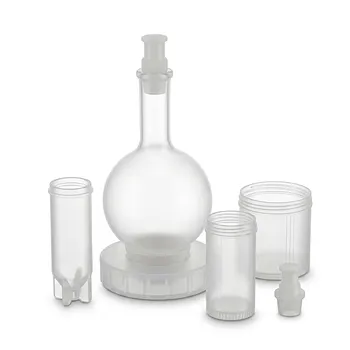
At KINTEK, we specialize in high-performance PTFE and PFA labware and custom components. Our expertise in polymer science and precision machining ensures you get the right material structure and processing for your application—whether you need extreme chemical resistance, flex endurance, optical clarity, or easy bonding.
From standard beakers and tubing to custom electrochemical cells and microwave digestion vessels, we deliver solutions tailored to your exact requirements. Contact us today to discuss your project and discover how our advanced fluoropolymer components can enhance your lab's efficiency and reliability. Get in touch now!
Related Products
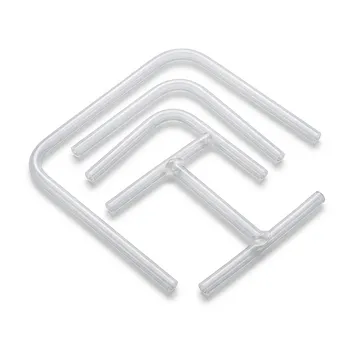
- Corrosion Resistant High Purity PFA Valve and Weldable Transparent Tubing for Semiconductor Fluid Transfer
- Custom PTFE Insulating Gaskets and Corrosion Resistant Fluoropolymer Seals for Industrial Electrical Applications
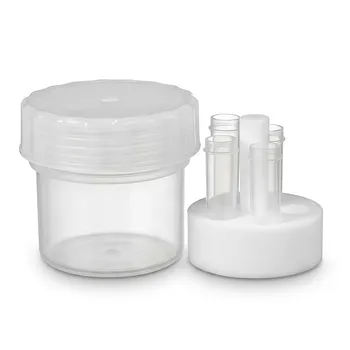
- High Purity PFA Chromatography Columns and Collection Bottles Corrosion Resistant Fluoropolymer Filtration Systems for Trace Analysis
- High Purity PFA Chromatography Column with Collection Bottle Corrosion Resistant Fluoropolymer Filtration System for Trace Analysis
- High Purity PTFE Dispersion Disk for Food and Cosmetic Processing Non Stick Corrosion Resistant Large Stirring Paddle Customizable Fluoropolymer Impeller
People Also Ask
- How do high-precision PFA fluid transfer components, such as tubing and fittings, affect the results of continuous-flow synthesis?
- How do PFA fluid transfer components contribute to chemical research precision? Achieve high-purity results today.
- What role do PFA tubing and valves play in high-precision laboratory fluid transfer systems? Ensure Ultra-Pure Results
- Which material characteristics of fluoropolymers are most critical for high-purity fluid transfer and labware? Key factors: chemical inertness, low extractables, thermal stability.
- Why are PTFE or PFA fluid transfer components used for DSSC electrolytes? Ensure High Purity & Corrosion Resistance.