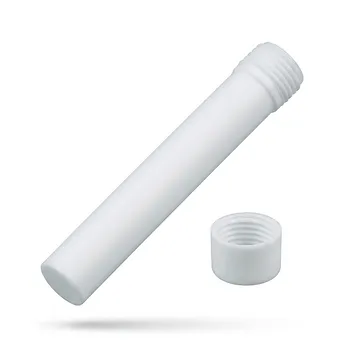
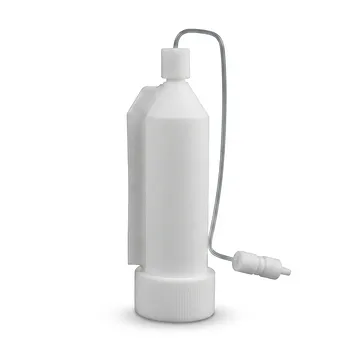
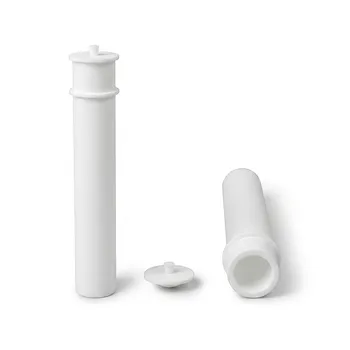
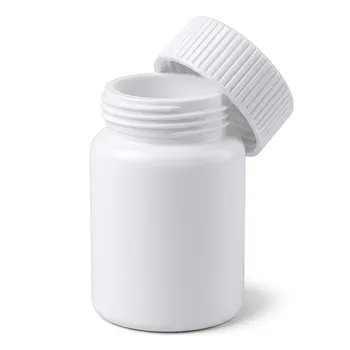
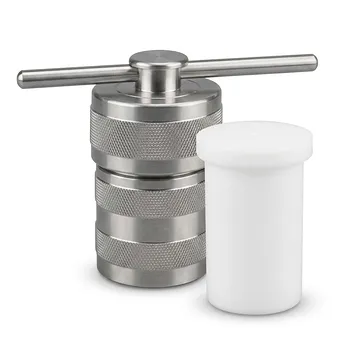
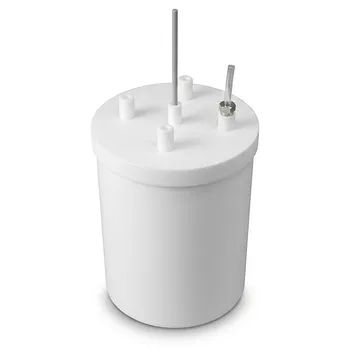
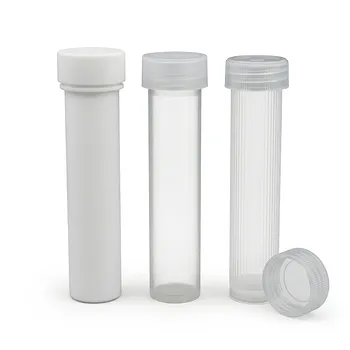
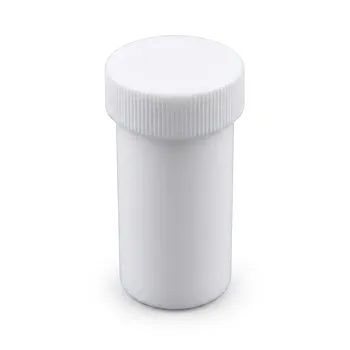
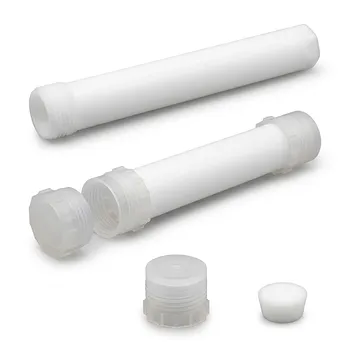
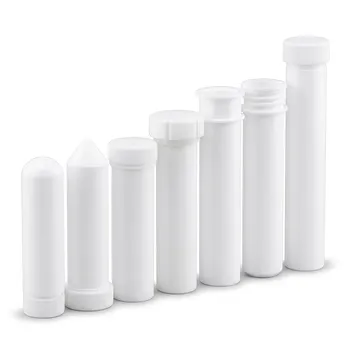
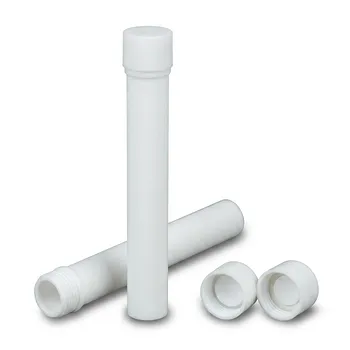
Density and processing conditions are major determinants of PTFE permeability. Denser, more crystalline PTFE with minimal internal voids presents fewer pathways for gas and vapor diffusion, so it generally provides lower permeability. In laboratory digestion vessels and reagent containers, careful particle consolidation, sintering, and coalescence are therefore essential—especially because elevated temperature can substantially accelerate transport through the vessel wall.
The key principle is simple: high density and low microporosity reduce gas and vapor transmission, while temperature increases it. Material grade, wall thickness, and processing quality must be evaluated together for reliable containment.
How Density Controls Gas and Vapor Transport
Higher density reduces diffusion pathways
Gas and vapor permeation through PTFE occurs primarily by molecular diffusion. Internal voids, poorly consolidated particle boundaries, and microporous regions create additional routes through which small molecules can migrate.
Increasing the bulk density reduces this internal free volume. PTFE processed toward the approximately 2.16–2.195 g/cm³ range generally has lower void content and therefore lower permeability than less densely consolidated material.
Crystallinity also limits molecular movement
PTFE is a semi-crystalline polymer. Its crystalline regions are more tightly ordered than its amorphous regions and restrict molecular mobility.
A higher degree of crystallinity can therefore reduce the rate at which gases, vapors, and small solvent molecules move through the polymer matrix. Density and crystallinity are related but not identical; both should be considered when comparing materials.
Low porosity protects sample integrity
Microporosity can allow aggressive vapors to penetrate into the wall, where they may later desorb or contaminate another sample. This is particularly important in trace analysis, where even small amounts of retained material can affect blank levels.
In digestion vessels, low porosity also helps prevent sample loss during extended heating and pressure cycles.
How Processing Creates or Removes Permeation Pathways
PTFE does not freely flow like a conventional thermoplastic
PTFE has exceptionally high molecular weight and very high melt creep viscosity. Although it passes through a melting transition, it does not readily flow and homogenize in the same way as many standard thermoplastics.
As a result, molded PTFE components can retain microscopic voids or particle boundaries if forming and thermal treatment are not tightly controlled.
Sintering promotes consolidation
During sintering, adjacent PTFE particles soften and consolidate. Proper thermal processing allows particle interfaces to disappear and reduces the internal void volume.
Insufficient or poorly controlled sintering can leave discontinuities that increase permeation and may also reduce mechanical reliability.
Coalescence creates a more continuous barrier
Coalescence is the consolidation of adjacent fluoropolymer particles under the influence of surface tension after melting. Complete coalescence eliminates internal particle boundaries and produces a more continuous, high-density matrix.
For laboratory vessels, this improves more than barrier performance. It also supports chemical resistance, stress-crack resistance, pressure reliability, and resistance to sample entrapment within the wall.
Processing consistency matters across the entire component
A vessel may have acceptable nominal density while still containing local regions of higher porosity. Variations in molding pressure, thermal history, cooling, geometry, or wall thickness can produce nonuniform microstructure.
Barrier performance should therefore be treated as a component-quality issue, not only as a resin-property issue.
Why Temperature Is Critical During Digestion
Permeability rises as molecular mobility increases
Temperature has a strong effect on PTFE gas and vapor transmission. Heating gives molecules more energy and increases their mobility within the polymer.
For gases such as oxygen, carbon dioxide, and nitrogen, permeability can increase by more than fourfold between approximately 20°C and 80°C. Water vapor transmission can increase even more sharply at elevated temperatures.
Digestion conditions can expose the weakest barrier performance
Microwave and other heated digestion processes combine elevated temperature with volatile reagents and pressure. Even if room-temperature permeability is very low, transport can become more significant during the hot portion of the cycle.
The relevant question is therefore not simply whether PTFE is chemically resistant. It is whether the specific PTFE grade, wall thickness, and processing quality provide adequate containment at the actual operating temperature and duration.
Pressure gradient affects flux differently
At a fixed temperature, the normalized permeability coefficient is generally much less sensitive to pressure gradient than to temperature. Increasing the pressure difference typically increases the total driving force and therefore the gas flux, while the intrinsic coefficient remains comparatively stable.
This distinction matters in design: temperature changes the material’s permeability substantially, while pressure primarily scales the amount transported across an already-defined barrier.
What This Means for Laboratory Containers
Digestion vessels need low-porosity walls
For acid digestion, microwave digestion, and other heated reactions, dense and well-coalesced PTFE helps reduce vapor migration through the vessel wall. This limits reagent loss and reduces the risk that volatile analytes or aggressive chemicals become retained in the material.
Wall thickness remains important because permeation generally decreases as the diffusion path becomes longer.
Reagent containers must control long-term vapor loss
Storage containers may experience lower temperatures than digestion vessels but much longer exposure times. A small continuous permeation rate can become meaningful over weeks or months, particularly for volatile solvents or reactive gases.
A low-porosity PTFE structure reduces both outward loss and inward migration of environmental contaminants.
Transfer tubing presents a different exposure profile
Thin tubing has a shorter diffusion path than a thick-walled vessel. Even when made from the same PTFE grade, it can transmit gases or vapors more readily because permeation is strongly influenced by thickness.
For volatile or high-purity fluids, tubing material, wall thickness, operating temperature, and residence time must be evaluated together.
Material Grade Can Further Improve Barrier Performance
Modified PTFE can reduce permeation
Modified PTFE formulations can provide substantially better barrier properties than conventional standard PTFE. The improvement is associated with a more effective material structure and reduced pathways for molecular transport.
Reported comparisons show particularly large reductions for helium, while chlorine, hydrogen chloride, and organic solvent vapors also show lower permeation through modified grades.
Grade selection should match the containment problem
Standard PTFE is adequate for many laboratory applications because its permeability is already low and its chemical resistance is excellent. Modified PTFE becomes more attractive when the application involves volatile reagents, long storage periods, high temperatures, strict trace-analysis limits, or hazardous gas containment.
Material selection should not rely on chemical compatibility alone; permeability data for the relevant gas or vapor should also be considered.
Understanding the Trade-offs
Lower permeability does not mean zero permeability
PTFE is not an absolutely impermeable barrier. Some small-molecule gases can permeate it, and certain halogenated organic solvents may show limited absorption.
For most laboratory uses, transmission remains low enough that PTFE performs comparably to other high-performance thermoplastics. However, highly volatile materials and long-duration exposures require a more deliberate assessment.
Thick walls improve containment but add practical costs
Increasing wall thickness lengthens the diffusion path and generally reduces permeation. It can also improve structural robustness under pressure.
The trade-offs include greater material usage, increased weight, slower thermal response, and potentially more demanding manufacturing requirements.
High temperature can outweigh a good room-temperature result
A container that performs well at ambient conditions may transmit substantially more gas or vapor during heating. Room-temperature permeability data should not be extrapolated casually to microwave digestion or other elevated-temperature processes.
Testing or data review should reflect the actual temperature range, chemical species, pressure conditions, and exposure duration.
Density alone is not a complete quality metric
A high measured density is beneficial, but it does not fully describe local defects, particle-boundary quality, crystallinity, or processing uniformity. Poor coalescence can create preferential pathways even when average bulk properties appear acceptable.
For critical applications, manufacturing controls and component-level validation are as important as the nominal material specification.
Applying the Principles to Vessel Design
Evaluate the full transport environment
Permeation depends on more than polymer identity. The relevant variables include:
- Gas or vapor species
- Temperature
- Pressure gradient
- Wall thickness
- Exposure duration
- PTFE density and crystallinity
- Microporosity and coalescence quality
- Whether the material is standard or modified PTFE
A reliable assessment considers these variables together rather than ranking materials by chemical resistance alone.
Prioritize processing quality for high-purity work
For trace analysis and reagent storage, specify PTFE components manufactured for high density and low void content. Controlled forming and sintering are central to reducing sample entrapment, cross-contamination, and vapor diffusion.
Where practical, use application-relevant permeation data rather than relying only on generic PTFE property tables.
Making the Right Choice for Your Goal
Select the design approach according to the dominant risk in your application.
- If your primary focus is minimizing vapor loss during heated digestion: Use a dense, well-coalesced PTFE grade with adequate wall thickness, and evaluate permeability at the actual operating temperature.
- If your primary focus is trace-analysis purity: Prioritize low microporosity, high processing consistency, and resistance to sample entrapment or later desorption.
- If your primary focus is long-term reagent storage: Consider modified PTFE or increased wall thickness for volatile reagents, and assess cumulative permeation over the full storage period.
- If your primary focus is gas handling or transfer tubing: Account carefully for the shorter diffusion path of thin walls and the strong temperature dependence of gas permeability.
The most reliable PTFE laboratory components combine high density, effective coalescence, suitable wall thickness, and operating conditions matched to the material’s permeability behavior.
Summary Table:
| Factor | Effect on Permeability |
|---|---|
| Higher density | Lowers permeability by reducing void pathways |
| Higher crystallinity | Restricts molecular motion, reducing permeability |
| Proper sintering/coalescence | Eliminates particle boundaries, reducing voids |
| Increased temperature | Increases permeability (e.g., 4x from 20°C to 80°C) |
| Increased wall thickness | Decreases permeability (longer diffusion path) |
| Modified PTFE | Significantly lower permeability (e.g., for He, Cl2, HCl) |
Ensure your lab's reliability with KINTEK's high-density, low-porosity PTFE digestion vessels and containers. Our precision-machined PTFE/PFA components are designed to minimize gas and vapor permeability, even under high-temperature digestion. Contact us today to find the perfect solution for your application! Contact us
Related Products
- High Purity TFM Microwave Digestion Vessels PTFE Acid Evaporation Liners Domestic GT-400 Equivalent Laboratory Reaction Containers
- Corrosion Resistant PTFE Digestion Bottle Solid Liquid Reaction Vessel High Purity Trace Analysis Mineral Labware
- Custom 100ml PTFE Digestion Tube for Heavy Metal Trace Analysis and High Temperature Acid Digestion
- Corrosion Resistant PTFE Digestion Tube White Opaque Tubular Bottle for Geological Mineral Sample Preparation Screw Cap Sealed Laboratory Vessel
- Custom High Purity PTFE Microwave Digestion Vessels and Graphite Block Compatible Acid Evaporation Tanks for Trace Metal Analysis
People Also Ask
- Why is PTFE preferred for microwave-assisted Ln-MOF synthesis? Key Benefits for Purity & Speed
- How does the dielectric property of PTFE benefit microwave-assisted digestion? Unlock Rapid and Uniform Sample Heating
- What are the advantages of using microwave digestion vessels for environmental analysis? Boost speed and sample accuracy.
- What safety features are commonly integrated into microwave digestion vessels? Ensuring High-Pressure Laboratory Safety
- What are the advantages of using microwave digestion vessels? Optimize EG@MO synthesis with superior thermal control.