Both phases must be evaluated because they respond differently to high electric fields. In crystalline regions, field-driven dipole alignment can produce contraction along chain directions, while the amorphous regions can develop positive extension through Maxwell stress. The resulting component deformation is therefore a coupled, competing response rather than a property that can be predicted from the crystalline phase or amorphous phase alone.
High-field fluoropolymer design requires phase-specific analysis because crystalline contraction and amorphous extension can partially cancel, reinforce local distortion, or produce field- and temperature-dependent dimensional changes. Ignoring either phase can lead to incorrect predictions of strain, volume, sealing performance, and long-term structural reliability.
Why the Two Phases Respond Differently
Crystalline domains can contract under field
Fluoropolymer crystalline regions contain more ordered molecular structures and aligned dipoles. Under a strong electric field, dipole reorientation and domain-level structural changes can produce shrinkage along particular chain directions.
This contraction is typically anisotropic, meaning that the direction and magnitude of deformation depend on molecular orientation and processing history.
Amorphous regions can extend under Maxwell stress
The amorphous phase is less structurally constrained than the crystalline phase. Electric-field-induced Maxwell stress can generate positive extension strains in this region.
That extension may oppose crystalline contraction or alter the overall shape and volume of the component. It cannot be treated as a minor correction when the field is high or the component has tight dimensional requirements.
The bulk response is a competition between phases
A machined or molded fluoropolymer component contains both regions, so its observed deformation reflects their combined behavior. The net strain depends on the relative phase content, morphology, orientation, temperature, mechanical constraint, and applied field.
The same material can therefore show different dimensional responses under different processing or operating conditions.
Why High Fields Make Phase Evaluation Essential
Opposing strains can produce unexpected saturation
When crystalline contraction and amorphous extension counteract each other, increasing the electric field does not necessarily produce a proportionate increase in bulk strain. The opposing responses can lead to strain saturation.
A design based on a single-phase assumption may therefore overpredict or underpredict deformation at the operating field.
Constraint transfers stress between phases
In a real component, the phases are mechanically connected. If one phase tends to contract while the other tends to extend, internal stresses develop at their interfaces and are redistributed through the polymer structure.
External constraints, such as a rigid housing, seal, electrode, or pressure boundary, can further change how these phase-level strains appear at the component scale.
Thermal conditions can change the balance
Temperature affects molecular mobility and the mechanical state of both phases. Under specific thermal conditions, the relative contributions of crystalline dipole alignment and amorphous Maxwell actuation can change.
High-field operation must therefore be evaluated across the relevant temperature range rather than at a single nominal temperature.
Why Volume Changes Matter in Component Design
Axial strain does not fully describe deformation
Crystalline shrinkage along chain directions and amorphous extension can combine into nonuniform dimensional changes. The component may experience changes in thickness, length, shape, or total volume even when one measured strain appears modest.
Specific-volume shifts observed under high pressures illustrate why volumetric behavior can be important alongside directional deformation.
Sealing tolerances are sensitive to small changes
Custom-machined fluoropolymer components and electrochemical cells often depend on tight fits and stable sealing interfaces. A phase-dependent dimensional change can alter contact pressure, gap dimensions, or alignment.
A design that considers only average linear expansion may miss local or directional changes that compromise sealing.
Mechanical and electrical stresses interact
High-field components may also operate under substantial mechanical pressure. Electrical-field-induced deformation can change the way pressure is distributed, while mechanical constraint can change the polymer's electrical response.
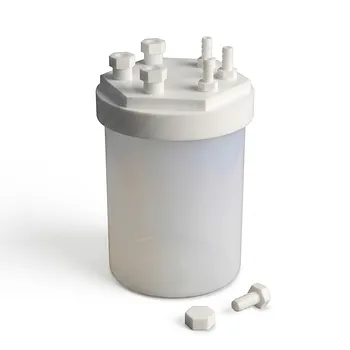
This coupled behavior is especially relevant to high-pressure digestion vessels and other structures exposed to simultaneous electrical and mechanical loading.
Understanding the Trade-offs
A single effective strain value can be misleading
Representing the material with one field-independent coefficient may be convenient, but it can conceal phase competition, anisotropy, and saturation. Such a simplification is risky when dimensional tolerances or structural loads are demanding.
An effective bulk model can still be useful, but it should be calibrated against conditions that represent the actual field, temperature, pressure, and constraint state.
Average behavior may hide local distortion
Even if crystalline and amorphous responses nearly cancel in the overall measurement, local stresses and phase-level deformation may remain significant. These local effects can contribute to thermal-mechanical distortion or progressive loss of dimensional stability.
Component evaluation should therefore consider both bulk dimensions and the locations where constraint or field concentration is greatest.
More testing does not replace phase-aware interpretation
Field, temperature, and pressure testing are necessary, but the results must be interpreted in terms of the material's two-phase response. Otherwise, a measured net strain may be mistaken for a simple and universally applicable material property.
The objective is to identify how the phases interact under service conditions, not merely to record one deformation value.
Making the Right Choice for Your Goal
The appropriate evaluation should reflect the component's actual electrical, thermal, and mechanical operating envelope.
- If your primary focus is dimensional accuracy: Characterize crystalline contraction and amorphous extension separately enough to predict net directional and volumetric strain under the intended field and temperature.
- If your primary focus is sealing reliability: Include phase-dependent deformation, mechanical constraint, and field-induced strain saturation when setting machining and compression tolerances.
- If your primary focus is structural integrity: Evaluate internal stress transfer between phases and the combined electrical-mechanical loading expected during service.
- If your primary focus is long-term performance: Test across the relevant field and thermal conditions so that changes in phase balance, saturation, and volume are not overlooked.
A reliable high-field fluoropolymer design begins by treating crystalline and amorphous deformation as coupled mechanisms that jointly determine component behavior.
Summary Table:
| Phase | Response to Electric Field | Implication for Design |
|---|---|---|
| Crystalline | Contraction (anisotropic) due to dipole alignment | Can reduce dimensions along chain directions |
| Amorphous | Extension via Maxwell stress | Can increase dimensions, opposing crystalline contraction |
| Combined | Competing responses lead to net strain, possible saturation | Must evaluate both phases to predict true component deformation |
Designing high-field fluoropolymer components? Ensure reliable performance by leveraging our expertise in PTFE/PFA labware and custom parts. Contact us to discuss your application and get tailored solutions — contact us today!
Related Products
- Corrosion Resistant High Purity PFA Valve and Weldable Transparent Tubing for Semiconductor Fluid Transfer
- High Purity PFA Chromatography Column with Collection Bottle Corrosion Resistant Fluoropolymer Filtration System for Trace Analysis
- High Purity PFA PTFE Flare Stop Valves Customizable 2-Way 3-Way Reducing Fluoropolymer Fluid Control Solutions
- High Purity PFA Chromatography Columns and Collection Bottles Corrosion Resistant Fluoropolymer Filtration Systems for Trace Analysis
- High Temperature Resistant PTFE Thermal Insulation Board Corrosion Resistant Metal Free Fluoropolymer Stand for Ultra Clean Laboratories
People Also Ask
- Why are high-purity PFA fluid transfer components preferred for battery electrolytes? Ensure Purity & Data Accuracy
- How do high-precision PFA fluid transfer components, such as tubing and fittings, affect the results of continuous-flow synthesis?
- How do PFA fluid transfer components contribute to chemical research precision? Achieve high-purity results today.
- What role do PFA tubing and valves play in high-precision laboratory fluid transfer systems? Ensure Ultra-Pure Results
- What advantages do PTFE and PFA tubing offer for organic solvents? Superior chemical resistance, purity, and high-temperature stability.