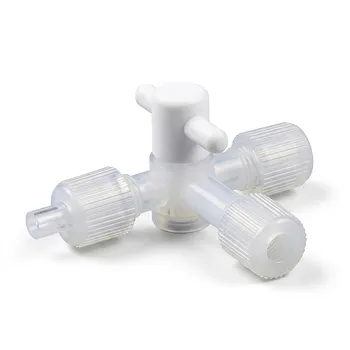
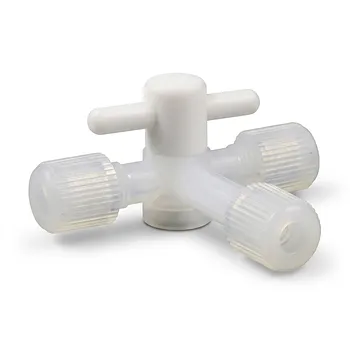
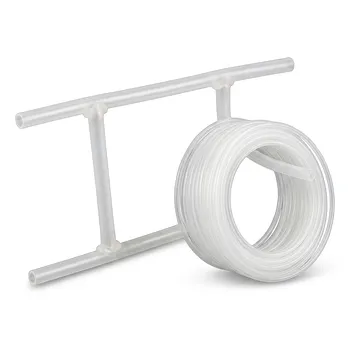
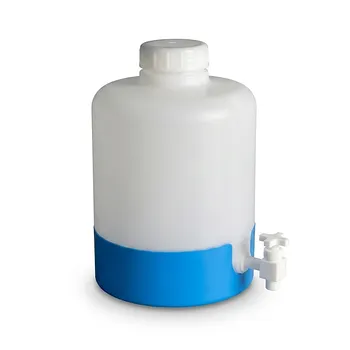
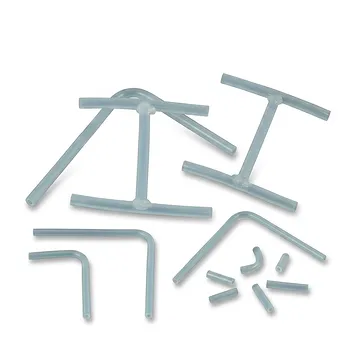
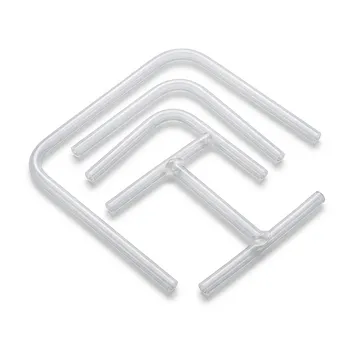
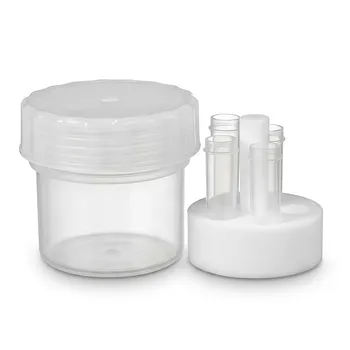
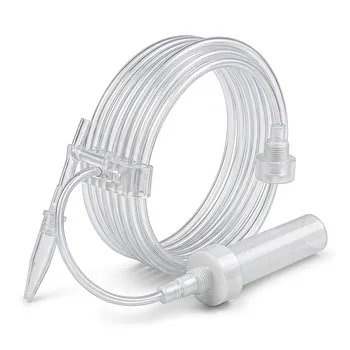
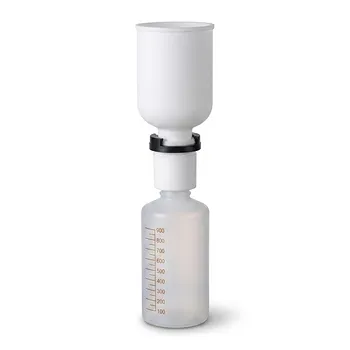
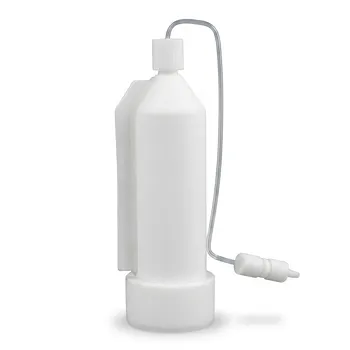
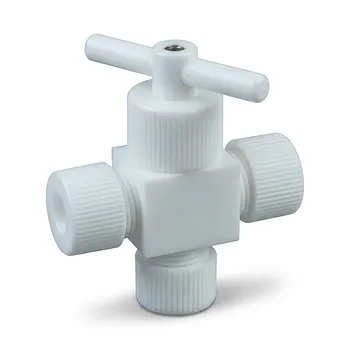
PTFE and PFA fluoropolymer tubing and fluid transfer components provide broad, dependable resistance to aggressive organic solvents. Unlike standard thermoplastics such as PVC, polycarbonate, ABS, and polystyrene, they generally resist swelling, softening, chemical attack, leaching, and loss of structural integrity when exposed to aromatic solvents, chlorinated solvents, esters, ketones, alcohols, hydrocarbons, and other demanding chemicals. This performance remains strong at elevated temperatures, making PTFE and PFA suitable for tubing, fittings, valves, containers, and other solvent-handling equipment.
PTFE and PFA protect both the fluid path and the sample: they remain chemically stable, maintain sealing integrity, and minimize contamination when handling aggressive organic solvents across a wide range of temperatures.
Why Organic Solvents Challenge Fluid Transfer Systems
Standard Plastics Can Swell or Degrade
Many conventional thermoplastics experience significant swelling, softening, or severe degradation when exposed to aromatic solvents, chlorinated solvents, esters, and ketones.
The risk increases at elevated temperatures. A component that performs acceptably at room temperature may lose strength, dimensional stability, or sealing performance at approximately 93°C.
Solvents Can Compromise the Entire Transfer Path
Chemical attack is not limited to tubing walls. It can affect fittings, valve bodies, seals, containers, and connection points, creating leakage or introducing contaminants into the process fluid.
For high-purity synthesis, extraction, and analytical work, even small amounts of leached material can affect results.
The Main Advantages of PTFE and PFA
Broad Chemical Compatibility
PTFE and PFA show exceptional compatibility with major organic solvent classes, including aromatic solvents, chlorinated solvents, esters, ketones, alcohols, hydrocarbons, and nitrile solvents.
The primary compatibility data rates both materials as effectively inert across the referenced solvent classes at both 25°C and 93°C, while testing also supports performance with specific solvents such as acetonitrile, acrylonitrile, pyridine, xylene, and white spirit.
Resistance to Swelling and Softening
Dimensional stability is essential for tubing and precision fluid-transfer components. Excessive swelling can reduce flow accuracy, alter fit, or compromise a seal.
PTFE and PFA typically exhibit negligible weight change and minimal mechanical impact in many organic-solvent applications, helping components retain their original form and function.
Protection Against Leaching
PTFE and PFA have low surface energy and strong chemical resistance, which limits solvent-driven erosion and material breakdown.
This helps prevent the transfer path from contributing unwanted extractables to the solvent, an important advantage in trace analysis, reagent preparation, and chemical synthesis.
Stable Sealing and Leak Resistance
Tubing, fittings, and valves must maintain dimensional and mechanical integrity to prevent leaks. PTFE and PFA resist the softening and degradation that can cause connections or seals to fail.
That stability is particularly valuable when systems experience elevated temperatures, pressure changes, or repeated solvent exposure.
High-Temperature Solvent Handling
Fluoropolymer components can maintain useful chemical and mechanical performance under demanding thermal conditions. Examples include isopropyl alcohol up to approximately 100°C, isooctane up to approximately 125°C, and pyridine across temperatures from room temperature toward boiling conditions.
Actual service limits depend on component design, pressure, concentration, exposure time, and the specific material grade.
Low Fluid Adhesion and Reduced Cross-Contamination
PTFE and PFA provide excellent release properties and low surface energy. Solvents and process fluids are less likely to adhere strongly to internal surfaces.
This can simplify draining, cleaning, and fluid changeover while reducing carryover between samples or reagents.
PTFE and PFA in Common Applications
Chemical Synthesis
During synthesis, tubing and valves may contact concentrated or undiluted solvents for extended periods. PTFE and PFA help preserve the integrity of the transfer route and reduce the risk of solvent-induced degradation.
Their resistance to aggressive solvents also supports reliable operation during repeated synthesis cycles.
Extraction and Sample Preparation
Extraction workflows often combine organic solvents with elevated temperatures. Fluoropolymer tubing, vessels, and fittings can withstand these conditions while helping maintain sample purity.
Their low tendency to leach or absorb common hydrogen-bearing organic solvents is useful when trace-level contamination must be controlled.
Analytical and High-Purity Fluid Handling
Analytical systems require predictable flow paths and minimal background contamination. PTFE and PFA support these requirements through chemical stability, low permeability, and resistance to solvent attack.
They are especially appropriate where the solvent is undiluted or where even minor changes in fluid composition could affect measurements.
Storage and Transfer of Harsh Solvents
Fluoropolymer containers, tubing, and valves can provide a leak-resistant path for difficult solvents such as pyridine, acetonitrile, xylene, and related chemicals.
The same resistance that protects a transfer line also helps preserve the container and connection points over repeated use.
Understanding the Trade-offs
Compatibility Is Not Absolute for Every Solvent
PTFE and PFA are highly resistant materials, but no compatibility chart should be treated as universal. Solvent structure, concentration, temperature, pressure, exposure duration, and mechanical loading all affect performance.
Some non-hydrogenated halogenated or perfluorinated solvents can penetrate the polymer matrix and cause measurable uptake or swelling under specific conditions.
Elevated Temperature Increases Solvent Uptake
Thermal energy can expand the polymer structure and increase solvent absorption. Although the resulting change may remain acceptable for a particular application, elevated-temperature service deserves separate evaluation.
Pressure, cycling, and mechanical stress should also be considered because chemical compatibility alone does not define the safe operating envelope.
Material Selection Still Matters
PTFE and PFA share many chemical-resistance advantages, but the best choice depends on the component and application. Consider flexibility, permeability, fabrication method, dimensional requirements, pressure, temperature, and whether the component must be welded, machined, or repeatedly flexed.
The tubing material should also be evaluated together with fittings, valves, seals, and any reinforcement layers. A fluoropolymer tube cannot compensate for a chemically incompatible connection or seal.
Low Permeability Is Application-Dependent
PTFE and PFA offer low permeability relative to many conventional materials, but highly polar solvents such as DMF and pyridine can have strong solubility and permeability characteristics.
For demanding containment or long-duration exposure, verify permeation performance for the exact solvent, temperature, wall thickness, and service duration.
Making the Right Choice for Your Goal
Select the material and component design according to the conditions the fluid-transfer system must withstand.
- If your primary focus is broad solvent compatibility: Use PTFE or PFA tubing, fittings, and valves for aggressive aromatic, chlorinated, ester, ketone, alcohol, hydrocarbon, and nitrile solvents, subject to application-specific verification.
- If your primary focus is sample purity: Choose fluoropolymer fluid paths to reduce leaching, solvent-driven degradation, fluid adhesion, and cross-contamination.
- If your primary focus is elevated-temperature operation: Confirm the solvent-specific temperature, pressure, exposure duration, and mechanical limits before selecting the final component.
- If your primary focus is long service life: Use PTFE or PFA where repeated solvent exposure and thermal cycling would cause standard plastics or coated metal components to degrade.
- If your primary focus is containment of highly polar solvents: Evaluate permeability and solvent uptake for the exact operating conditions, even when the material has excellent overall chemical resistance.
PTFE and PFA give solvent-handling systems a stable, low-contamination foundation, provided compatibility is verified against the actual solvent and operating conditions.
Summary Table:
| Material | Chemical Resistance | Swelling Resistance | Leaching | Temp Range | Applications |
|---|---|---|---|---|---|
| PTFE | Excellent | Excellent | Minimal | Broad | General lab, high-purity |
| PFA | Excellent | Excellent | Minimal | Slightly higher | High-temp, high-purity |
Ensure reliable solvent handling with KINTEK's PTFE/PFA components. Our tubing, fittings, valves, and custom-machined parts offer unmatched chemical resistance and purity. Contact us today to discuss your application and get a quote — Contact Us.
Related Products
- Corrosion Resistant High Purity PFA Valve and Weldable Transparent Tubing for Semiconductor Fluid Transfer
- High Purity PFA Valves and Weldable Corrosion Resistant Transparent Tubing for Semiconductor Sensor Manufacturing Fluid Transfer
- Corrosion Resistant PFA Tubing 1/4 Inch Custom Molded Welded Fluid Transfer Components
- High Corrosion Resistant PTFE Faucet Polytetrafluoroethylene Valve for Chemical Storage Drums and Fluid Transfer Systems Customizable Industrial Grade
- High Performance PFA Coiled Spring Tubing and Custom PTFE Fabrication Services with Welded Fittings and Precision Bent Components
People Also Ask
- Why are high-purity PFA fluid transfer components preferred for battery electrolytes? Ensure Purity & Data Accuracy
- How do high-precision PFA fluid transfer components, such as tubing and fittings, affect the results of continuous-flow synthesis?
- How do PFA fluid transfer components contribute to chemical research precision? Achieve high-purity results today.
- What role do PFA tubing and valves play in high-precision laboratory fluid transfer systems? Ensure Ultra-Pure Results
- Which material characteristics of fluoropolymers are most critical for high-purity fluid transfer and labware? Key factors: chemical inertness, low extractables, thermal stability.