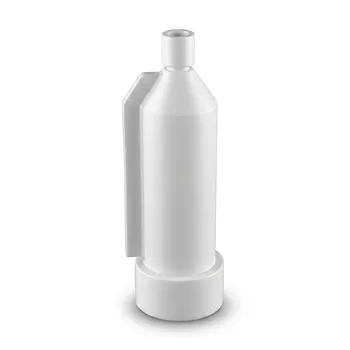
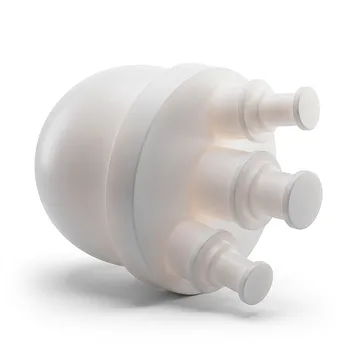
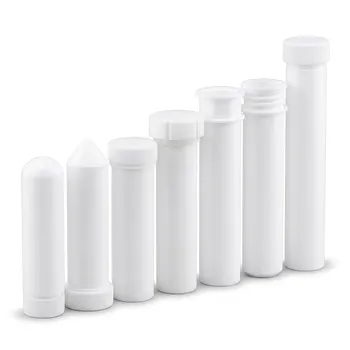
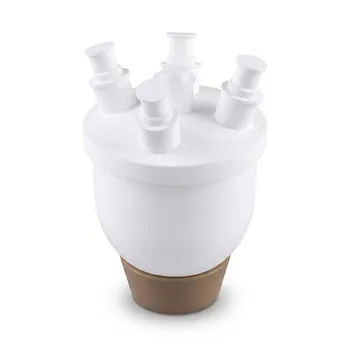
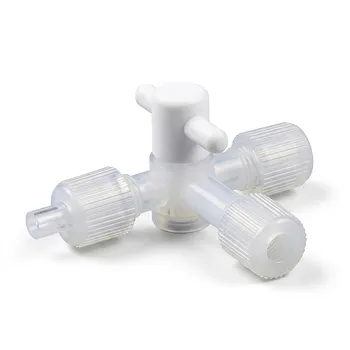
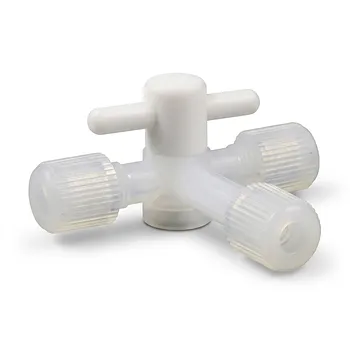
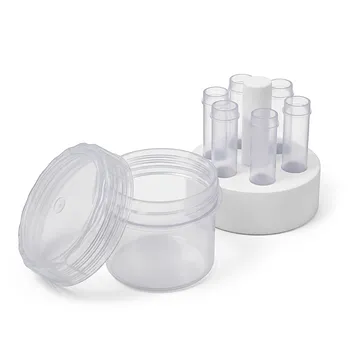
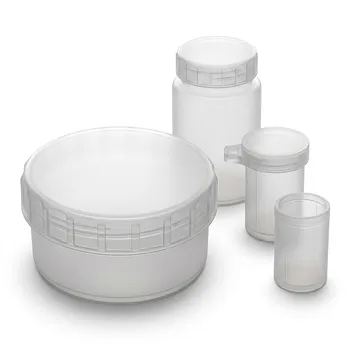
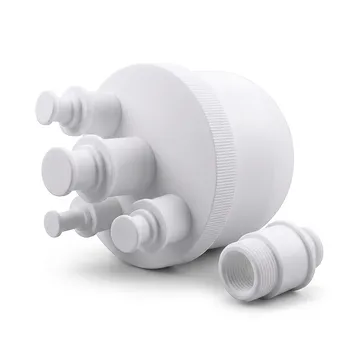
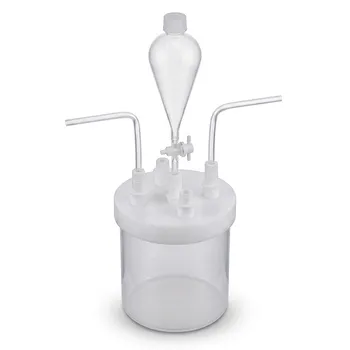
PTFE is ideal for high-purity chemical handling because it combines exceptional chemical inertness with very low contamination risk. It resists virtually all common solvents, strong acids, bases, and many corrosive gases without dissolving, degrading, or leaching significant impurities. This makes PTFE suitable for digestion vessels, reagent bottles, tubing, valves, seals, and other components used in aggressive chemical treatments and trace analysis.
The central advantage of PTFE is containment without chemical interference: it protects the sample and the equipment while contributing very little contamination or reactivity of its own.
Why PTFE Resists Harsh Chemicals
Strong carbon–fluorine bonds
PTFE’s polymer backbone is fully fluorinated, with carbon–fluorine bonds that are highly stable. This molecular structure makes the material resistant to chemical attack from concentrated acids, strong bases, oxidizing agents, organic solvents, and many reactive gases.
Unlike many conventional plastics, PTFE generally does not swell, dissolve, or chemically degrade when exposed to aggressive laboratory media.
Broad chemical compatibility
PTFE is insoluble in virtually all common solvents below its melting point and remains stable in contact with many highly corrosive substances. It is therefore useful where metals may corrode and ordinary polymers may soften, crack, or release contaminants.
This resistance is especially valuable for acid digestion, reagent storage, gas handling, and fluid transfer involving chemically reactive compounds.
Protection against corrosion-related failure
When a vessel or fluid path corrodes, it can leak, shed particles, or alter the chemistry of the material being handled. PTFE substantially reduces these risks by maintaining its structural and chemical stability in environments that rapidly damage metals, rubbers, and less-resistant plastics.
Historically, PTFE’s use in handling exceptionally reactive compounds such as uranium hexafluoride illustrates the level of chemical resistance associated with the material. Compatibility must still be verified for the specific compound and operating conditions.
Why PTFE Supports High-Purity Work
Minimal extractables and leachables
High-purity analysis can be affected by extremely small amounts of contamination. PTFE’s high purity and chemical stability mean it contributes very low levels of extractable or leachable material under typical laboratory conditions.
That helps preserve sample composition and improves confidence in trace-level measurements.
Low surface energy reduces residue
PTFE has a very low surface energy and a non-stick surface. Samples, particulates, and reaction residues are less likely to adhere strongly to PTFE than to many other materials.
This reduces carryover and makes cleaning more effective, particularly in tubing, vessels, valves, fittings, and transfer lines used for multiple samples.
Smooth surfaces limit particle buildup
Smooth PTFE surfaces provide fewer locations for particles and deposits to accumulate. PTFE bellows and fluid-transfer components can therefore help reduce internal particulate sources in systems where cleanliness is critical.
The result is a cleaner fluid path and a lower risk of cross-contamination between process steps.
Why PTFE Works Well in Fluid Transfer Components
Low friction supports reliable movement
PTFE has an exceptionally low coefficient of friction. This benefits moving components such as valve stems, diaphragms, bellows, seals, and sliding interfaces by reducing mechanical resistance and wear.
Lower friction can also reduce the generation of wear particles, which is important in high-purity fluid systems.
It does not readily react with the fluid
A PTFE-lined valve, tube, fitting, or vessel creates a chemically resistant barrier between the process fluid and the underlying hardware. This allows components to be designed around structural requirements while using PTFE where direct chemical contact occurs.
The approach is particularly useful when the handled medium would attack ordinary elastomers, unprotected metals, or standard thermoplastics.
It maintains integrity across demanding temperatures
PTFE has a broad operating temperature range and a melting point of approximately 327°C. It can therefore tolerate many high-temperature laboratory and process conditions while retaining its chemical resistance.
Actual service temperature depends on pressure, mechanical loading, component design, and the specific chemical environment—not temperature alone.
Why PTFE Is Valuable in Laboratory Vessels
Reliable containment during aggressive treatments
Digestion vessels and crucibles may be exposed to strong acids, oxidizing mixtures, elevated temperatures, and repeated cleaning cycles. PTFE helps maintain containment without introducing reactive surfaces that could alter the digestion chemistry.
This supports more consistent sample preparation and reduces the likelihood of vessel degradation.
Accurate sample preservation
For trace analysis, the vessel must not significantly absorb, react with, or release substances into the sample. PTFE’s inertness and low adhesion help preserve the original sample composition during storage, transfer, and treatment.
That is why PTFE is commonly selected for reagent bottles, liners, vessels, and other high-purity laboratoryware.
Non-toxic and non-reactive in normal use
PTFE is generally non-reactive and non-toxic under its intended service conditions. Its value comes less from being universally safe under every circumstance and more from its strong resistance to the chemicals and temperatures commonly encountered in controlled laboratory applications.
Understanding the Trade-offs
PTFE is not universally compatible
PTFE has important exceptions. Extreme conditions involving molten alkali metals, elemental fluorine at elevated temperatures or pressures, and certain highly reactive fluorinating compounds can attack it.
A compatibility chart and application-specific review are still necessary, especially for unusual gases, high concentrations, elevated temperatures, or mixtures.
Chemical resistance does not eliminate gas permeation
PTFE may resist chemical reaction while still allowing some gases to permeate through the material over time. For highly toxic, reactive, or valuable gases, system design must consider permeation, leakage, pressure, temperature, and containment requirements.
A chemically compatible material is not automatically an adequate barrier for every gas-handling application.
Mechanical properties require consideration
PTFE is relatively soft compared with metals and has greater creep or deformation under sustained load. Pressure, torque, dimensional stability, seal compression, and repeated cycling must be evaluated when designing valves, fittings, and vessels.
Filled PTFE grades, support structures, or composite designs may be appropriate where mechanical demands exceed the capability of unfilled PTFE.
Temperature limits still apply
PTFE’s chemical resistance should not be interpreted as permission to use it at any temperature. Excessive heat, pressure, or poor ventilation can create safety hazards, and PTFE should not be exposed to conditions that cause thermal decomposition.
The complete operating envelope must include chemical concentration, temperature, pressure, mechanical stress, and exposure duration.
Choosing PTFE for the Application
PTFE is most effective when chemical purity and corrosion resistance are the primary design requirements.
- If your primary focus is high-purity trace analysis: Choose PTFE vessels and fluid paths to minimize extractables, sample adhesion, particulates, and cross-contamination.
- If your primary focus is harsh acid or solvent handling: Use PTFE where direct chemical contact occurs, while verifying compatibility with the exact chemical mixture, concentration, temperature, and exposure time.
- If your primary focus is corrosive gas transfer: Evaluate PTFE’s chemical resistance together with gas permeation, seal design, pressure rating, and secondary containment.
- If your primary focus is long component life: Use PTFE to reduce corrosion, friction, and chemical degradation, but account for creep, wear, and mechanical support in the component design.
PTFE is trusted in demanding laboratory systems because it provides an unusually strong combination of chemical inertness, purity, low adhesion, and dependable containment.
Summary Table:
| Property | Benefit for High-Purity Lab Use |
|---|---|
| Strong C-F bonds | Resists attack from acids, bases, solvents, and reactive gases. |
| Broad chemical compatibility | No swelling, dissolving, or degradation in most aggressive media. |
| Minimal extractables | Low levels of leachables preserve sample purity. |
| Low surface energy | Non-stick surface reduces residue and improves cleaning. |
| Low friction | Reduces wear in moving parts and minimizes particle generation. |
| Thermal stability | Operates up to 327°C, tolerating high-temperature processes. |
Enhance your lab's purity and reliability with KINTEK's PTFE/PFA labware, custom machined for harsh chemical handling. From digestion vessels to fluid transfer components, we ensure inertness and low contamination. Contact us today for solutions tailored to your needs! Get in touch.
Related Products
- High Purity PTFE Corrosion Resistant Reaction Vessel with Luer Fittings and Caps for Trace Analysis
- High Purity PTFE Reaction Vessel with Electric Stirring System and Customizable 5L Tank including Buchner Funnel Filtration Assembly
- Custom PTFE Flask Large Volume 18L Corrosion Resistant Low Background High Purity Chemical Vessel
- High Purity Custom PTFE Large Volume 15L Flask Corrosion Resistant Low Trace Background Fluoropolymer Reaction Vessel
- Custom High Purity PTFE Digestion Tubes and Centrifuge Tubes for Trace Metal Analysis
People Also Ask
- Why is a PTFE reaction vessel required for Ti3C2Tx MXene synthesis? Ensure Safe HF Etching & High Purity
- What reaction vessel and fluid handling considerations are necessary for living cationic polymerization of fluorinated monomers involving Lewis acid catalysts? Key design and safety tips
- Why are high-purity PTFE or PFA reaction vessels recommended for the synthesis of PANI-TiC hybrid materials? - Guide
- Why are fluoroplastic (PTFE) reaction vessels recommended for Methylene Blue (MB) adsorption kinetic experiments?
- Ion Activation Reaction Vessel Requirements: Why PTFE is Critical for Membrane Performance