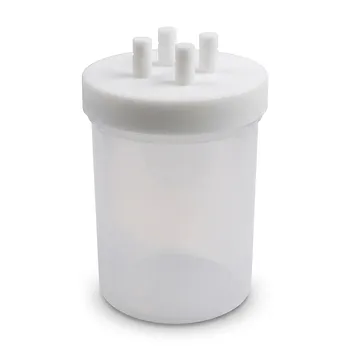
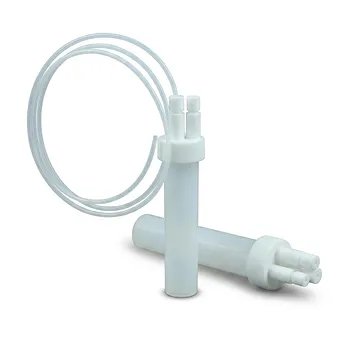
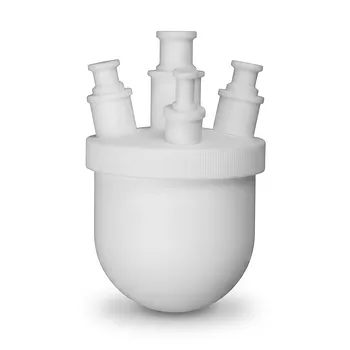
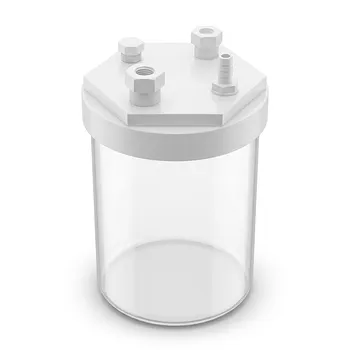
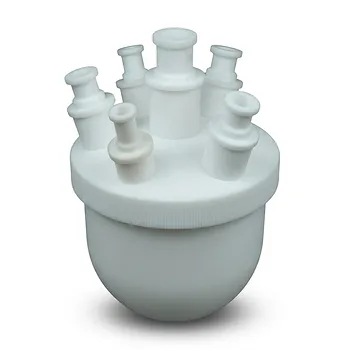
PFA is preferred over FEP when chemical analysis combines high temperature, aggressive reagents, and strict sample-integrity requirements. Both fluoropolymers provide excellent chemical resistance, but PFA supports continuous operation around 500°F (260°C), compared with approximately 400°F (204°C) for FEP. PFA also has a higher melting range, better elevated-temperature strength, and greater resistance to creep and stress cracking, making it more reliable for heated vessels and critical fittings.
The central advantage of PFA is its wider operating margin: it retains fluoropolymer-level chemical inertness while providing the thermal and mechanical stability needed for demanding digestion, reaction, and fluid-transfer processes.
Why High-Temperature Applications Favor PFA
PFA tolerates higher continuous temperatures
PFA has a maximum continuous operating temperature of approximately 260°C (500°F). FEP is generally limited to about 200°C (400°F) for continuous service because its mechanical properties deteriorate more rapidly at higher temperatures.
This difference matters when components are exposed to sustained heating, thermal cycling, microwave digestion, or hot chemical transfer. Operating near a material's limit leaves less margin for deformation and premature failure.
PFA has a higher melting range
PFA melts at approximately 575–590°F, while FEP melts at roughly 500–535°F. The higher melting range reflects PFA's greater thermal stability.
The melting point is not the same as the recommended operating temperature, but it helps indicate how much thermal headroom the material has before processing or service conditions become damaging.
PFA retains strength under thermal stress
High temperature softens polymer components and increases the risk of dimensional change. PFA offers superior mechanical strength and creep resistance compared with FEP at elevated temperatures.
That stability is important for vessel walls, seals, threaded fittings, valves, and tubing connections that must maintain their shape while exposed to pressure, heat, and chemical stress.
Why PFA Supports Reliable Chemical Analysis
Chemical resistance remains excellent
PFA and FEP both provide top-tier resistance to concentrated acids, strong bases, and many organic solvents. Choosing PFA is therefore not primarily about gaining a completely different chemical-resistance class.
The practical advantage is that PFA maintains this chemical inertness under more severe thermal and mechanical conditions.
PFA helps protect sample integrity
High-purity PFA can provide very low extractables and low metal-ion leaching, reducing the risk that the vessel or fitting contributes contamination to the sample.
This is particularly important in trace analysis, where contamination that would be insignificant in routine chemistry can distort results or reduce reproducibility.
PFA has a non-wetting, cleanable surface
PFA's low-friction, non-wetting surface discourages sample adhesion, scaling, and carryover. Easier cleaning reduces the chance that residues from one reaction will affect the next.
For analytical workflows, this supports consistent blanks, lower cross-contamination risk, and more dependable measurements.
Why Melt-Processability Matters for Fittings
PFA can be molded into complex geometries
PFA is melt-processible, allowing manufacturers to produce intricate vessels, valves, connectors, tubing, and customized reaction components through extrusion or injection molding.
This is a significant manufacturing advantage over standard PTFE, which has extremely high melt viscosity and generally requires compression molding, machining, or related processes.
Complex designs can retain high-purity performance
Melt-processing allows PFA components to be formed with fewer joints, seams, and machined interfaces. In fluid handling, that can simplify cleaning and reduce locations where contamination or leakage may develop.
The result is a practical combination of complex geometry, chemical inertness, thermal endurance, and low contamination potential.
FEP remains useful at lower temperatures
FEP is also melt-processible and can be an effective choice for tubing, liners, vessels, and fittings operating within its temperature range. Its lower continuous-use temperature does not make it unsuitable; it limits its suitability for sustained high-temperature service.
When the process remains comfortably below approximately 200°C and mechanical loads are modest, FEP may provide adequate performance.
Where PFA Provides the Greatest Benefit
Microwave digestion and heated reaction vessels
Microwave digestion exposes vessels to high temperatures, aggressive reagents, and repeated thermal cycling. PFA's higher temperature rating and resistance to creep and stress cracking provide greater protection against deformation and loss of containment.
These properties help preserve vessel geometry and reduce the risk of compromising the digestion process.
High-temperature acid transfer lines
Hot acids place simultaneous demands on chemical resistance, pressure retention, and dimensional stability. PFA is better suited than FEP when the line must remain mechanically reliable near the upper end of fluoropolymer service temperatures.
This applies to tubing, manifolds, valves, and fittings used in demanding analytical or process systems.
High-purity fluid handling
PFA is well suited to semiconductor-grade and trace-analysis fluid systems where low extractables and minimal ionic contamination are essential. Its thermal margin also helps accommodate sterilization, heated cleaning, and process-temperature variation.
Understanding the Trade-offs
PFA is not automatically the best choice for every system
PFA generally costs more than FEP and may require more demanding processing controls. If the application operates well below FEP's temperature limit, the additional performance may not justify the added material cost.
Material selection should consider actual temperature, pressure, chemical exposure, thermal cycling, and cleanliness requirements rather than temperature rating alone.
Temperature ratings depend on the complete design
A polymer's continuous-use rating does not guarantee that every finished component will perform identically at that temperature. Wall thickness, pressure, fitting geometry, reinforcement, cycling frequency, and exposure time all affect service life.
A thin tube under pressure may have a different practical limit from a thick-walled vessel made from the same resin.
Processing quality affects long-term reliability
PFA linings and molded components require controlled processing. In coating applications, insufficiently controlled heating or repeated coat-and-bake cycles can create bubbles, voids, or resin-decomposition defects.
The material's performance depends on both resin selection and manufacturing quality.
PFA does not eliminate chemical or thermal risk
PFA is highly inert, but no fluoropolymer should be selected without verifying compatibility with the exact reagent mixture, temperature, pressure, and operating duration. Sudden thermal excursions and mechanical abuse can still cause failure.
The correct decision is based on the full operating envelope, not on a material label alone.
Making the Right Choice for Your Goal
Select the fluoropolymer according to the most demanding condition the component must reliably withstand.
- If your primary focus is sustained high-temperature operation: Choose PFA when service temperatures approach 260°C or when you need greater resistance to creep, deformation, and stress cracking than FEP provides.
- If your primary focus is high-purity trace analysis: Choose high-purity PFA to minimize extractables, metal-ion leaching, sample adhesion, and carryover contamination.
- If your primary focus is complex molded fittings or vessels: Choose PFA when intricate melt-processed geometries, valves, connectors, or customized reaction components are required.
- If your primary focus is cost-effective service below 200°C: FEP may be sufficient when the application has modest mechanical stress and does not require PFA's higher thermal margin.
For demanding chemical analysis, PFA provides the strongest balance of thermal endurance, chemical inertness, mechanical stability, processability, and sample protection.
Summary Table:
| Feature | PFA | FEP |
|---|---|---|
| Max Continuous Operating Temp | ~260°C (500°F) | ~200°C (400°F) |
| Melting Range | 575–590°F (302–310°C) | 500–535°F (260–280°C) |
| Elevated-Temperature Strength | Superior | Good |
| Creep & Stress Crack Resistance | Superior | Moderate |
| Chemical Resistance | Excellent | Excellent |
| Extractables / Leaching | Very low | Low |
| Processability | Melt-processable | Melt-processable |
| Typical Applications | High-temp digestion, high-purity fluid handling | Lower-temp tubing, liners |
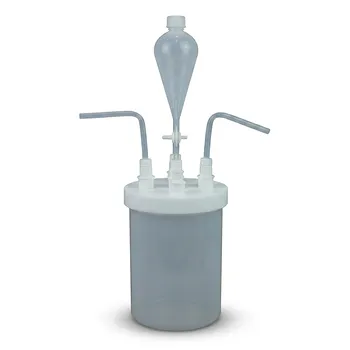
Elevate your demanding chemical analysis with KINTEK's precision-machined PFA vessels and fittings. Our high-purity components withstand up to 260°C, resist creep, and minimize contamination, ensuring reliable results. Whether you need standard labware or custom high-temperature reaction systems, our PTFE/PFA expertise and CNC machining deliver exactly what you need. Contact us today to discuss your requirements and get a tailored solution!
Related Products
- Corrosion Resistant PFA Translucent Reaction Bottle with PTFE Screw Cap and Standard 19 24 Ground Joint Neck for High Temperature Lab Applications
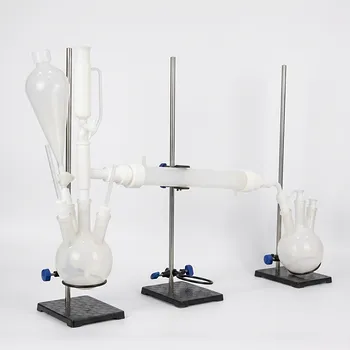
- High Purity PFA Constant Pressure Condensation Reaction System Acid Resistant High Temperature Customizable Teflon Labware
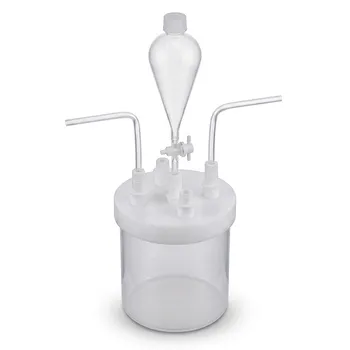
- High Purity PFA Reaction Vessel for Biopharmaceutical Synthesis and Corrosive Chemical Fluid Handling with Customizable Tube Fittings
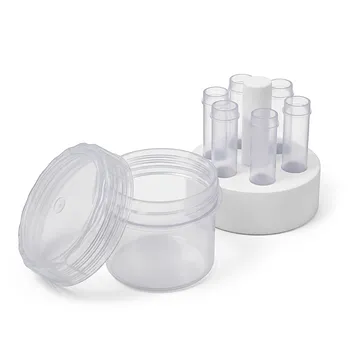
- High Purity Corrosion Resistant PFA Reaction Vessel with PTFE Holder and Integrated Sampling Tube for Trace Analysis
- High Purity PFA Reaction Tank for Proton Exchange Membrane Electrolysis and Water Oxygen Separation Custom Labware
People Also Ask
- How do the material choice and sealing integrity of the reaction vessel affect the growth of NiFe-LDH? Optimize Synthesis
- Why are well-sealed reaction vessels necessary for superacid-promoted Friedel-Crafts polycondensation? Optimize Synthesis
- Role of reaction vessels in alkali treatment for oil palm waste: Achieve High-Purity Cellulose with PTFE Vessels
- Why are PTFE or PFA reaction vessels required for the selective etching process of MXene using hydrofluoric acid (HF)?
- What is the role of high chemical inertness reaction vessels in the organic synthesis of acylhydrazone ligands? | Guide