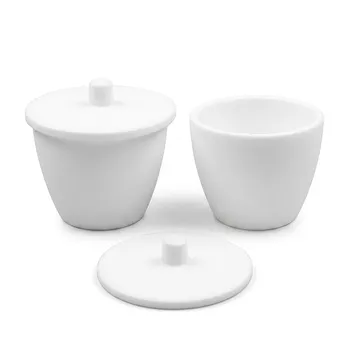
Minimizing fluoride evolution is essential because it signals thermal degradation of the fluoropolymer. At temperatures near 350 °C, lower-grade or poorly stabilized PTFE can release fluoride-containing gases and corrosive degradation products that contaminate trace samples, attack nearby equipment, and weaken the labware itself. Thermal stability is controlled during synthesis by managing polymerization conditions, molecular-weight development, chain-end chemistry, particle formation, and—in some formulations—small concentrations of stabilizing or chain-transfer additives such as hydrocarbon species.
Fluoride evolution is both a purity risk and a materials-failure warning. A well-controlled PTFE formulation reduces thermal breakdown, preserves mechanical integrity, and remains suitable for demanding equipment such as microwave digestion vessels and high-temperature reaction apparatus.
Why Fluoride Evolution Matters at High Temperature
It can compromise trace analysis
Fluoride-containing degradation products can enter the sample environment during heating. Even very small amounts may create unacceptable background contamination when measuring trace metals, ions, or other low-concentration analytes.
This makes low outgassing particularly important for microwave digestion vessels, reaction tubes, and high-purity sample-handling components.
It can accelerate equipment degradation
Thermal degradation products may be chemically aggressive. They can attack adjacent metals, seals, sensors, and other components, especially when combined with moisture or reactive chemicals.
Fluoride evolution therefore affects more than the PTFE itself; it can shorten the service life of the complete apparatus.
It indicates loss of structural integrity
As the polymer chain breaks down, molecular weight and mechanical strength decline. The labware may become more vulnerable to creep, deformation, cracking, or loss of dimensional stability under heat and pressure.
A low fluoride-evolution rate is consequently a practical indicator that the material is retaining its structure during operation.
Why High-Temperature PTFE Requires Careful Control
PTFE has strong inherent thermal resistance
PTFE benefits from highly stable carbon-fluorine bonds and a rigid helical chain conformation. Virgin PTFE has a melting point near 342 °C on its first melt and a reported decomposition midpoint around 505 °C.
These properties provide substantial thermal capability, but they do not make PTFE immune to degradation. Prolonged exposure, local overheating, impurities, defects, and pressure can reduce the practical safety margin.
Operation near the melting region increases risk
An operating temperature around 350 °C is close to PTFE's melting range. At this point, the material may lose dimensional rigidity even before substantial chemical decomposition occurs.
For labware, thermal design must therefore address both chemical stability and mechanical creep or deformation.
Porosity can worsen contamination
Surface and microstructural porosity allow aggressive reagents, residues, and trace contaminants to penetrate the material. Those retained species can later desorb during heating and contribute to cross-contamination.
Low-porosity resin and controlled processing improve cleanability, chemical resistance, and sample integrity in repeated high-temperature use.
How Thermal Stability Is Controlled During Synthesis
Emulsion polymerization controls particle formation
In PTFE emulsion polymerization, the reaction conditions determine the size, distribution, and stability of the colloidal polymer particles. Smaller, well-stabilized particles can support more uniform polymer growth and reduce defects that may become sites for thermal breakdown.
The goal is a resin with consistent morphology and fewer weak regions rather than simply maximizing polymer yield.
Molecular weight and chain growth are managed
Controlled initiator levels, reaction conditions, and molecular-weight development help produce long, consistent polymer chains. High molecular weight generally supports better mechanical retention and lower susceptibility to deformation during heating.
The formulation must also control chain ends and other irregular structures, because unstable end groups can degrade more readily than the fully fluorinated backbone.
Stabilizing and chain-transfer additives can reduce degradation
The primary reference identifies small concentrations of methane or ethane as agents used during emulsion polymerization. More precisely, hydrocarbon species in this context should be understood as formulation or chain-control additives, not as a universal standalone solution for thermal stability.
Their purpose is to influence particle formation and polymer-chain chemistry, helping reduce thermally vulnerable structures and lowering fluoride evolution under stress. The exact additive, concentration, and process window depend on the resin formulation and must be validated experimentally.
Polymer architecture is selected for the operating environment
The fluoroalkene building blocks and any comonomers affect decomposition behavior, crystallinity, and long-term thermal endurance. Highly fluorinated and appropriately selected polymer backbones generally provide stronger resistance to thermal and chemical attack.
This is why resin selection is as important as the nominal material label. “PTFE” does not by itself guarantee identical high-temperature performance across grades.
Processing preserves the benefits of the resin
Cooling rate, crystallinity, curing, and machining quality affect density, strength, permeability, and porosity. Slower controlled cooling can produce higher crystallinity and improved mechanical strength, while uncontrolled processing may increase amorphous content or create defects.
The final labware therefore depends on both polymer synthesis and post-polymerization processing.
Understanding the Trade-offs
Thermal stability does not eliminate all emissions
Even high-quality PTFE can generate degradation products when overheated or exposed to temperatures beyond its validated operating range. Stabilization reduces the risk; it does not make improper temperature control acceptable.
Laboratory equipment should use temperature limits based on the specific grade, geometry, pressure, exposure time, and chemical environment.
Crystallinity involves competing properties
Higher crystallinity can improve density, strength, and resistance to chemical permeation. Faster cooling can increase amorphous content, which may improve flexibility or optical clarity but reduce mechanical strength and density.
The appropriate morphology depends on whether the priority is pressure resistance, flexibility, transparency, permeability control, or repeated thermal cycling.
Additives must be evaluated for purity
An additive that improves chain stability may introduce its own extractables, residues, or process-related impurities. For trace-analysis equipment, the additive package must therefore be assessed for outgassing, extractables, and compatibility with the intended samples.
A lower fluoride-evolution result is not sufficient if the material introduces another contamination pathway.
Test data must match real service conditions
A decomposition temperature from a laboratory test does not fully predict performance in a loaded vessel. Thermal gradients, pressure, reagent chemistry, repeated cycles, and contact with metal parts can all change the degradation rate.
Validation should include representative heating profiles and chemical exposures, not only a single short-term temperature test.
How to Apply This to Your Project
Material selection and synthesis control should be matched to the actual temperature, pressure, chemical, and analytical requirements.
- If your primary focus is trace-analysis purity: Choose a low-outgassing, low-porosity fluoropolymer grade and verify fluoride evolution, extractables, and blank contamination under the complete heating cycle.
- If your primary focus is high-temperature mechanical reliability: Prioritize controlled molecular weight, stable chain-end chemistry, suitable crystallinity, and validated creep resistance at the operating temperature.
- If your primary focus is synthesis optimization: Control initiator level, particle formation, molecular-weight growth, additive concentration, and cooling or curing conditions, then confirm the result with thermal-evolution testing.
- If your primary focus is equipment service life: Evaluate corrosive degradation products and thermal cycling together with the PTFE grade, because protecting the surrounding seals, metals, and sensors is part of the materials decision.
The reliable approach is to treat low fluoride evolution as a measurable consequence of controlled polymer chemistry, controlled processing, and validated operating conditions.
Summary Table:
| Factor | Why It Matters | How It's Controlled |
|---|---|---|
| Fluoride Evolution | Indicates thermal degradation; contaminates samples & equipment | Controlled polymerization conditions & additives |
| Thermal Stability | Prevents breakdown near 350°C; preserves integrity | Molecular weight & chain-end management |
| Porosity | Absorbs contaminants; worsens outgassing | Low-porosity resin & controlled processing |
| Crystallinity | Affects strength & permeability | Cooling rate & curing conditions |
| Additives | Can improve stability but may introduce impurities | Evaluate for extractables & compatibility |
| Test Validation | Lab tests don't capture real service conditions | Match testing to actual temperature/pressure/chemical exposure |
Ensure high-temperature purity and reliability with our premium PTFE/PFA labware. Our custom CNC machining and rigorous material selection minimize fluoride evolution for trace analysis. Contact us today to find the perfect solution for your lab — get in touch for a consultation!
Related Products
- Custom Thickened PTFE Beaker 3000ml Hotplate Heating High Temperature Deformation Resistant Fluoropolymer Labware
- High Purity Custom PTFE Beaker 5000ml With Lid Hot Plate Heating Compatible High Temperature Chemical Labware
- Large Scale PTFE Beakers and Flasks for High Temperature Corrosion Resistant Laboratory Applications with Custom CNC Fabrication
- High Temperature Corrosion Resistant PTFE Reaction Flask Custom Multi Neck Laboratory Vessel with Flat or U Bottom
- High Temperature Resistant Thickened PTFE Beaker 2000ml for Chemical Processing and Laboratory Trace Analysis
People Also Ask
- Why is the material of the reaction vessel critical for tribocatalytic degradation? Boost Your Catalytic Yield!
- What are the limitations of pure PTFE in high temperature applications? Understanding the 200°C Ceiling
- How do the thermal and processing properties of FEP compare to PTFE, and how does this affect material selection for specialized fluoropolymer labware? Choose the right material for your lab's demands.
- What are the maximum operating temperatures and processing differences between PTFE and PFA, and how do they guide material selection for high-temperature laboratory apparatus?
- Are Teflon parts capable of withstanding high temperatures? Understanding the 260°C Limit for Performance