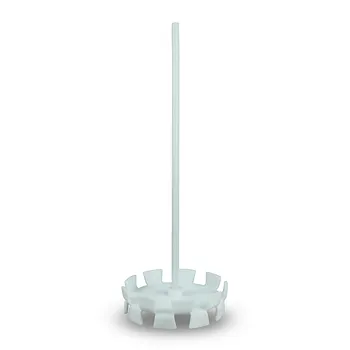
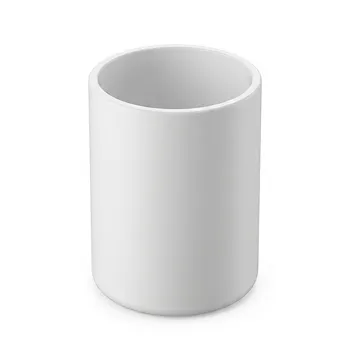
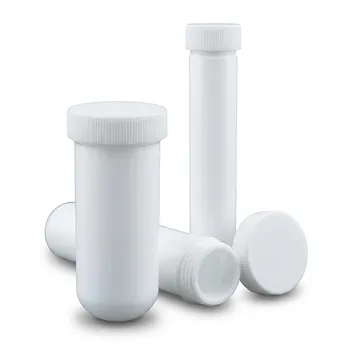
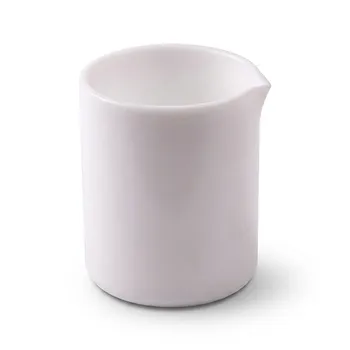
For rigid PTFE laboratory supplies, suspension-polymerized granular resin is preferred because its particle morphology and processing behavior are designed for compression molding and solid-stock machining. It produces dense preforms, billets, and blocks with the structural integrity needed for beakers, crucibles, valves, reaction vessels, fittings, and seals. Fine-powder dispersion resins are generally optimized for paste extrusion, thin films, coatings, tubing, and porous expanded PTFE rather than thick, rigid machined components.
The decisive distinction is not molecular weight alone. Both resin families can have very high molecular weight, but suspension-polymerized granular PTFE is supplied in a form that compacts reliably into dense solid shapes, while dispersion-polymerized fine powder is designed to fibrillate or form paste-extruded structures.
Why Granular PTFE Fits Rigid Laboratory Supplies
It supports compression molding
Suspension polymerization produces granular PTFE particles suitable for filling a mold and compacting them into a preform. The preform can then be sintered into a solid billet, block, or near-net-shape component.
This process is well suited to thick-walled vessels and structural parts that must retain their geometry under chemical, thermal, and mechanical stress.
It produces structurally continuous stock
Compression molding followed by sintering creates a dense PTFE body with the continuity required for machining and fluid containment. Properly selected grades minimize internal voids and weak regions that could compromise a vessel or valve body.
That structural continuity is important when the component must withstand clamping, pressure differentials, repeated handling, or machining forces.
It provides the strength required for machining
High-molecular-weight granular PTFE offers the combination of tensile strength, rigidity, wear resistance, and dimensional stability needed for CNC machining. Manufacturers can turn molded stock into precise threads, channels, seats, ports, and sealing surfaces.
The material must behave as a stable solid during cutting rather than deforming, tearing, or losing its intended geometry.
Why Fine-Powder Dispersion Resins Are Different
Their morphology is optimized for fibrillation
Dispersion-polymerized fine powder has a fine-particle morphology and a molecular structure that can form a node-and-fibril network under high-shear or high-strain processing. This property is essential for paste extrusion and expanded PTFE applications.
It is advantageous for flexible tubing, wire insulation, porous membranes, and thin films, but it is not the primary requirement for a dense, rigid machined vessel.
They are commonly processed as pastes
Fine powder is typically blended with a hydrocarbon lubricant and paste-extruded. The lubricant enables the powder to move through the extrusion process, while the resin’s fibrillation behavior helps form a continuous extrudate.
This processing route differs fundamentally from the powder compaction and sintering used to make solid PTFE stock shapes.
They are poorly suited to conventional mold filling
Fine-cut dispersion powders have low bulk density and poor flow characteristics. They may not fill an automatic or isostatic mold uniformly without specialized handling, oversized tooling, or additional conditioning.
Uneven filling can create density variations and defects in the molded preform. Those defects are especially undesirable in trace-analysis vessels, digestion containers, and precision fittings.
The Role of Particle Size and Powder Form
Fine-cut granular resin prioritizes performance
Fine-cut granular PTFE can provide small particles that compact into highly integrated molded structures. This form is associated with strong mechanical performance and good material density when the molding process is properly controlled.
The limitation is handling: fine particles often flow poorly and have low apparent bulk density.
Pelletized granular resin prioritizes manufacturing efficiency
Pelletized or free-flow granular PTFE is made by soft-agglomerating smaller particles. This increases bulk density and improves hopper feeding and mold-cavity filling.
The result is better compatibility with automatic and isostatic molding, although there can be a modest trade-off in ultimate mechanical properties compared with the best fine-cut grades.
Resin selection must match the molding method
A high-performance machined component may favor a fine-particle, high-strength granular grade. A high-throughput molding operation may instead favor a free-flow grade that fills tooling rapidly and uniformly.
The correct choice therefore depends on the balance between mechanical performance, mold filling, component geometry, and production method.
Why This Matters for Laboratory Equipment
Rigid vessels require dimensional stability
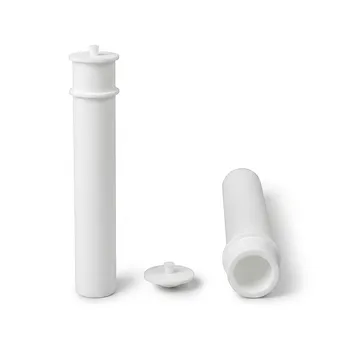
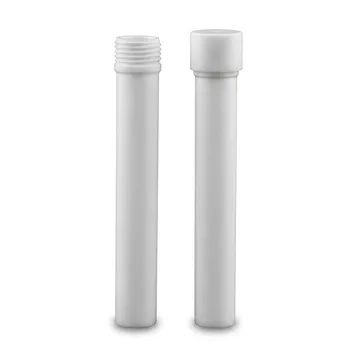
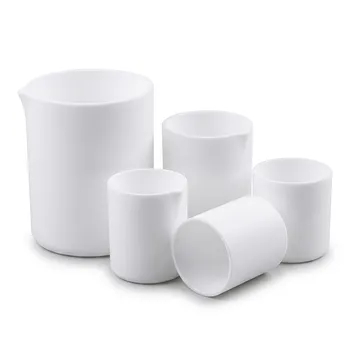
Beakers, crucibles, digestion vessels, and custom reaction containers must maintain their shape during heating, cooling, filling, and handling. A dense granular-PTFE preform provides a suitable foundation for these requirements.
Machining can then produce accurate walls, bores, grooves, and interfaces without relying on a flexible or fibrillated structure.
Fluid-handling components require integrity
Valves, fittings, manifolds, and seals must resist deformation and leakage while exposed to aggressive chemicals. Granular PTFE stock provides the solid, machinable body needed for these functions.
The material’s chemical resistance is valuable only if the component also has sufficient density and mechanical integrity.
High-purity applications need controlled internal quality
Trace-analysis and digestion equipment can be sensitive to contamination, discoloration, and fluid permeation. Processing wet polymer beads before pelletization can help remove trapped initiator residues, supporting high chemical purity and consistent appearance.
More broadly, controlled molding reduces micro-voids and nonuniform regions that could retain contaminants or affect cleaning.
Understanding the Trade-offs
Granular PTFE is not automatically the strongest in every form
Fine-cut granular grades may offer the highest mechanical performance, while pelletized grades improve flow and manufacturing efficiency. Selecting a free-flow grade solely for convenience can reduce the performance margin of a demanding machined component.
The resin should be chosen against the required tensile strength, elongation, permeability, dimensional stability, and machining behavior.
Fine powder is not an inferior resin
Dispersion-polymerized fine powder is the correct material for applications that depend on paste extrusion or fibrillation. It can be the better choice for flexible tubing, porous filtration media, expanded PTFE, and thin coatings.
Its disadvantage appears only when it is used for a process—such as conventional compression molding of rigid stock—for which its powder morphology is not optimized.
Molecular weight should not be treated as the only criterion
High molecular weight supports PTFE’s mechanical performance, but it does not by itself determine whether a resin is suitable for molding or machining. Polymerization route, particle morphology, apparent density, flow behavior, crystallinity, and intended processing method are equally important.
The practical question is not simply “Which resin has higher molecular weight?” It is “Which resin form produces the required component through the selected manufacturing process?”
Machining does not replace proper molding
CNC machining can create precise geometry, but it cannot correct poor preform density or internal voids. The molded stock must first be uniform and structurally sound.
For critical laboratory components, both the resin grade and the compression-molding cycle require validation.
Making the Right Choice for Your Goal
Choose the resin according to the component’s manufacturing route and service requirements:
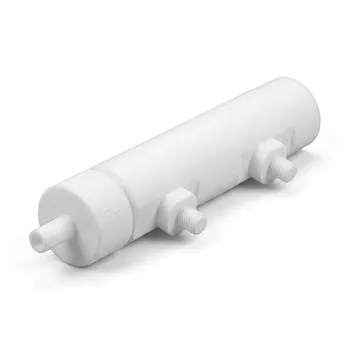
- If your primary focus is rigid, chemically resistant laboratory vessels: Use high-molecular-weight granular PTFE designed for compression molding and subsequent machining.
- If your primary focus is precision CNC machining: Select a dense, fine-particle granular grade with the required strength, low void content, and dimensional stability.
- If your primary focus is automated or high-volume molding: Consider pelletized free-flow granular PTFE for improved hopper feeding and uniform mold filling.
- If your primary focus is flexible tubing, films, coatings, or porous membranes: Use dispersion-polymerized fine powder because its paste-extrusion and fibrillation behavior is better suited to those applications.
The best PTFE grade is the one whose particle morphology and processing behavior match the final component—not merely the one with the highest stated molecular weight.
Summary Table:
| Resin Type | Polymerization | Particle Form | Best For | Processing Method |
|---|---|---|---|---|
| Granular PTFE | Suspension | Granular (fine-cut or pelletized) | Rigid machined components like beakers, crucibles, valves, fittings | Compression molding, sintering, machining |
| Fine-Powder PTFE | Dispersion | Fine powder | Flexible tubing, films, coatings, porous membranes | Paste extrusion, fibrillation |
Looking for high-performance PTFE labware? KINTEK manufactures custom, precision-machined components from granular PTFE to ensure maximum strength and chemical resistance. Our end-to-end CNC machining capabilities handle complex geometries and high-volume orders. Contact us today to discuss your requirements and get a quote!
Related Products
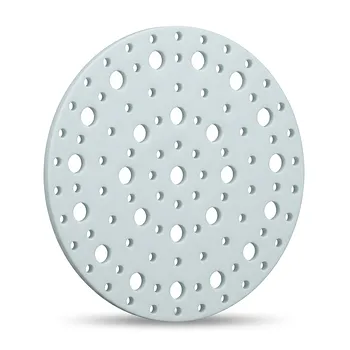
- High Temperature Resistant TFM Insulating Baffles Ultra Clean Laboratory PTFE Partitions with Customizable Pore Patterns
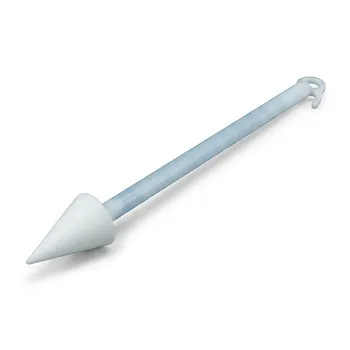
- High Temperature PTFE Solid Sampler Corrosion Resistant White Reusable Biopharmaceutical Sampling Tool
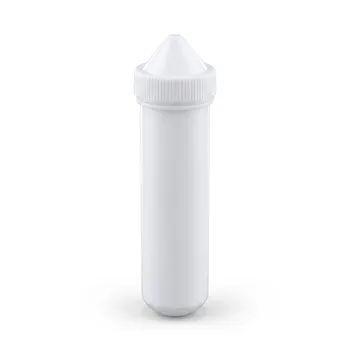
- High Purity PTFE Digestion Tubes and Custom Centrifuge Tubes 100ml for Trace Analysis and Chemical Digestion
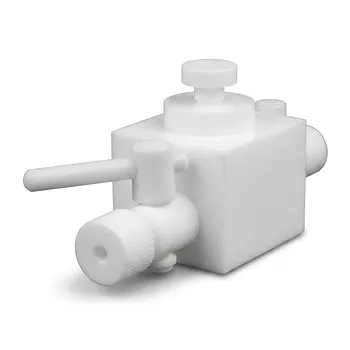
- Custom PTFE Filtration System Acid Resistant High Purity Semiconductor Grade Chemical Processing Filter
- High Purity Custom PTFE Reaction Cell Electrolytic Tank for Semiconductor and Polysilicon Industrial Applications
People Also Ask
- Are Teflon parts capable of withstanding high temperatures? Understanding the 260°C Limit for Performance
- What are the main advantages of using PTFE for custom parts? Solve Complex Engineering Challenges
- What are the key properties of Teflon (PTFE) used in custom parts? | Achieve Peak Performance
- What advantages do custom PTFE parts offer for industrial efficiency? Boost Uptime & Cut Costs
- What industries benefit most from custom PTFE parts? Solve Extreme Environment Challenges