Densified ePTFE is preferred because it combines the chemical purity of virgin PTFE with far greater resistance to creep and cyclic fatigue. Standard skived PTFE can cold-flow under sustained load and elevated temperature, causing dimensional loss, reduced bolt or clamp load, and eventual leakage. Filled PTFE improves creep resistance, but fillers can reduce purity, chemical resistance, permeability performance, and flexural fatigue life. Densified ePTFE addresses these weaknesses through a compressed node-and-fibril structure that remains mechanically stable while retaining essentially pure-PTFE chemistry.
The key advantage is balance: densified ePTFE provides dimensional stability, fatigue resistance, and barrier performance without sacrificing the chemical inertness required for aggressive or high-purity fluid service.
Why Standard PTFE Struggles in Diaphragm Service
Sustained load causes cold flow
Skived PTFE is a solid, relatively homogeneous material with excellent chemical resistance but limited resistance to long-term deformation. Under diaphragm clamping forces, pressure differentials, and elevated temperatures, it can slowly creep away from the original geometry.
This deformation can reduce contact pressure and bolt or clamp-load retention. In a pump diaphragm, that may contribute to leakage, uneven motion, or premature loss of sealing performance.
Temperature accelerates deformation
PTFE becomes more susceptible to creep as temperature and mechanical stress increase. A diaphragm experiences both conditions simultaneously: it is repeatedly flexed while exposed to a chemically aggressive fluid and often elevated process temperatures.
The result is not simply static dimensional change. Thermal exposure can amplify the effects of repeated mechanical loading and make conventional PTFE less predictable over service life.
Cyclic flexing adds fatigue demands
A pump diaphragm is a dynamic component rather than a static gasket. Each stroke creates repeated bending and tensile-compressive stress, so the material must resist both creep under load and flexural fatigue over many cycles.
Standard skived PTFE can provide chemical compatibility, but its dynamic durability is often less suitable for severe, high-cycle diaphragm operation.
How Densified ePTFE Improves Performance
The node-and-fibril structure resists deformation
ePTFE is formed by stretching PTFE to create nodes connected by microscopic fibrils. In densified ePTFE, this structure is subsequently compressed or calendered, producing a much denser and more mechanically integrated material.
The resulting architecture helps distribute applied stress through the material rather than allowing localized deformation to accumulate as readily as it can in conventional skived PTFE.
High density improves dimensional stability
Densification reduces the porosity associated with ordinary expanded PTFE and creates a stronger, more compact barrier. Depending on the manufacturing process, product specifications may describe densities near full-density PTFE or values somewhat below it; the relevant design property is the resulting combination of density, strength, and creep resistance.
This distinction matters because ordinary porous ePTFE and densified ePTFE are not interchangeable. A diaphragm facing aggressive fluid service generally requires a product engineered for low permeability, controlled flexure, and resistance to compression and cyclic deformation.
Creep resistance protects sealing force
The main practical benefit is improved retention of shape and applied load. Densified ePTFE is designed to resist cold flow under high mechanical loads and elevated temperatures, helping the diaphragm maintain its profile and its interface with adjacent components.
That stability supports more consistent sealing and reduces the risk that thermal or mechanical cycling will progressively relax the assembly.
Flexural fatigue resistance supports pump cycling
Densified ePTFE retains the fibrillated reinforcement created during expansion while gaining the structural stability of compression. This makes it better suited to repeated flexing than conventional solid PTFE.
The material is particularly valuable when diaphragm life is governed by millions of strokes, frequent start-stop operation, or thermal cycling rather than by a single static exposure.
Why Fillers Are Not Always the Right Solution
Fillers can reduce chemical purity
Adding glass, carbon, mineral, or other fillers can improve PTFE's resistance to creep and wear. However, the resulting compound is no longer chemically equivalent to pure PTFE.
For high-purity chemical processing, laboratory systems, pharmaceutical equipment, or analytical applications, filler constituents can introduce extractables, trace contamination, or compatibility concerns.
Fillers can compromise flexural life
A filler that stiffens PTFE may also make it less tolerant of repeated bending. That trade-off can be acceptable in a static bearing or rigid seal, but it is less attractive in a diaphragm that must flex continuously.
The best material for a dynamic diaphragm must retain strength without becoming excessively brittle or losing fatigue resistance.
Fillers can alter barrier behavior
Fillers change the polymer matrix and can affect permeability, surface characteristics, and resistance to low-surface-tension fluids. These effects may be undesirable when the diaphragm must isolate the process fluid from the actuator or support structure.
Densified ePTFE offers a route to improved mechanical performance while preserving the chemical inertness of an unfilled fluoropolymer.
The Role of the Elastomeric Backing
ePTFE supplies the chemical barrier
A densified ePTFE layer can face the process fluid and provide resistance to aggressive acids, bases, solvents, and other corrosive media. Because it remains essentially pure PTFE, it is appropriate where chemical cleanliness is as important as mechanical durability.
Its low-surface-tension fluid barrier performance also helps limit wetting and fluid passage through the diaphragm structure.
The elastomer supplies flexibility
A flexible elastomeric backing contributes the compliance needed for efficient diaphragm movement. The laminated construction separates the functions: ePTFE provides chemical protection and dimensional stability, while the elastomer supports flexure and actuation.
This combination is more effective than expecting one homogeneous PTFE formulation to optimize chemical resistance, fatigue life, flexibility, and creep resistance simultaneously.
The laminate must be designed as a system
The interface between ePTFE and elastomer is critical. Adhesion, thermal expansion, thickness, edge design, and operating temperature must all be compatible with the pump's stroke and pressure profile.
Densified ePTFE improves the material side of the problem, but it cannot compensate for an unsuitable backing material or poorly designed laminate.
Understanding the Trade-offs
Densification reduces porosity but changes flexibility
Ordinary ePTFE is intentionally porous and can be very flexible, but high porosity is not generally desirable for a fluid-isolating diaphragm. Densification improves barrier and load-bearing behavior, though it may reduce some of the compliance associated with lightly expanded material.
The specified grade must therefore match the diaphragm's required flexural stiffness, permeability, and pressure resistance.
Temperature ratings are application-specific
The references identify high-temperature capability for PTFE-based materials, including operation approaching the upper PTFE service range. Actual diaphragm limits depend on continuous versus intermittent exposure, pressure, stroke rate, chemical medium, laminate construction, and hardware design.
A material designation alone is not a substitute for qualification under the real thermal and cyclic conditions.
ePTFE data must be interpreted carefully
General ePTFE data can be misleading because expanded products vary widely in density, porosity, expansion direction, and post-processing. Claims about tensile strength, fatigue life, or density should be treated as product-specific rather than universal properties of every ePTFE material.
In particular, a highly porous filtration membrane should not be compared directly with a densified diaphragm facing layer.
It may cost more than conventional PTFE
Densified ePTFE and laminated diaphragm constructions typically involve more controlled processing than standard skived sheet. The material cost may therefore be higher.
That premium is justified when leakage, contamination, downtime, or frequent diaphragm replacement carries a greater cost than the initial component price.
Making the Right Choice for Your Goal
Select the diaphragm construction according to the failure mode that matters most in the application.
- If your primary focus is high-temperature dimensional stability: Choose densified ePTFE because its compressed node-and-fibril structure better resists creep, cold flow, and loss of sealing load.
- If your primary focus is chemical purity: Choose an unfilled densified ePTFE fluid-facing layer because it preserves the inertness and low-contamination profile of pure PTFE.
- If your primary focus is long cyclic life: Use densified ePTFE laminated to a compatible elastomeric backing to combine fatigue-resistant fluoropolymer protection with controlled flexibility.
- If your primary focus is leak prevention during thermal cycling: Qualify the complete diaphragm and assembly, since material creep resistance, laminate adhesion, clamping design, and operating conditions all affect retained sealing performance.
For demanding pump service, densified ePTFE is preferred because it preserves PTFE's chemical advantages while directly addressing the creep, fatigue, and dimensional-stability limitations that make standard skived or filled PTFE less suitable.
Summary Table:
| Property | Standard PTFE | Filled PTFE | Densified ePTFE |
|---|---|---|---|
| Creep resistance | Poor | Moderate (with fillers) | High |
| Flexural fatigue | Low | Reduced by fillers | High |
| Chemical purity | Excellent | Reduced by fillers | Excellent |
| Permeability | High | Variable | Low |
| Dimensional stability | Poor at elevated temps | Moderate | Excellent |
| Suitability for diaphragms | Limited | Limited by purity/fatigue | Optimal |
For high-performance PTFE/PFA pump diaphragms that endure extreme temperatures and cyclic stress, trust KINTEK's expertise. Our precision-machined densified ePTFE components deliver superior reliability, purity, and longevity, ensuring your operations run without failure. Contact us today to discuss your custom diaphragm requirements and experience the KINTEK difference. Get in touch now!
Related Products
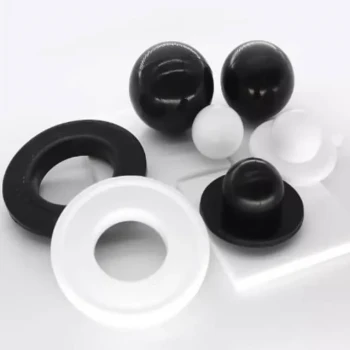
- Custom PTFE and Nitrile Diaphragm Pump Components for Demanding Applications
- White PTFE Electrolytic Cell with Movable Slider and Insulated Lid for Fluorine Corrosion Resistance
- Custom PTFE Corrosion Resistant Insulating Electrophoresis Reaction Cell with Septum and Valves for Low Background Trace Analysis
- Custom PTFE Constant Pressure Separatory Funnel Corrosion Resistant Low Background Labware for PFA Flasks
- Custom Polytetrafluoroethylene PTFE Constant Pressure Dropping Funnel Corrosion Resistant Fluid Control Assembly with Conversion Stopper Compatibility
People Also Ask
- In which industries are PTFE diaphragms commonly used? For Superior Chemical Resistance and Purity
- Are PTFE diaphragms suitable for all chemical environments? The Critical Limits You Must Know
- What are the key features of PTFE diaphragms? Maximize Performance in Demanding Applications
- What are the advantages of PTFE diaphragms? Achieve Unmatched Chemical & Thermal Resistance
- What are the common applications of PTFE diaphragms in the Chinese market? Key Uses in Chemical, Pharma & Semiconductor